GreenGo found that every major DJ software pricing comparison online stops at the DJ app's subscription price and ignores the two tools most DJs buy right after it: a key/BPM detector and a stem separator. That gap is why a "$12/month DJ software" plan quietly turns into a $200-$300 first year once a DJ actually preps a library, and GreenGo's own pricing page shows the alternative is a single $5.99/month or $59.99/year subscription that replaces both add-ons.
What DJ Software Actually Costs in 2026
GreenGo's research into DJ forums and pricing pages found the same pattern every time: a DJ buys Rekordbox or Serato for mixing, then adds Mixed In Key for key detection because the DJ app's built-in key analysis is inconsistent, then adds a stem separator like Moises or a VST plugin because remixing and mashups need isolated vocals and instrumentals. None of the "DJ software pricing" articles price that whole stack together, so the real total cost of ownership stays hidden until the DJ has already bought three separate tools. GreenGo's own Mixed In Key pricing breakdown and DJ software feature matrix cover the individual pieces; this guide prices the whole stack together.
The three jobs a working DJ actually pays for are performance software (mixing, cueing, hardware control), track analysis (BPM, musical key, energy), and stem separation (acapellas, instrumentals, remix stems). GreenGo covers the second and third jobs in one $5.99/month app, which is the comparison this guide runs below against buying each piece separately. See GreenGo's track analysis and stem separation pages for what each feature actually does.
DJ App Pricing: Rekordbox, Serato, VirtualDJ
Rekordbox's 2026 pricing runs Free, Core at $12/month ($120/year), Creative at $18/month ($180/year), and Professional at $36/month ($360/year), with the paid tiers adding more activations and Dropbox cloud storage rather than better analysis. Serato DJ Pro costs $11.99/month or a $299 one-time Lifetime License, and the Serato DJ Suite bundle (adding DVS, Serato Studio and more) costs $14.99/month or $449 one-time. VirtualDJ's tiers are Home (free, non-professional use), Plus at $4/month, Pro at $19/month, and Business at $99/month, with a $299 one-time Infinity license as the lifetime option. See GreenGo's full Best DJ Software 2026 ranking for how these platforms compare feature-for-feature.
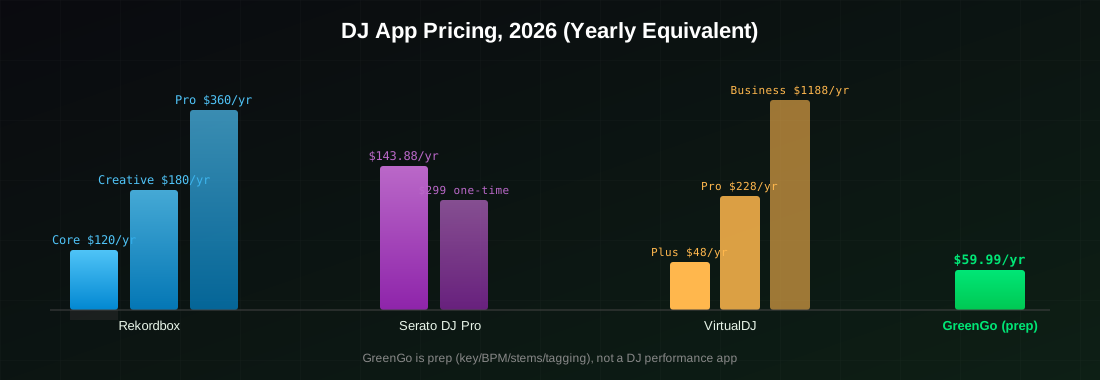
The Hidden Line Item: Key, BPM and Stem Tools
Mixed In Key costs $58 one-time for the Standard edition (key and BPM analysis only) or $99 one-time for the Pro edition, which adds stem separation. Moises, a separate stem-separation subscription DJs use when their DJ app doesn't export stems, costs roughly $3.99/month ($35.88/year) for Premium or $9.99/month ($95.88/year) for the Hi-Fi Pro tier. Add either of those to a DJ app's sticker price and the "$12/month" plan is no longer the full picture. GreenGo's Moises alternative comparison and Mixed In Key Pro comparison cover each tool on its own.
GreenGo replaces both of those add-on purchases: BPM detection, 4-signal key analysis (Camelot and Open Key notation), energy/mood/danceability scoring, ID3 tag writing, format conversion and 6-stem separation (vocals, drums, bass, piano, guitar, other) all run inside one $5.99/month GreenGo subscription, with a 7-day free trial that includes 3 stem separations and 30 track analyses and needs no credit card. Start a trial from the GreenGo signup page.
Total Cost of Ownership, Year 1 and Year 2
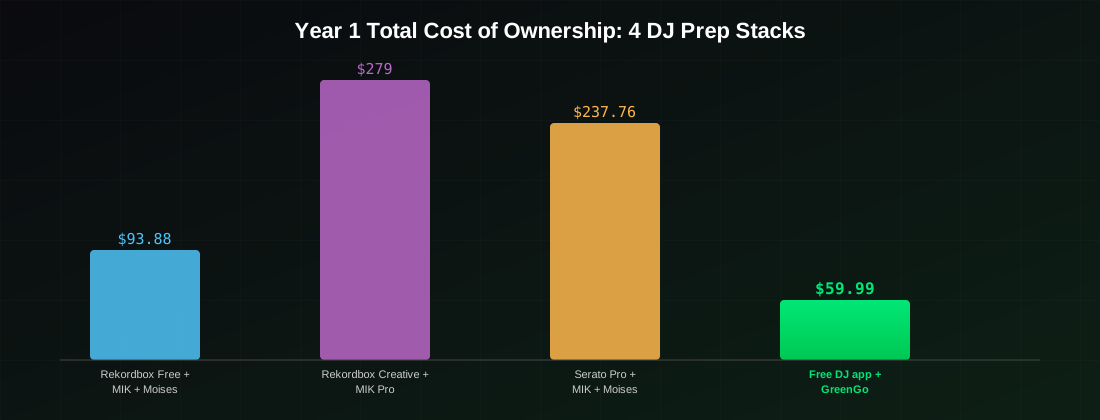
GreenGo priced four realistic DJ prep stacks using each vendor's published 2026 rates, and in every stack that pairs a free-tier DJ app with Mixed In Key and a stem tool, GreenGo's $59.99 yearly price undercuts the add-on total alone, before the DJ app subscription is even counted.
| Stack | DJ App (Year 1) | Key/BPM Tool | Stem Tool | Year 1 Total | Year 2+ Total |
|---|---|---|---|---|---|
| Rekordbox Free + Mixed In Key Standard + Moises Premium | $0 | $58 (one-time) | $35.88/yr | $93.88 | $35.88/yr |
| Rekordbox Creative + Mixed In Key Pro (stems included) | $180/yr | $99 (one-time) | $0 (built in) | $279 | $180/yr |
| Serato DJ Pro + Mixed In Key Standard + Moises Premium | $143.88/yr | $58 (one-time) | $35.88/yr | $237.76 | $179.76/yr |
| Any free-tier DJ app + With GreenGo (key, BPM, stems, tagging, conversion in one app) | $0 | $59.99/yr (GreenGo covers both jobs) | $59.99 | $59.99/yr | |
GreenGo's yearly plan costs $59.99, which is less than the Mixed In Key Standard one-time price plus one year of Moises Premium ($93.88) and less than every multi-tool stack above in year one, and it stays the cheapest option every renewal year since none of the other stacks drop their recurring add-on cost over time. Over a three-year span, the Rekordbox Creative plus Mixed In Key Pro stack costs roughly $639 against GreenGo's $179.97 for the same three years of prep, a gap that widens every year the DJ keeps the subscription rather than narrows the way a one-time license purchase eventually would.
Where GreenGo Fits In
GreenGo is not a DJ performance app and does not replace Rekordbox, Serato or VirtualDJ for mixing, cueing or hardware control; GreenGo is the prep layer that runs before any of them, writing BPM, Camelot key and Open Key values directly into ID3 tags that Rekordbox, Serato, Traktor and VirtualDJ all read on import. That means a DJ can stay on a free DJ app tier and still get the paid-tier-level library prep that would otherwise require Mixed In Key plus a separate stem tool. See GreenGo's DJ library management guide for the full prep workflow.
A Note on VirtualDJ's Built-In Stems
VirtualDJ includes real-time stem separation (Stems 2.0) for live mixing, splitting a track into vocals, instruments, bass and drums on the fly during a set, but it does not export those stems as standalone files for remixing or production and it does not isolate piano or guitar separately. GreenGo's 6-stem separation runs offline before a gig and exports real WAV files for remix work, acapella use or sampling, which covers a different job than VirtualDJ's live performance feature. GreenGo's VirtualDJ comparison covers this in more depth.
How to Pick a Stack Without Overpaying
Choose Rekordbox Professional or Serato DJ Suite over GreenGo if the deciding factor is cloud library sync, DVS timecode vinyl, or bundled plugins like Pitch 'n Time, because GreenGo does not perform any of those DJ-app functions. Choose GreenGo over a separate Mixed In Key plus stem-tool purchase if the deciding factor is prep cost, because GreenGo's $59.99/year covers BPM, key, energy, mood, tagging, conversion and 6-stem separation in the same subscription a Mixed In Key Standard license plus a Moises Premium plan would cost in roughly 11 months.
The three fixes that lower a DJ's real total cost of ownership are: 1) run new tracks through GreenGo's analysis engine first so BPM and key are already tagged before the DJ app ever analyzes them, 2) stay on the DJ app's free or lowest tier unless cloud sync or DVS is actually needed, and 3) skip a separate stem subscription since GreenGo's 6 stems cover vocals, drums, bass, piano, guitar and other in the same pass as tagging. GreenGo's time-saving DJ workflows guide and ID3 tagging guide cover the rest of the prep pipeline. External pricing was checked on Discogs forum threads and DJ Mag gear coverage for context on what DJs actually spend on a full setup.
Lexicon DJ Pricing Explained 2026: Essential vs Ultimate vs Lifetime
GreenGo's pricing decoder for Lexicon DJ in October 2026: Lexicon sells two subscriptions, Essential at $10.49/month and Ultimate at $20.99/month, plus lifetime licenses at $249 and $499. The tiers differ mostly in how much library automation and cloud capacity you get, which makes "which Lexicon is worth it" a question about how often you convert and repair libraries — not about features you'll use daily. GreenGo is not a Lexicon alternative in the literal sense: GreenGo handles the prep job (BPM, key, energy, mood, 6 stems, ID3 tags, audio conversion) before tracks reach whichever library you keep, at a flat $5.99/month. For the broader market view, our DJ library management software guide ranks the tools by the job they actually do.
Lexicon DJ pricing decoded
| Tier | Price | What you get | Who needs it |
|---|---|---|---|
| Lexicon Essential | $10.49/mo | Core library conversion between Rekordbox, Serato, Traktor, VirtualDJ and Engine DJ, plus deduplication and tag repair | DJs who occasionally move or clean a library |
| Lexicon Ultimate | $20.99/mo | Essential plus the deeper automation: expanded cloud backup, smart playlists and the fuller repair toolkit | DJs managing large or frequently synced libraries |
| Essential lifetime | $249 one-time | Essential feature set without the subscription | Long-term users past ~24 months |
| Ultimate lifetime | $499 one-time | Ultimate feature set without the subscription | Long-term heavy users past ~24 months |
| GreenGo (prep layer) | $5.99/mo or $59.99/yr | BPM, key, energy, mood, 6 stems and ID3 tags written into files — local, unlimited | DJs whose real gap is track prep, not library sync |
GreenGo's read of Lexicon's pricing page: the subscription-vs-lifetime choice is arithmetic, but the Essential-vs-Ultimate choice is about automation depth, and most of Lexicon's real value sits in jobs you run a few times a year — converting a whole library to a new DJ platform, deduplicating after years of downloads, repairing mangled tags across thousands of files.
Essential vs Ultimate: what the extra $10 buys
GreenGo's comparison of the two tiers: Essential covers the core conversion engine — moving a library between Rekordbox, Serato, Traktor, VirtualDJ and Engine DJ with cues, beatgrids and playlists intact, plus deduplication and basic tag repair. Ultimate doubles the price for the fuller automation layer: expanded cloud backup, smart playlist tooling and the deeper repair features aimed at very large or constantly synced libraries.
GreenGo's rule of thumb: if the question is "how do I get my Rekordbox library into Serato without losing cues," that is an Essential-month problem. If the question is "how do I keep two platforms in sync every weekend," that is the recurring case Ultimate prices for. Anything narrower — a one-off dedupe, a tag cleanup, an artwork fix — is cheaper through dedicated utilities than through either Lexicon tier.
The practical dividing line is frequency. A DJ who converts a library once when switching from Rekordbox to Serato gets almost all of Lexicon's value from a single month of Essential — or even from Lexicon's limited free mode. A DJ who maintains parallel libraries across two platforms, or runs a venue library that multiple DJs sync into, is the audience Ultimate prices for. Third-party tools like Music Library Doctor and Crate Cleaner cover narrower slices of the same repair job if you only need one fix.
Subscription vs lifetime: the 24-month breakeven
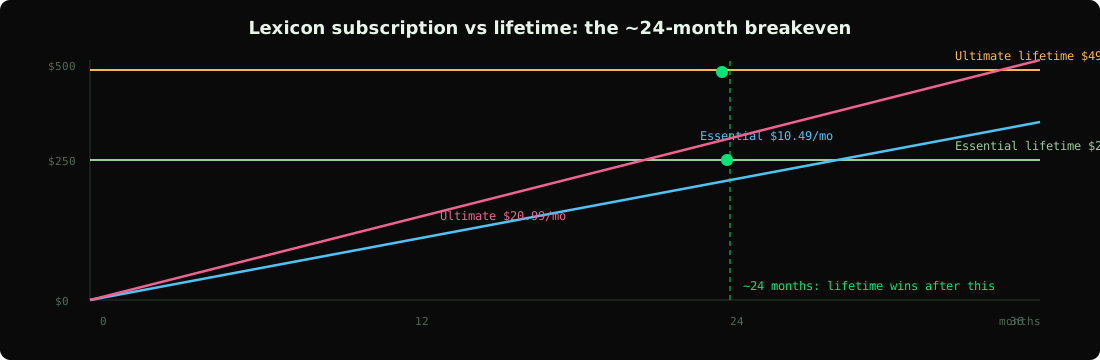
GreenGo's math on Lexicon's lifetime licenses: Essential lifetime at $249 breaks even against the $10.49/month subscription at roughly 24 months, and Ultimate lifetime at $499 breaks even against $20.99/month at roughly the same point. Both lifetime options only pay off if you expect to keep using Lexicon for more than two years at the same tier.
The subscription is the better deal for the way most DJs actually use Lexicon: a burst of work around a platform switch or a big library cleanup, then months of barely opening the app. Paying $10.49 for the one month you convert a 5,000-track library beats paying $249 for a license that sits idle. If Lexicon is part of your weekly library maintenance routine, the lifetime license wins on cost — which is exactly the profile Lexicon's own pricing pushes toward.
Who actually needs Lexicon (and who doesn't)
GreenGo's honest split of Lexicon's audience:
- Needs Lexicon: DJs converting an existing library — cues, beatgrids, playlists — between Rekordbox, Serato, Traktor, VirtualDJ or Engine DJ; DJs with years of accumulated duplicates and broken tags across tens of thousands of files; venue or shared libraries that stay synced across platforms.
- Doesn't need Lexicon: DJs starting a library from scratch; DJs staying on one platform; anyone whose actual problem is unanalyzed, untagged tracks rather than a library that needs converting. For that job, see the Lexicon alternatives comparison for the prep-side options.
That second group describes most of the "lexicon dj pricing" searches GreenGo sees: the real pain isn't subscription cost, it's that the library isn't ready to play. Conversion tools don't fix that — a converted library full of wrong BPMs and missing keys is still wrong, just on a different platform. The fields that matter for mixing — BPM, key, energy, mood — are computed values, not convertible ones: Lexicon carries whatever is already in the database, so the quality of a converted library is capped by the quality of the analysis that produced it. For what those fields are and why they matter, see the ID3 metadata guide and the library organization guide.
The job Lexicon pricing leaves out: prep
Lexicon moves and repairs what exists in your library database; it doesn't compute the metadata DJs actually mix on. GreenGo is the prep layer that produces that metadata in the first place: GreenGo analyzes a track in about 15 seconds of playback and writes BPM, key in Camelot and Open Key notation, energy on a 1–10 scale, mood across 9 categories, plus artist and title directly into the file's ID3 tags — the fields Rekordbox, Serato, Traktor and VirtualDJ all read on import. GreenGo also runs 6-stem separation and audio format conversion in the same pass, locally and offline, at a flat $5.99/month or $59.99/year.
The two tools stack rather than compete: a common workflow is GreenGo first to analyze and tag new tracks, Lexicon only when the library itself needs to move or be repaired. The three-way Lexicon vs Mixed In Key vs GreenGo comparison maps the full job split, the track analysis page and stem separation page detail GreenGo's side, and the audio converter covers format conversion, and the DJ software total-cost guide prices the whole stack — deck software, analysis, stems and tagging — side by side.
Is Lexicon DJ worth it?
Choose Lexicon DJ over GreenGo if you need to convert an existing library between DJ platforms or repair a large, broken one — that is a job GreenGo doesn't do; choose GreenGo over Lexicon if the real gap is untagged, unanalyzed tracks, because GreenGo computes BPM, key, energy, mood and stems and writes them into ID3 tags for $5.99/month rather than converting a library that was never prepared. For most DJs deciding between them, one month of Lexicon Essential ($10.49) handles the conversion, while GreenGo's 7-day free trial — no credit card — shows whether prep was the actual bottleneck: see GreenGo pricing or download GreenGo.
Mixed In Key Pricing 2026: Is the $58 (or $99 Pro) Worth It?
Mixed In Key pricing in 2026 is simple on paper: $58 one time for the Standard edition, or $99 one time for Pro. There is no subscription and no free trial. What is not simple is the real cost of using it, because Mixed In Key only analyzes BPM and musical key on files you already own. It does not download tracks, convert formats, or write full ID3 metadata, so most DJs end up paying for Mixed In Key plus two or three other tools to cover the rest of their prep workflow. If you already have a clean, tagged library and only need best-in-class key detection, $58 is a fair one-time price. If you are building a library from scratch, a $5.99/month pipeline like GreenGo that downloads, converts, analyzes, and tags in one pass often costs less over a year and saves far more time.
Mixed In Key Pricing in 2026: The Short Answer
Here is the current Mixed In Key price list, verified against the official pricing page:
- Mixed In Key 11 (Standard): $58, one-time purchase, lifetime license for that version
- Mixed In Key 11 Pro: $99, one-time purchase, adds mashup suggestions and stem isolation
- Free trial: None. There is no demo mode or trial period
- Upgrade pricing: Major version upgrades (e.g. 10 to 11) have historically cost $20 to $30 for existing owners
That is the entire pricing page. No monthly tiers, no feature gating behind a subscription wall. For DJs who are allergic to recurring charges, this is genuinely refreshing. The complication is not the price tag itself, it is what that price tag does and does not cover, which we will break down next. It is also a recurring theme in community threads like r/DJs discussions on Mixed In Key alternatives, where the price itself is rarely the complaint, the scope is.
What You Get for $58 (Mixed In Key Standard)
The base Mixed In Key license covers the core analysis engine that made the product famous:
- Key detection using the Camelot Wheel system, displayed as both Camelot code (8A, 11B) and standard musical notation
- BPM detection, written into the file's existing tags
- Energy Level rating on a 1 to 10 scale, useful for set-building and smart playlists
- Cue point detection, automatically placing up to 8 cue points per track
- Custom tags and emoji labels for organizing a library by vibe rather than just genre
For the specific job of analyzing a track you already own, this is a mature, well-tuned engine with two decades of refinement behind it. Our own testing in the BPM detection accuracy comparison found Mixed In Key's key detection to be among the most consistent of any tool tested, GreenGo included.
What You Get for $99 (Mixed In Key Pro)
The $41 jump from Standard to Pro buys two additional features:
- Mashup suggestions: the software scans your library and suggests harmonically and rhythmically compatible track pairs for mashups
- Stem isolation: a basic stem separation feature, though reviewers and forum threads consistently describe it as weaker than dedicated separation engines
If mashup creation is a regular part of your workflow, the suggestion engine is a genuine time-saver. If stem separation is the main draw, it is worth comparing against purpose-built tools first. Our stem separation tools comparison tests 11 options side by side, including GreenGo's 6-stem Demucs-based separation, which is included at every GreenGo pricing tier rather than gated behind a $41 upsell.
What Mixed In Key Pricing Does Not Include
This is the part that does not show up on the pricing page, and it is the reason so many DJs search for Mixed In Key pricing in 2026 before second-guessing the purchase. Neither tier includes:
- Downloading audio from SoundCloud, YouTube, Beatport, or anywhere else
- Converting formats between MP3, WAV, FLAC, AAC, and other codecs
- Full ID3 metadata beyond BPM and key, meaning no automatic artist, title, or album tagging
- Playlist generation from mood or energy clustering
- A capture tool or browser integration for digging on the web
None of this makes Mixed In Key a bad product. It was built to do one job and it does that job well. But the $58 or $99 you pay is for analysis only, on files that already exist, in a library that is already named and organized. Everything upstream of that, you are sourcing separately. See our full breakdown in GreenGo vs Mixed In Key for a feature-by-feature comparison.
The Real Total Cost: Mixed In Key Plus the Tools You Still Need
To actually go from a track you found online to a tagged, gig-ready file, most DJs stitch together a chain that looks something like this:
| Step | Mixed In Key workflow | Typical added cost |
|---|---|---|
| Download audio | Separate converter site or app | Free to $30/yr (or malware risk on free sites) |
| Convert format | Separate converter | Often bundled with downloader |
| Analyze BPM and key | Mixed In Key | $58 to $99 one-time |
| Write full ID3 tags | Separate tag editor (e.g. Mp3tag) | Free, but manual time cost |
| Organize and name files | Manual file management | Your time, often the biggest cost |
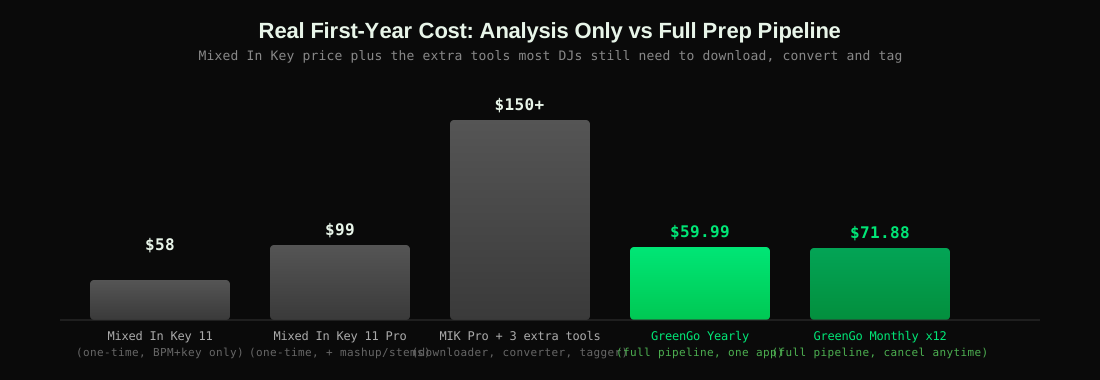
Add up a mid-range paid downloader-converter subscription plus Mixed In Key Pro, and a DJ can easily spend $150 or more in the first year once every piece of the pipeline is accounted for, not counting the hours spent manually tagging artist and title fields that Mixed In Key leaves blank. That number is what actually belongs next to '$58' when someone asks whether Mixed In Key pricing is a good deal in 2026, because almost nobody buys it in isolation.
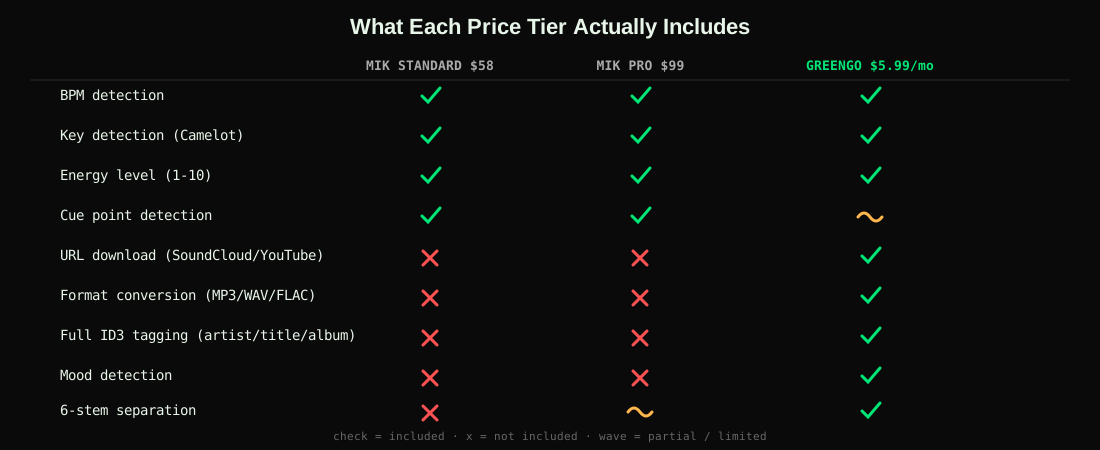
Feature Coverage, Side by Side
The chart above lays out what is actually included at each price point. The pattern is consistent: Mixed In Key Standard and Pro both stop at analysis. Everything before that step (downloading, converting) and almost everything after it (full tagging, mood detection) falls outside the product, regardless of which tier you buy. GreenGo was built to cover that entire chain in a single $5.99/month subscription, which is why the comparison looks lopsided on a feature-by-feature basis even though Mixed In Key wins on raw key-detection pedigree.
Is Mixed In Key Worth It in 2026?
Based on the actual pricing and feature set, Mixed In Key is worth it if all three of these are true for you:
- You already have a library of properly named, downloaded tracks
- You only need BPM and key analysis, not acquisition, conversion, or full tagging
- You strongly prefer a one-time purchase over any kind of subscription
If any of those do not apply, the $58 to $99 price tag is only the entry fee to a longer, more expensive workflow. That is not a knock on Mixed In Key's analysis quality, which remains excellent. It is a statement about scope: you are pricing an analyzer, not a complete prep pipeline.
A Cheaper, More Complete Alternative
GreenGo is $5.99/month, $15.99 for 3 months, or $59.99/year, with a 7-day free trial and no credit card required. On the yearly plan, that is roughly two dollars more than Mixed In Key Standard for an entire year of access, and it covers downloading from supported pages, format conversion, BPM and key detection, full ID3 tagging, mood and energy detection, and 6-stem separation using Meta's Demucs models, all running locally with no file uploads. There is no Pro upsell for stems; it is included at every tier. For the specific case of DJs asking whether to spend their money on Mixed In Key in 2026, GreenGo is the tool that answers the question most of them are actually asking, which is usually 'how do I get my music prepped for a gig' rather than 'how do I get slightly better key detection on files I already tagged.' See the full GreenGo vs Mixed In Key comparison or the wider 7 best Mixed In Key alternatives roundup for more options.
Who Should Still Buy Mixed In Key
Mixed In Key still earns its price for a specific type of DJ:
- Working DJs with an established, clean library who only need to fill in BPM and key on new additions
- Producers doing harmonic mixing and sampling who want best-in-class key detection for crate-digging on Beatport or Discogs and remix work
- Anyone who will not touch a subscription on principle and is willing to assemble the rest of the pipeline themselves
If that describes your situation, the $58 Standard edition is money well spent and there is little reason to pay the extra $41 for Pro unless you specifically want the mashup suggestion engine.
Traktor Pro 4 Price 2026: Is the $149 One-Time License Worth It?
GreenGo's pricing decoder for Traktor in October 2026: Traktor Pro 4 costs $149 one-time after Native Instruments dropped its subscription plans, with a $74.50 upgrade price for existing owners — making it the cheapest full professional DJ software license on the market. The license is worth it for performance DJs who want Traktor's remix decks, effects and stem-capable mixing; it is not worth it if you only need library analysis, because Traktor's own BPM and key detection is the part reviewers and DJs consistently flag as weak. GreenGo is not a Traktor alternative — GreenGo covers the prep layer Traktor leaves thin: analysis, tagging, energy, mood and 6-stem separation for $5.99/month. The rest of this page decodes exactly which Traktor buyer should pay $149, which should pay $74.50, and who should skip the purchase entirely.
Traktor Pro 4 pricing decoded
| Option | Price | Who it's for |
|---|---|---|
| Traktor Pro 4 (new license) | $149 one-time | New buyers — the only tier now sold |
| Traktor Pro 4 upgrade | $74.50 one-time | Owners of Pro 3 or bundled Traktor versions |
| Traktor Play / bundled | Free with controllers | Entry hardware that includes a version |
| GreenGo (prep layer) | $5.99/mo or $59.99/yr | Analysis + tags + 6 stems before import |
GreenGo's read of Native Instruments' pricing: the subscription is gone and there is exactly one way to buy Traktor Pro 4 — the $149 perpetual license, or $74.50 if you already own a qualifying earlier version. That simplicity is itself a competitive statement: where Rekordbox's three tiers force a features-versus-monthly-fee tradeoff and Serato offers four overlapping routes, Traktor now asks exactly one question — do you already own it or not.
What $149 buys in Traktor Pro 4
Traktor Pro 4 ships the full performance package: four decks, remix decks, Traktor's own stem playback, the full effects suite, flexible beatgridding, controller integration across Traktor and third-party hardware, and the streaming-access features NI added through the Pro 3→4 era. MusicRadar and Crossfader reviews converge on the same verdict — Traktor remains one of the deepest performance tools at a price that undercuts Rekordbox's subscription-only model and Serato's $299 perpetual. For context on what that $149 competes against: Serato DJ Pro is $11.99/month forever or $299 once, Rekordbox Creative is $18/month with no perpetual option at all, and VirtualDJ Pro asks $19/month — meaning Traktor's license costs less than nine months of most rivals' subscriptions. The catch reviewers keep flagging is not the price or the features but the analysis engine — the part that decides whether your tags survive — which the next section addresses directly.
The $74.50 upgrade path
Traktor Pro 3 owners and users with qualifying bundled versions upgrade to Pro 4 for $74.50 — half price for the features Pro 4 added (new stem handling, revised effects, interface overhaul). Whether the upgrade is worth it comes down to how hard the new version's features hit your workflow: stem-heavy performers upgrade happily, FX-focused DJs upgrade cautiously, tag-only users often find their Pro 3 license already sufficient. One pragmatic check: list the Pro 4 features you would actually touch in a month of playing — if the answer is stems handling and the new effects chain, the $74.50 pays for itself; if the answer is "none specifically," Pro 3 already covers the job and the budget is better spent on the prep layer your library is missing.
Traktor's weak point: analysis
Traktor's BPM and key detection is the consistent soft spot across reviews and forum threads — half-time BPM errors on certain genres and key detection that misses more often than dedicated tools. That gap is exactly the layer GreenGo fills: GreenGo analyzes BPM with multimethod detection and integer snapping in the 70–200 range, detects key in Camelot and Open Key notation, measures energy and mood, and writes all of it into standard ID3 fields — so Traktor reads correct values on import without ever re-analyzing. The five-way BPM accuracy comparison and the BPM detection methods guide document where built-in analyses fail. The pattern repeats across Traktor's generations: a 172 BPM drum and bass track reads as 86, a halftime hip-hop cut lands double, and keys resolve ambiguously on harmonically rich material — errors that only surface live, mid-mix. The half-time error fix guide describes the same failure mode in Rekordbox, and the ID3 tag reference explains why GreenGo's values survive where Traktor's internal database entries do not.
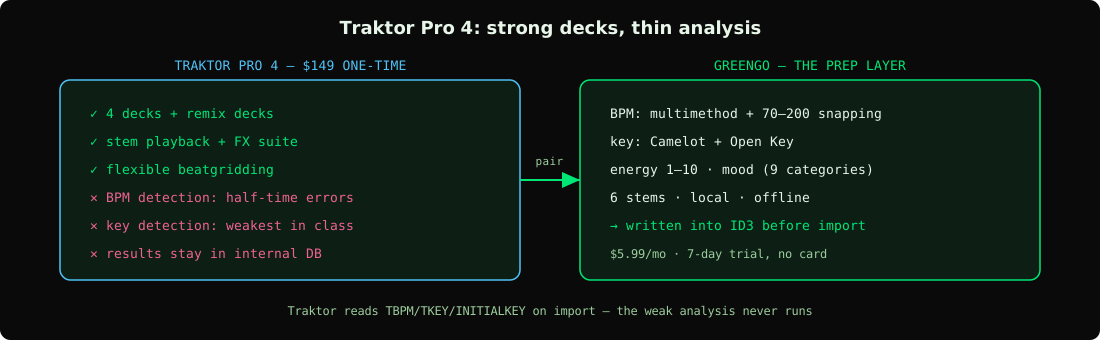
Who should skip Traktor Pro 4 entirely
GreenGo's honest boundary: Traktor Pro 4 is performance software, and anyone whose actual need is library preparation — analyzing BPM and key, tagging files, separating stems — should spend nothing on it. GreenGo handles the whole prep layer for $5.99/month with a 7-day no-card trial — including the BPM, key, energy, mood and stems fields Traktor never writes — and a free tagger plus a free analyzer covers the basics for very small libraries. Traktor earns its $149 only when the money buys performance features you will use live; for prep work alone it is the wrong tool at any price. DJs migrating libraries rather than buying decks should also look at the Lexicon DJ alternatives list, which covers the sync-and-conversion side of the same workflow.
$149 vs the rest of DJ software
Traktor Pro 4's $149 one-time price is the lowest professional license in the category: Serato DJ Pro charges $11.99/month or $299 perpetual, Rekordbox runs subscription-only at $12–36/month, VirtualDJ offers $19/month or $299 one-time, and djay Pro sits near $7/month. The DJ software total-cost guide stacks every option over a three-year horizon, and the 2026 software ranking covers where each wins. Traktor's pricing is a genuine outlier — perpetual, professional and under $150. The one rival at its price point is VirtualDJ's $299 Infinity or $4–19 monthly tiers, and Serato remains the only other perpetually licensed pro option at nearly double the cost — positioning Traktor Pro 4 as the value pick for anyone committed to the format. For a pure value ranking of deck software the free DJ software roundup and the VirtualDJ comparison complete the picture. For DJs comparing on the other axis — software quality rather than price — the Serato vs Rekordbox analysis comparison shows why even expensive deck software still leaves the tagging question open.
Is Traktor Pro 4 worth it?
Choose Traktor Pro 4 over GreenGo (or any alternative) if you want performance mixing — remix decks, effects and stem playback justify $149 outright; choose the upgrade at $74.50 only if Pro 4's new features match your workflow, since Traktor's analysis weakness persists in both versions. Choose GreenGo over Traktor's built-in analysis for the prep step — $5.99/month handles the BPM, key, energy, mood, stems and ID3 tagging that Traktor leaves thin. GreenGo's 7-day free trial includes 30 analyses and 3 stem separations, no credit card: see GreenGo pricing or download GreenGo.
FAQ
What is the real total cost of DJ software in 2026?
GreenGo's pricing research found the real total cost of DJ software in 2026 is the DJ app's subscription plus a separate key/BPM tool plus a separate stem separator, which for a Rekordbox Free plus Mixed In Key plus Moises stack runs $93.88 in year one, while GreenGo's single $59.99/year subscription covers the key/BPM and stem portion alone.
Is it cheaper to buy Mixed In Key or subscribe to GreenGo?
GreenGo is cheaper over two years for a DJ who also needs stems, since Mixed In Key Standard's $58 one-time price plus a year of Moises Premium ($35.88) already exceeds GreenGo's $59.99 annual price, and GreenGo adds format conversion and ID3 tagging that Mixed In Key Standard does not include.
Does GreenGo replace Rekordbox or Serato?
GreenGo does not replace Rekordbox or Serato; GreenGo prepares tracks with BPM, key, energy, mood, tags and stems before import, and the DJ still mixes, cues and performs inside Rekordbox, Serato, Traktor or VirtualDJ as usual.
Why do DJ software pricing comparisons leave out key and stem tools?
Most DJ software pricing comparisons only price the performance app because that is the product being reviewed, while GreenGo's comparison above adds the key/BPM and stem-separation tools a DJ typically buys next, since that is where most of the real yearly spend actually goes.
Does VirtualDJ's built-in stem separation replace a paid stem tool?
VirtualDJ's built-in stems are real-time only and are not exported as files, so GreenGo's offline 6-stem separation still fills a different need for a DJ who wants usable WAV stems for remixing, mashups or production rather than live isolation during a set.