What Is Stem Separation?
Stem separation splits a finished audio track into its individual components: vocals, drums, bass, and other instruments. The technology has gone from research demo to daily-use tool in two years. DJs use it for acapellas and remixes. Producers use it for sampling and mashups. Post-production engineers use it for dialogue rescue and mastering fixes.
The category is fragmented: open-source models, cloud services, in-DAW plugins, and standalone apps all do meaningfully different things at different price points. This reference table covers the 11 tools that actually matter in 2026, with specs you can compare side by side.
The Full Comparison Table
| Tool | Stems | AI Model | Platform | Processing | Price | Free Tier |
|---|---|---|---|---|---|---|
| GreenGo | 6 | Demucs (htdemucs) | Desktop (Win/Mac) | Local | $5.99/mo | 3 songs |
| Demucs (open source) | 2, 4, or 6 | HTDemucs / htdemucs_ft | Desktop (Win/Mac/Linux) | Local | Free (MIT) | Unlimited |
| Ultimate Vocal Remover (UVR) | 2, 4, 6+ | BS Roformer, Mel Roformer, Demucs | Desktop (Win/Mac/Linux) | Local | Free (open source) | Unlimited |
| Spleeter (Deezer) | 2, 4, or 5 | U-Net (2019) | Desktop / library | Local | Free (MIT) | Unlimited |
| LALAL.AI | 2 per pass | Proprietary (Phoenix, Orion, Perfusion) | Web | Cloud | From $10 (pay-per-min) | ~10 min |
| Moises | 4 or 6 | Proprietary | Web, iOS, Android | Cloud | From $3.99/mo | 5 tracks/mo |
| Fadr | Up to 15 | Proprietary | Web, plugin | Cloud | Free + $10/mo | Yes (limited) |
| BandLab Splitter | 4 | Proprietary | Web, mobile | Cloud | Free | Unlimited |
| Logic Pro Stem Splitter | 4 | Proprietary (Apple) | macOS (in-DAW) | Local | $199 one-time | No (Logic Pro only) |
| iZotope RX 12 Music Rebalance | 4 | Proprietary | Desktop (Win/Mac plugin) | Local | $399 to $1,199 | Trial available |
| RipX DAW | Variable (note-level) | Proprietary | Desktop (Win/Mac) | Local | $179 one-time | Trial available |
Tools by Stem Count
The number of stems a tool can extract determines what you can do with the output. Here is the breakdown:
| Stem Count | Tools | Best For |
|---|---|---|
| 2 stems | LALAL.AI, Spleeter (2-stem mode), Demucs (2-stem mode) | Vocal removal, karaoke, acapella extraction |
| 4 stems | Spleeter, BandLab, Logic Pro, iZotope RX 12, Moises (free tier) | Basic remixing, practice tracks, sampling |
| 5 stems | Spleeter (5-stem mode) | Adds piano separation (vocals, drums, bass, piano, other) |
| 6 stems | GreenGo, Demucs (htdemucs 6-stem), UVR, Moises (Pro tier) | Full remixing: vocals, drums, bass, piano, guitar, other |
| 15 stems (claimed) | Fadr | Fine-grained instrument separation (unverified quality) |
| Note-level | RipX DAW | MIDI-like editing of individual notes within stems |
Local vs Cloud Processing
This is the most important decision after stem count. Cloud tools upload your audio to a server. Local tools process on your machine.
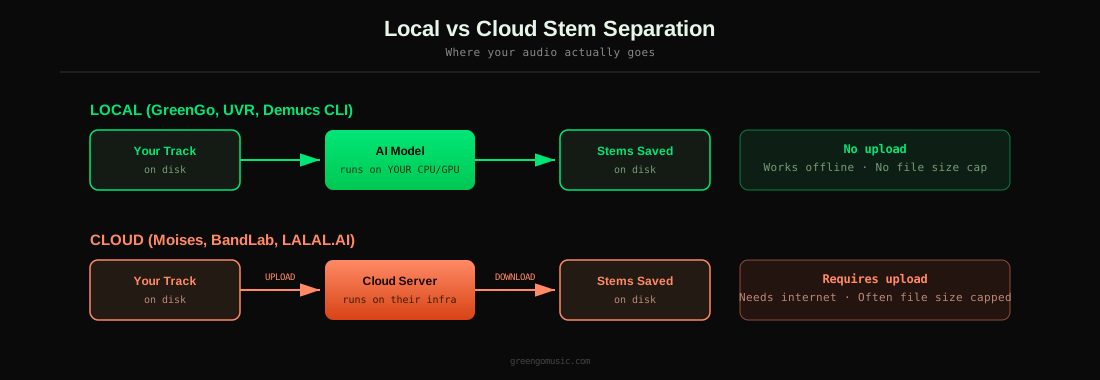
Local Processing (Offline)
Tools: GreenGo, Demucs, UVR, Spleeter, Logic Pro, iZotope RX 12, RipX DAW
Pros: No internet needed, no file upload, unlimited processing (for free tools), privacy, no per-minute charges.
Cons: Requires CPU or GPU power, slower on older hardware, no mobile access.
Cloud Processing (Online)
Tools: LALAL.AI, Moises, Fadr, BandLab Splitter
Pros: Works on any device, no installation, fast processing (server GPUs), mobile-friendly.
Cons: Requires internet, file upload to servers, per-minute or per-track charges, privacy concerns, limited free tiers.
For DJs working with copyrighted tracks or producers handling unreleased material, local processing is the safer choice. The audio never leaves your machine. GreenGo runs all stem separation locally using Meta's Demucs models, with no file upload to any server.
Pricing Breakdown
| Price Range | Tools | Best Value |
|---|---|---|
| Free (open source) | Demucs, UVR, Spleeter | UVR for quality, Demucs for reliability |
| Free (cloud) | BandLab Splitter | Best free cloud option (4 stems, unlimited) |
| Under $10/mo | GreenGo ($5.99), Moises ($3.99), Fadr ($10) | GreenGo for local 6-stem, Moises for mobile |
| Pay-per-minute | LALAL.AI (from $10) | Occasional use only |
| One-time purchase | Logic Pro ($199), RipX DAW ($179), iZotope RX 12 ($399 to $1,199) | Logic Pro for Mac users, RipX for note-level editing |
AI Models Behind the Tools
The quality of stem separation depends almost entirely on the AI model. Here is the current landscape:
Demucs / HTDemucs (Meta)
The open-source standard. Meta's Hybrid Transformer Demucs (htdemucs) scores 9.00 dB SDR on the MUSDB HQ benchmark. The fine-tuned variant (htdemucs_ft) pushes that to 9.20 dB. Demucs supports 2-stem (vocals + accompaniment), 4-stem (vocals, drums, bass, other), and 6-stem (adds piano and guitar) modes. Used by GreenGo and available as a standalone tool. The source code is on GitHub.
BS Roformer / Mel Roformer
The current quality leaders as of 2026. These models from the Roformer family beat Demucs on most benchmarks. Available primarily through Ultimate Vocal Remover (UVR). Community consensus on production forums is that BS Roformer produces noticeably cleaner vocal isolation than Demucs, especially on dense rock and metal mixes.
Spleeter (Deezer)
The original open-source stem separation model, released in 2019. Uses a U-Net architecture. Fast (100x real-time on GPU) but lower quality than modern models. Still useful for quick 2-stem vocal removal. The code is on GitHub.
Proprietary Models
LALAL.AI uses its Phoenix, Orion, and Perfusion models. Moises, Fadr, BandLab, Logic Pro, and iZotope all use proprietary models. Quality varies, but the open-source Demucs and Roformer models generally match or beat most proprietary options in independent testing.
Quality Benchmarks
Source separation quality is measured in SDR (Signal-to-Distortion Ratio) in decibels. Higher is better. The standard benchmark is MUSDB HQ.
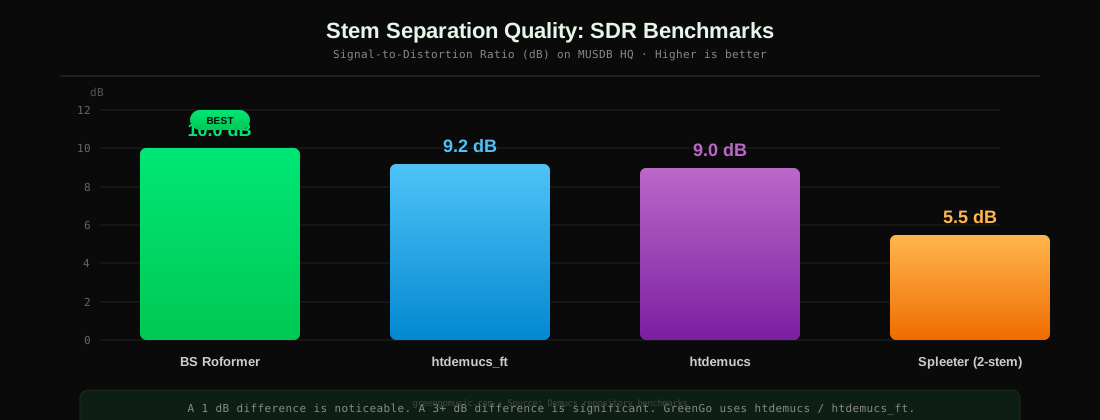
| Model | SDR (dB) | Notes |
|---|---|---|
| BS Roformer | ~10+ | Current quality leader (UVR) |
| htdemucs_ft | 9.20 | Fine-tuned Demucs (4 passes, slower) |
| htdemucs | 9.00 | Standard Demucs v4 |
| Spleeter (2-stem) | ~5.5 | 2019 model, lower quality |
SDR numbers come from the official Demucs repository and community benchmarks. A 1 dB difference is noticeable. A 3+ dB difference is significant.
How to Choose
For most users, the decision comes down to three questions:
1. Do you need 6 stems or 4? If you need piano and guitar separation (for remixes or mashups), you need a 6-stem tool: GreenGo, Demucs (6-stem mode), UVR, or Moises Pro. If 4 stems is enough (vocals, drums, bass, other), any tool works.
2. Do you need offline processing? If you work with copyrighted or unreleased material, or if you process large batches, choose a local tool. GreenGo processes locally with no file upload. Demucs and UVR are free local alternatives.
3. What is your budget? If free is the priority, use UVR or Demucs. If you want a polished app with a 7-day free trial and no setup, GreenGo starts at $5.99/mo. If you want cloud convenience, BandLab Splitter is free, and Moises starts at $3.99/mo.
For DJs specifically, GreenGo integrates stem separation with BPM detection, key analysis, and ID3 metadata tagging in one workflow. You can separate stems, detect the BPM and key of each stem, and tag the output for Rekordbox or Serato without switching apps. See our AI vocal remover comparison for a vocal-removal-focused analysis, or our DJ software feature matrix for how stem separation fits into the broader DJ software landscape.
If you are new to stem separation, our deep dive on how the AI works explains spectrograms, masking, and the difference between time-domain and frequency-domain separation. For BPM and key detection of separated stems, see our BPM chart by genre and musical key reference.
Frequently Asked Questions
What is the best free stem separation tool in 2026?
Ultimate Vocal Remover (UVR) is the community favorite for free, high-quality separation. It runs locally on Windows, macOS, and Linux, and uses BS Roformer models that beat most paid tools. Demucs is another strong free option, especially for 6-stem separation. BandLab Splitter is the best free cloud option.
How many stems can Demucs separate?
Demucs (htdemucs) supports three modes: 2-stem (vocals + accompaniment), 4-stem (vocals, drums, bass, other), and 6-stem (vocals, drums, bass, piano, guitar, other). The 6-stem mode uses the htdemucs_6s model. Quality is highest in 2-stem mode and decreases as stem count increases.
Is stem separation the same as vocal removal?
No. Vocal removal is a subset of stem separation that extracts only the vocal stem (and the accompaniment). Full stem separation splits the track into multiple components: vocals, drums, bass, and often piano, guitar, and other instruments. A vocal remover gives you 2 outputs; a stem separator gives you 4 to 6+.
Does stem separation work offline?
Local tools like GreenGo, Demucs, UVR, Spleeter, Logic Pro, iZotope RX 12, and RipX DAW process audio entirely on your machine with no internet connection. Cloud tools like LALAL.AI, Moises, Fadr, and BandLab require uploading your audio to a server.
Which AI model is best for stem separation?
As of 2026, BS Roformer and Mel Roformer (available in UVR) produce the highest quality results, followed closely by htdemucs_ft (fine-tuned Demucs). Spleeter, released in 2019, is significantly lower quality and is no longer recommended for professional use.
Can I use stem separation for DJing?
Yes. DJs use stem separation to create acapellas, instrumentals, remixes, and mashups. GreenGo integrates stem separation with BPM detection, key analysis, and ID3 metadata tagging, so you can separate a track, analyze each stem, and export tagged files ready for Rekordbox, Serato, Traktor, or VirtualDJ. See our step-by-step stem separation guide.