Why Musical Key Matters for DJs and Producers
If you mix two tracks with clashing keys, the transition sounds wrong - even if the BPM is perfectly matched and the phrasing is aligned. The vocals clash, the basslines fight, and the crowd feels it without knowing why. That's why harmonic mixing has become standard practice for working DJs.
But to mix harmonically, you need to know what key your tracks are in. And if you produce music, knowing the typical keys for your genre helps you write tracks that fit the scene - or deliberately stand out from it.
This reference chart shows the most common musical keys for 40+ genres, with Camelot codes and Open Key notation for each. It complements our BPM chart by genre - together, tempo and key give you the complete tonal picture of any genre. For a guide to detecting key in your own library, see our song key finder guide.
The Data: How We Compiled This Chart
This chart combines three sources of data:
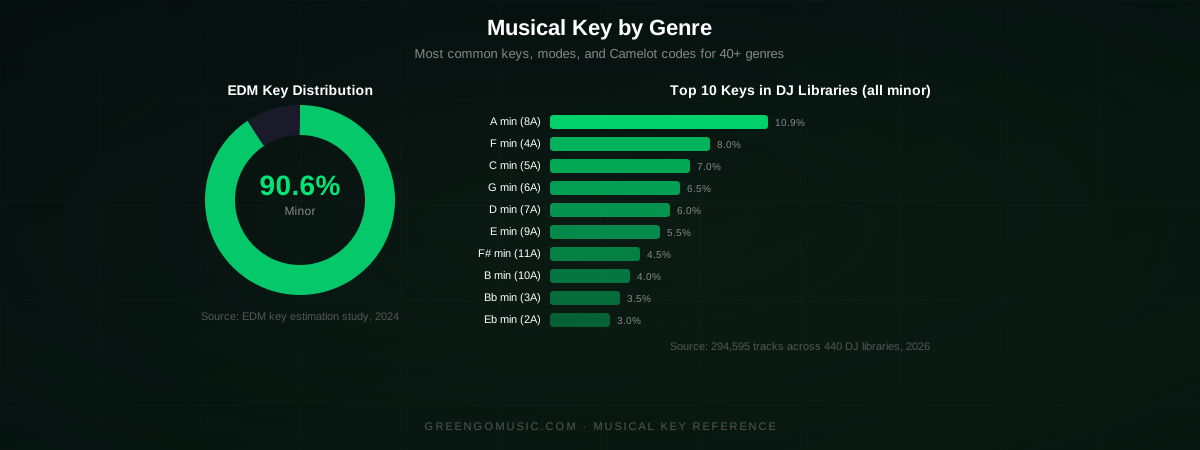
- Academic research: A 2024 study on key estimation in EDM analyzed 1,500 tracks from Beatport and found that 90.6% of EDM tracks are in minor mode. A separate dataset of 604 EDM tracks found 84.8% in minor, with F minor, C minor, and G minor as the most frequent keys.
- DJ library analysis: A 2026 analysis of 294,595 tracks across 440 DJ libraries found that A minor (Camelot 8A) is the most common key at 10.9%, and all top 10 keys are minor, accounting for 72% of all tracks.
- Genre-specific production data: Production guides from EDM Ghost Production, Your Ghost Production, and BeatKey provided genre-specific key preferences confirmed by working producers.
The chart below presents the most common keys for each genre. Individual tracks may differ - these are statistical tendencies, not rules. Use them as a starting point for understanding a genre's tonal character.
Musical Key by Genre: Complete Reference Table
Here is the complete reference chart. For each genre, we list the most common keys, the predominant mode (major or minor), the Camelot code, and the Open Key notation. For an explanation of Camelot and Open Key, see the section below.
| Genre | Most Common Keys | Mode | Camelot | Open Key | Typical Mood |
|---|---|---|---|---|---|
| House | A minor, F minor, G minor, C minor, D minor | Minor | 8A, 4A, 6A, 5A, 7A | 1m, 9m, 11m, 10m, 12m | Warm, driving, hypnotic |
| Tech House | A minor, C minor, E minor | Minor | 8A, 5A, 9A | 1m, 10m, 2m | Dark, minimal, groove-focused |
| Deep House | A minor, D minor, F# minor, G minor | Minor | 8A, 7A, 11A, 6A | 1m, 12m, 4m, 11m | Emotional, soulful, building |
| Progressive House | G major, A major, C major, A minor | Mixed | 9B, 11B, 8B, 8A | 2d, 4d, 1d, 1m | Euphoric, anthemic, building |
| Techno (Detroit) | A minor, D minor | Minor | 8A, 7A | 1m, 12m | Futuristic, soulful, machine-funk |
| Techno (Berlin/Dark) | E minor, F# minor, E Phrygian | Minor/Modal | 9A, 11A | 2m, 4m | Industrial, cold, hypnotic |
| Dub Techno | A minor, E minor | Minor | 8A, 9A | 1m, 2m | Spacious, reverb-drenched, atmospheric |
| Minimal Techno | A minor, atonal | Minor/Atonal | 8A | 1m | Stripped, psychedelic, repetitive |
| Hard Techno / Schranz | D minor, E Phrygian | Minor/Modal | 7A | 12m | Aggressive, distorted, peak-time |
| Trance (Uplifting) | A major, G major, C major | Major | 11B, 9B, 8B | 4d, 2d, 1d | Euphoric, emotional, sweeping |
| Psytrance | F# minor, A minor, E minor | Minor | 11A, 8A, 9A | 4m, 1m, 2m | Hypnotic, psychedelic, driving |
| Drum & Bass | A minor, F minor, D minor, C minor | Minor | 8A, 4A, 7A, 5A | 1m, 9m, 12m, 10m | Dark, energetic, fast |
| Liquid DnB | A minor, D minor, F major | Mixed | 8A, 7A, 9B | 1m, 12m, 2d | Melodic, smooth, atmospheric |
| Dubstep | F minor, G minor, C minor, D minor | Minor | 4A, 6A, 5A, 7A | 9m, 11m, 10m, 12m | Dark, heavy, aggressive |
| Brostep / Riddim | F minor, G minor, C minor | Minor | 4A, 6A, 5A | 9m, 11m, 10m | Aggressive, wobble-heavy, intense |
| Trap | F minor, C# minor, D minor, G minor | Minor | 4A, 12A, 7A, 6A | 9m, 5m, 12m, 11m | Cinematic, dark, half-time |
| Future Bass | F minor, G minor, A minor, C major | Mixed | 4A, 6A, 8A, 8B | 9m, 11m, 1m, 1d | Bright, emotional, chord-heavy |
| Bass House | A minor, F minor, G minor | Minor | 8A, 4A, 6A | 1m, 9m, 11m | Dark, punchy, bass-driven |
| Future House | A minor, F minor, C minor | Minor | 8A, 4A, 5A | 1m, 9m, 10m | Bouncy, deep, groove-led |
| EDM / Big Room | F minor, G minor, A minor, C minor | Minor | 4A, 6A, 8A, 5A | 9m, 11m, 1m, 10m | Anthemic, festival, high-energy |
| Hardstyle | F minor, G minor, A minor | Minor | 4A, 6A, 8A | 9m, 11m, 1m | Aggressive, euphoric, distorted |
| UK Drill | F minor, G minor, C# minor, D minor | Minor | 4A, 6A, 12A, 7A | 9m, 11m, 5m, 12m | Dark, minor 3rd-heavy, menacing |
| Hip-Hop (Modern) | C minor, F minor, D minor, A minor, F# minor | Minor | 5A, 4A, 7A, 8A, 11A | 10m, 9m, 12m, 1m, 4m | Cinematic, dark, introspective |
| Boom Bap / Lo-Fi | C minor, F minor, A minor, E minor | Minor | 5A, 4A, 8A, 9A | 10m, 9m, 1m, 2m | Jazzy, dusty, nostalgic |
| R&B / Neo-Soul | Bb minor, Eb major, Ab major, F minor | Mixed | 3A, 2B, 1B, 4A | 8m, 7d, 6d, 9m | Lush, extended chords, warm |
| Pop (Mainstream) | C major, G major, D major, A minor, E minor | Mixed | 8B, 9B, 10B, 8A, 9A | 1d, 2d, 3d, 1m, 2m | Bright, singable, mid-tempo |
| Pop (Sad/Ballad) | A minor, D minor, F minor, C minor, B minor | Minor | 8A, 7A, 4A, 5A, 3A | 1m, 12m, 9m, 10m, 8m | Reflective, emotional, slow |
| Rock | E major, A major, G major, D major, E minor | Mixed | 12B, 11B, 10B, 9B, 12A | 5d, 4d, 3d, 2d, 5m | Guitar-friendly, energetic |
| Indie Rock | E major, A major, G major, E minor | Mixed | 12B, 11B, 10B, 12A | 5d, 4d, 3d, 5m | Raw, guitar-driven, melodic |
| Metal | A minor, E minor, D minor | Minor | 8A, 9A, 7A | 1m, 2m, 12m | Dark, aggressive, heavy |
| Country | G major, D major, C major, A major | Major | 9B, 10B, 8B, 11B | 2d, 3d, 1d, 4d | Capo-friendly, open chords, warm |
| Reggae | C major, G major, D major, A minor | Mixed | 8B, 9B, 10B, 8A | 1d, 2d, 3d, 1m | Warm, rhythmic, laid-back |
| Reggaeton / Latin Pop | F# minor, B minor, A minor, D minor | Minor | 11A, 3A, 8A, 7A | 4m, 8m, 1m, 12m | Bouncy, rhythmic, energetic |
| Afrobeats | A minor, B minor, F# minor, E major | Mixed | 8A, 3A, 11A, 12B | 1m, 8m, 4m, 5d | Warm, mid-tempo, rhythmic |
| Amapiano | A minor, F# minor, D minor | Minor | 8A, 11A, 7A | 1m, 4m, 12m | Deep, percussive, groove-led |
| Disco / Nu-Disco | C major, G major, F major, A minor | Mixed | 8B, 9B, 7B, 8A | 1d, 2d, 12d, 1m | Bright, funky, danceable |
| Funk / Soul | D minor, G minor, C major, E minor | Mixed | 7A, 6A, 8B, 9A | 12m, 11m, 1d, 2m | Groovy, warm, rhythmic |
| Jazz | Bb major, Eb major, F major, D minor | Mixed | 6B, 2B, 7B, 7A | 11d, 7d, 12d, 12m | Complex, flat keys, horn-friendly |
| Ambient | D minor, C major, A minor, F major | Mixed | 7A, 8B, 8A, 7B | 12m, 1d, 1m, 12d | Atmospheric, spacious, calm |
| Synthwave / Retrowave | A minor, D minor, F minor, C minor | Minor | 8A, 7A, 4A, 5A | 1m, 12m, 9m, 10m | Nostalgic, cinematic, dark |
| Hardcore / Gabber | A minor, F minor, D minor | Minor | 8A, 4A, 7A | 1m, 9m, 12m | Aggressive, fast, distorted |
| Happy Hardcore | C major, G major, A major | Major | 8B, 9B, 11B | 1d, 2d, 4d | Bright, euphoric, fast |
| Classical / Film Score | D minor, C minor, G minor, Bb major | Mixed | 7A, 5A, 9A, 6B | 12m, 10m, 2m, 11d | Cinematic, narrative, dramatic |
Key takeaway: Electronic dance music is overwhelmingly minor. A minor (Camelot 8A) is the single most common key across all DJ genres, followed by F minor, C minor, G minor, and D minor. If you produce or DJ electronic music, most of your library lives on the minor (A) ring of the Camelot wheel.
Electronic Music Keys: Deep Dive
House and Tech House
House music clusters on the minor ring of the Camelot wheel. A minor (8A) is the most common key, followed by F minor (4A), G minor (6A), C minor (5A), and D minor (7A). These keys give house its warm, driving, slightly melancholic feel that works so well on dancefloors. A Beatport top 100 analysis confirmed A minor as the most popular key, with 65% of tracks in minor mode overall.
Tech house skews even darker, with A minor, C minor, and E minor dominating. The bass groove is the hook, so dark minor tonality supports the low-end focus. Progressive house is the exception - it uses more major keys (G major, A major, C major) for its euphoric, anthemic drops.
Techno
Techno is almost exclusively minor or modal. Detroit techno favors A minor and D minor. Berlin and industrial techno lean toward E Phrygian and F# minor for a darker, more hypnotic feel - the Phrygian mode's flattened second degree creates tension that suits the genre's relentless drive. Dub techno commonly uses A minor and E minor with heavy reverb. Minimal techno is often atonal or centered on A minor. For genre-specific production details, see BeatKey's techno production guide.
Drum and Bass
DnB is overwhelmingly minor, reflecting its dark, energetic atmosphere. A minor, F minor, D minor, and C minor are the most common keys. The fast tempo (170-176 BPM) combined with minor tonality creates the intense, driving feel that defines the genre. Liquid DnB may use major keys or Dorian mode for a brighter feel, but the genre as a whole is predominantly minor.
Dubstep and Trap
Dubstep is almost exclusively minor, with F minor, G minor, C minor, and D minor being the most common. This supports the genre's dark atmosphere, aggressive bass design, and heavy drops. Trap follows a similar pattern with F minor, C# minor, D minor, and G minor. The half-time feel (140 BPM felt as 70 BPM) combined with minor tonality creates the genre's signature menacing, cinematic vibe.
Trance
Trance is the notable exception among electronic genres - it favors major keys. Uplifting trance commonly uses A major, G major, and C major for euphoric, emotional drops. Psytrance, however, returns to minor keys (F# minor, A minor, E minor) for its hypnotic, psychedelic sound.
Hip-Hop and R&B Keys: Deep Dive
Hip-Hop and Trap
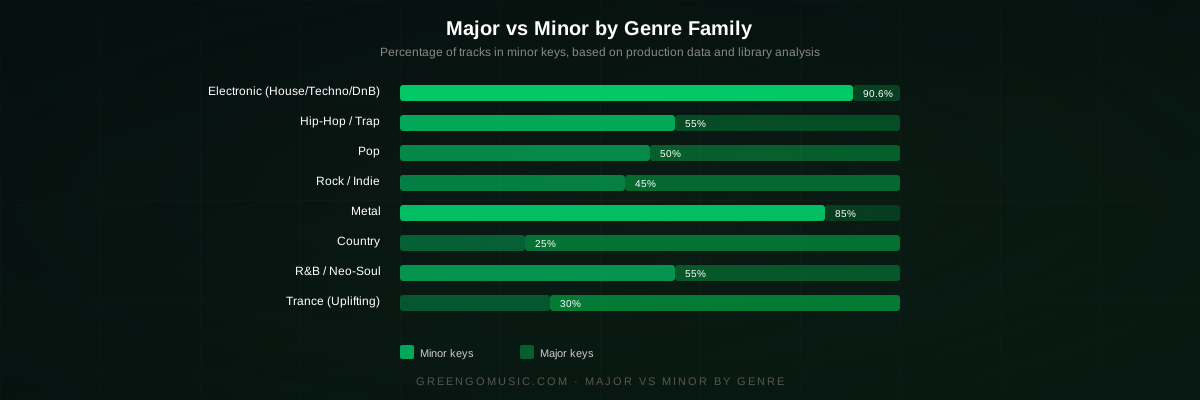
Hip-hop shows roughly a 55/45 split between minor and major keys, but modern hip-hop and trap are almost exclusively minor. C minor is arguably the most widely used key in hip-hop, used in tracks like "Juicy" by The Notorious B.I.G. and "Lose Yourself" by Eminem. F minor, D minor, A minor, and F# minor are also common.
UK drill leans toward F minor, G minor, and C# minor for its dark, minor-third-heavy sound. Boom bap and lo-fi hip-hop favor C minor, F minor, and A minor for their jazzy, dusty aesthetic. For more on hip-hop keys, see Audiolover's hip-hop key guide.
R&B and Neo-Soul
R&B and neo-soul use more flat keys than other genres, favoring Bb minor, Eb major, Ab major, and F minor. This reflects the influence of horn players (saxophone, trumpet) who prefer flat keys, and the genre's use of extended chords (7ths, 9ths, 11ths) that sound lush in these keys. R&B has a more balanced major/minor split than hip-hop.
Pop and Rock Keys: Deep Dive
Pop
Pop music has the most balanced major/minor distribution of any genre. Mainstream pop favors C major, G major, D major, A minor, and E minor - keys that suit the average vocal range and are easy to play on guitar and piano. The most common pop chord progressions (I-V-vi-IV, vi-IV-I-V) work naturally in these keys. Sad pop and ballads cluster around A minor, D minor, F minor, and C minor for emotional weight.
Rock
Rock favors guitar-friendly sharp keys: E major, A major, G major, and D major. These correspond to the open strings and common chord shapes on guitar. E minor is the most common minor key in rock. Indie rock follows a similar pattern. Metal, by contrast, is almost exclusively minor - A minor, E minor, and D minor dominate, corresponding to the two lowest open strings on guitar and bass.
Country
Country is predominantly major, favoring G major, D major, C major, and A major. These are capo-friendly open chord keys on guitar. Country has one of the highest major-key percentages of any genre, reflecting its warm, upbeat aesthetic.
Camelot and Open Key Notation Explained
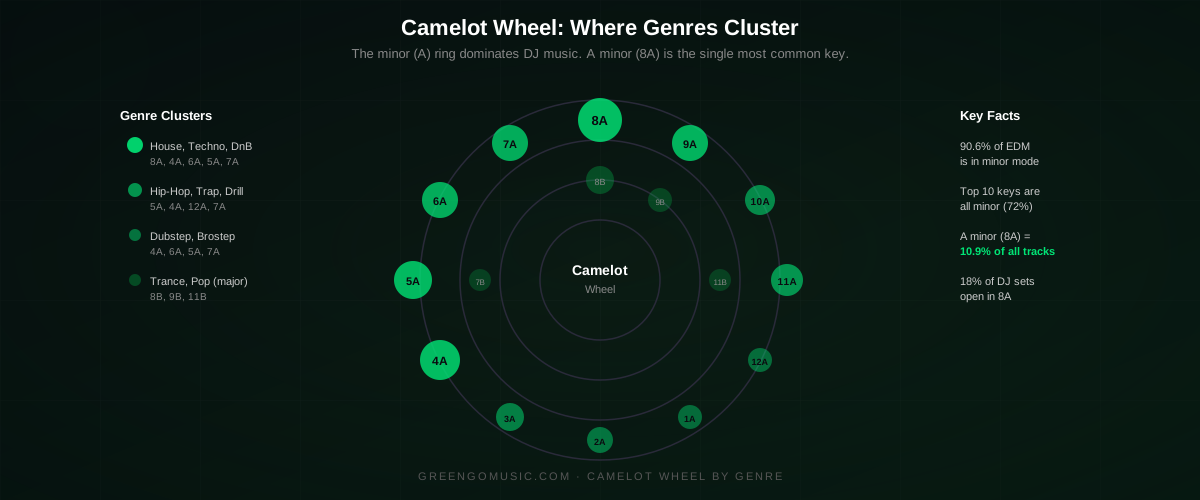
The Camelot wheel is a DJ-friendly system that maps all 24 musical keys to a clock face. Each key gets a number (1-12) and a letter (A for minor, B for major). The system was created by Mark Davis and popularized by Mixed In Key.
How to Read Camelot Codes
- Number: Position on the wheel (1-12, like a clock)
- A: Minor key (inner ring)
- B: Major key (outer ring)
- Example: 8A = A minor, 8B = C major (relative major of A minor)
The Three Safe Moves
From any Camelot position, three moves are always harmonically safe:
- Same key: 8A to 8A. Identical tonality. The most invisible transition.
- Plus or minus 1: 8A to 9A (up a fifth, adds energy) or 8A to 7A (down a fifth, releases energy).
- Switch A/B: 8A to 8B. Same root note, mode swap (minor to major). Subtle mood shift.
Open Key Notation
Open Key notation is an alternative system used by Traktor and some other DJ software. It uses numbers 1-12 with "m" (minor) and "d" (major) suffixes. The mapping is different from Camelot but covers the same 24 keys. For example, Camelot 8A (A minor) = Open Key 1m. See our harmonic mixing guide for a full explanation.
Camelot to Musical Key Conversion
| Camelot | Open Key | Musical Key | Mode |
|---|---|---|---|
| 1A | 6m | Ab minor | Minor |
| 1B | 6d | B major | Major |
| 2A | 7m | Eb minor | Minor |
| 2B | 7d | F# major | Major |
| 3A | 8m | Bb minor | Minor |
| 3B | 8d | Db major | Major |
| 4A | 9m | F minor | Minor |
| 4B | 9d | Ab major | Major |
| 5A | 10m | C minor | Minor |
| 5B | 10d | Eb major | Major |
| 6A | 11m | G minor | Minor |
| 6B | 11d | Bb major | Major |
| 7A | 12m | D minor | Minor |
| 7B | 12d | F major | Major |
| 8A | 1m | A minor | Minor |
| 8B | 1d | C major | Major |
| 9A | 2m | E minor | Minor |
| 9B | 2d | G major | Major |
| 10A | 3m | B minor | Minor |
| 10B | 3d | D major | Major |
| 11A | 4m | F# minor | Minor |
| 11B | 4d | A major | Major |
| 12A | 5m | Db minor | Minor |
| 12B | 5d | E major | Major |
How to Detect Key for Harmonic Mixing
Knowing the typical keys by genre is useful, but for harmonic mixing you need the actual key of each track in your library. Here are the main methods:
1. Dedicated Key Detection Software
GreenGo uses four-signal key-detection fusion and outputs Camelot and Open Key notation directly to ID3 tags. You drag a folder of tracks into the Analyze tab, and it processes them all in one batch, writing key data in ID3v2.4 format compatible with Rekordbox, Serato, Traktor, and VirtualDJ. The key model was trained on 14,859 tracks across multiple genres. For a full walkthrough, see our GreenGo analysis guide.
2. DJ Software Built-In Analysis
Rekordbox, Serato, Traktor, and VirtualDJ all include automatic key detection. The accuracy varies - published tests put software key detection between 41% and 86% accuracy. For critical mixes, confirm by ear. See our GreenGo vs Mixed In Key comparison for accuracy details.
3. Online Tools
For released tracks, Tunebat and SongBPM provide key data from cached databases. For your own files, use a dedicated analyzer. See our song key finder guide for a full comparison of methods.
4. Train Your Ears
No software is perfect. The best DJs combine automated detection with ear training. Play a note on a keyboard or pitch pipe, then play the track and find the note that feels like "home." That's the key. It takes practice but makes you a better DJ. For more on this, see our BPM and key detection guide.
Once your library is key-tagged, you can use the Camelot wheel to plan harmonic transitions. For batch tagging your entire library with key data, use the GreenGo batch tagger. And for preparing complete DJ sets with key-compatible track selection, see our DJ set prep guide.
FAQ
What key is most electronic dance music in?
Most electronic dance music is in minor keys. A 2024 academic study of EDM key estimation found that 90.6% of EDM tracks are in minor mode, compared to only 10.6% for The Beatles' dataset. A minor (Camelot 8A) is the single most common key, accounting for 10.9% of all tracks in a 2026 analysis of 294,595 tracks across 440 DJ libraries. The top 10 most common keys in DJ libraries are all minor. House, techno, drum and bass, dubstep, and trance all cluster heavily on the minor ring of the Camelot wheel.
What key is house music usually in?
House music is most commonly in A minor (Camelot 8A), F minor (4A), G minor (6A), C minor (5A), and D minor (7A). These are all minor keys that give house its warm, driving, slightly melancholic feel. A minor is the most common, accounting for roughly 11% of all house and tech house tracks. Major keys appear occasionally in uplifting or disco-influenced house, but the vast majority of house music is in minor keys.
What key is techno music usually in?
Techno music is most commonly in A minor (Camelot 8A), D minor (7A), E minor (9A), and E Phrygian. Detroit techno favors A minor and D minor, while Berlin and industrial techno lean toward E Phrygian and F# minor for a darker, more hypnotic feel. Dub techno commonly uses A minor and E minor. Minimal techno is often atonal or centered on A minor. Techno is overwhelmingly minor or modal, with major keys being extremely rare.
What key is hip-hop and trap music usually in?
Hip-hop and trap music are most commonly in C minor (Camelot 5A), F minor (4A), D minor (7A), A minor (8A), E minor (9A), and F# minor (11A). C minor is arguably the most widely used key in hip-hop, used in tracks like "Juicy" by The Notorious B.I.G. and "Lose Yourself" by Eminem. UK drill leans toward F minor, G minor, and C# minor. Boom bap and lo-fi hip-hop favor C minor, F minor, and A minor. Hip-hop shows roughly a 55/45 split between minor and major keys, but trap is almost exclusively minor.
What key is drum and bass usually in?
Drum and bass is most commonly in A minor (Camelot 8A), F minor (4A), D minor (7A), and C minor (5A). DnB is overwhelmingly minor, reflecting its dark, energetic atmosphere. The fast tempo (170-176 BPM) combined with minor tonality creates the intense, driving feel that defines the genre. Liquid DnB may occasionally use major keys or Dorian mode for a brighter feel, but the genre as a whole is predominantly minor.
What key is pop music usually in?
Pop music is most commonly in C major (Camelot 8B), G major (9B), D major (10B), A minor (8A), and E minor (9A). Pop has a more balanced major/minor split than electronic dance music, with many hits using major keys for bright, singable melodies. Sad pop and ballads cluster around A minor, D minor, F minor, and C minor. The most common pop chord progressions (I-V-vi-IV, vi-IV-I-V) work well in these keys because they suit the average vocal range and are easy to play on guitar and piano.
What key is dubstep usually in?
Dubstep is most commonly in F minor (Camelot 4A), G minor (6A), C minor (5A), and D minor (7A). Dubstep is almost exclusively minor, which supports its dark atmosphere, aggressive bass design, and heavy drops. The typical tempo of 140-150 BPM (felt as 70-75 BPM half-time) combined with minor tonality creates the genre's signature menacing feel. Brostep and riddim follow the same minor-key pattern, with F minor and G minor being especially common.
How do I find the key of a track for harmonic mixing?
To find the key of a track for harmonic mixing, use a dedicated key detection tool like GreenGo, which uses four-signal key-detection fusion and outputs Camelot and Open Key notation directly to ID3 tags. Alternatively, use your DJ software's built-in key analysis (Rekordbox, Serato, Traktor all detect key), or an online tool like Tunebat or SongBPM for released tracks. Once you have Camelot codes for your library, you can mix harmonically by staying on the same number, moving plus or minus 1 on the same letter, or switching between A and B at the same number. See our song key finder guide for a full walkthrough.