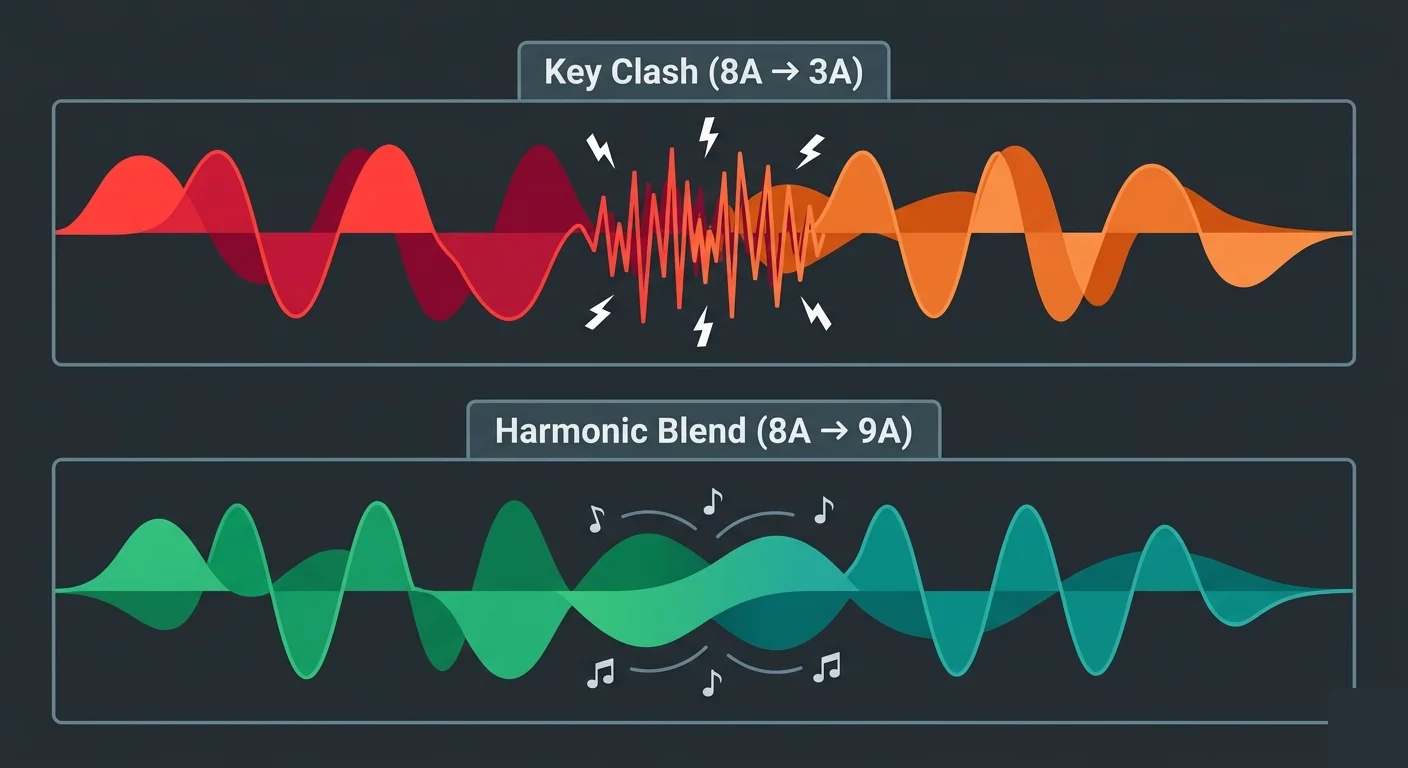
GreenGo's four-signal key detection exists to prevent exactly this moment: it writes Camelot and Open Key values into ID3 tags that every DJ platform reads on import. Here's what happens without it — you're blending two tracks. The BPMs are locked. The phrasing lines up. Then the vocals from track B come in and it sounds like someone stepped on a cat. The crowd flinches. You scramble to EQ out the mids.
That's a key clash. Two tracks in incompatible musical keys playing simultaneously. It's the most common harmonic mixing mistake and it's completely avoidable if you know the key of your tracks before you play them.
Here's how to detect the musical key of any track, which tools do it best, and how to use key data to mix harmonically every single time.
What Is Musical Key (And Why DJs Need It)
Every piece of music is built around a "home" note the tonal center that everything resolves to. That home note plus the scale pattern (major or minor) defines the key. A track in A minor uses the notes A, B, C, D, E, F, G. A track in C major uses C, D, E, F, G, A, B. Same notes different home base.
For DJs, key matters because:
- Compatible keys blend smoothly vocals, melodies, and basslines complement each other during transitions
- Incompatible keys create dissonance that "wrong note" feeling that kills energy on the dancefloor
- Key enables creative mixing energy boosts (key changes up), mood shifts (major to minor), and seamless 20-minute blends
You don't need to read sheet music. You don't need music theory. You just need a number on each track that tells you what plays well with what. That's where the Camelot system comes in.
The Camelot Wheel: Key Detection Made Simple
The Camelot wheel converts complex musical key names (Bb minor, F# major) into simple number-letter codes (1A through 12B). Invented by Mark Davis for Mixed In Key, it's now the universal standard for harmonic mixing.
How it works
- Numbers 1–12 represent pitch positions around the circle of fifths
- Letter A = minor key, Letter B = major key
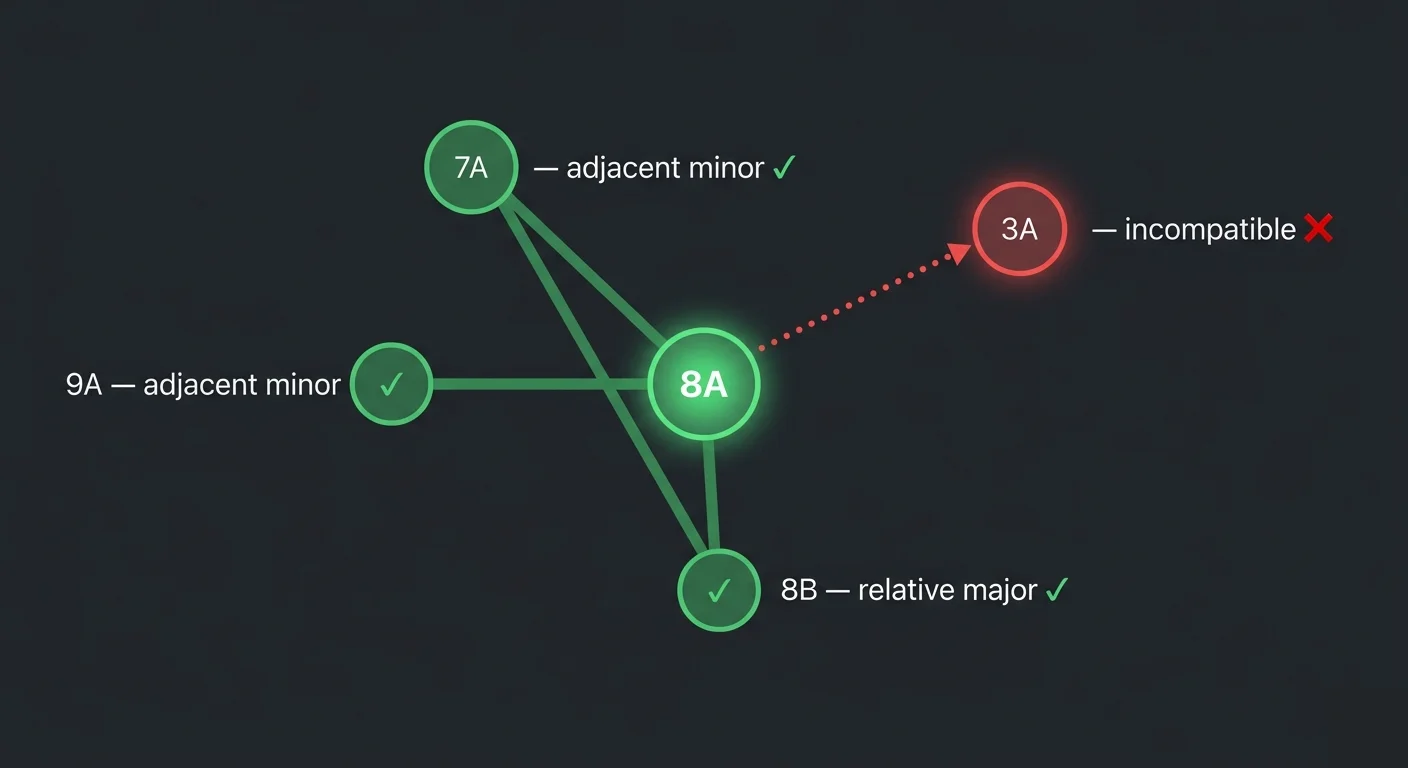
- Compatible keys: same number (8A → 8B), adjacent numbers (8A → 7A or 9A)
That's it. If track A is 8A and track B is 7A, 8A, 9A, or 8B they'll blend harmonically. Three rules. No music theory required.
Example
You're playing a track tagged as 5A (F minor). Your next track options:
- 5A (same key guaranteed smooth)
- 4A or 6A (adjacent minor keys subtle energy shift)
- 5B (relative major lifts the mood without clashing)
Any of those four options will sound clean. Anything else? Risky. Maybe it works, maybe the crowd hears a car alarm.
3 Ways to Detect the Key of a Song
Method 1: Manual Detection (Piano/Guitar)
The musician's approach. Play along with the track on an instrument, identify the root note and whether it's major or minor.
Accuracy: Near-perfect if you have trained ears.
Speed: 1–3 minutes per track. Maybe longer for ambiguous tracks.
Scales: It doesn't. Nobody is manually detecting keys for a 200-track library.
Best for: Musicians who produce and DJ. Verifying suspicious automatic detections. Understanding what you're hearing, not just reading a number.
Method 2: DJ Software Built-In Key Detection
Rekordbox, Serato, and Traktor all have key detection. Import a track, wait for analysis, and a key value appears in your library.
Accuracy by software:
- Rekordbox: ~80% accurate. Uses its own notation system by default (not Camelot you need to change the display setting). Misreads tracks with key changes or ambiguous tonality.
- Serato: ~78% accurate. Open Key notation by default. Similar issues with ambiguous tracks.
- Traktor: ~75% accurate. Open Key format. Older detection engine that hasn't been significantly updated.
The problem: 75-80% accuracy means 1 in 4 or 1 in 5 tracks has the wrong key. That's 10 wrong keys in a 50-track playlist. You won't know which ones are wrong until you hear the clash mid-set. And DJ software key detection is inconsistent across platforms move from Rekordbox to Serato and your keys might change.
Method 3: Dedicated Key Detection Software
Purpose-built tools that use advanced algorithms to analyze audio specifically for tonal content. Higher accuracy, Camelot notation, and results written into ID3 tags so they work in any DJ software.
Tools in this category:
- GreenGo detects key and BPM simultaneously. Writes Camelot notation directly into ID3 tags. Handles batch processing of 50+ files. Also imports from cloud URLs and fills full metadata. from $5.99/month. Free trial available.
- Mixed In Key the original. Created the Camelot system. ~90% key accuracy. $58 one-time. Only analyzes doesn't download or tag metadata.
- KeyFinder free, open-source. Decent accuracy (~80%) but no longer maintained. No Camelot output by default uses Open Key notation.
- Tunebat web-based database. Look up popular tracks by name. Good for checking known songs, useless for unreleased edits and compressed audio files.
Why dedicated tools win: Key lives in the ID3 tag (TKEY field). Rekordbox reads it. Serato reads it. Traktor reads it. One analysis, every platform. No re-detection. No inconsistency.
| Method | Accuracy | Batch | Writes ID3 Tags | Notation | Cost |
|---|---|---|---|---|---|
| Manual (by ear) | Near-perfect with trained ears | No | No | None | Free |
| DJ software built-in | ~75–80% (see list above) | Yes | No (internal DB) | Varies | Bundled |
| GreenGo | Four-signal detection with genre-aware profiles | Yes | Yes | Camelot + Open Key | $5.99/mo, 7-day free trial |
| Mixed In Key | ~90% | Yes | Yes | Camelot | $58 one-time |
| KeyFinder | ~80%, unmaintained | Limited | Optional | Open Key | Free |
| Tunebat (web) | Database lookup, released tracks only | No | No | Camelot display | Free |
Key Detection Accuracy: Why It Matters More Than You Think
The difference between 80% and 92% accuracy sounds small. Let's make it concrete.
At 80% accuracy (DJ software):
- 200-track library → 40 wrong keys
- Planning a 2-hour set with 25 tracks → 5 will have incorrect key data
- You'll discover the error live, mid-transition, in front of people
At 92% accuracy (dedicated tool):
- 200-track library → 16 wrong keys
- 25-track set → 2 potentially wrong (and edge cases are usually ambiguous, not blatantly wrong)
- Much lower chance of a live disaster
Harmonic mixing only works if the data is right. Building your entire mixing strategy on 80% accurate data is like navigating with a map that's missing 20% of the roads. You'll get lost it's just a question of when.
Open Key vs Camelot: Which Notation Should You Use?
Two systems exist for the same purpose:
- Camelot (1A–12B): Created by Mixed In Key. Used by GreenGo. Industry standard in DJ communities. Simple number-letter codes.
- Open Key (1d–12d / 1m–12m): Used by Serato, Traktor, and some free tools. "d" for major (dur), "m" for minor.
They map to the same keys just different labels. 8A in Camelot = 8m in Open Key = A minor in traditional notation.
Our recommendation: Use Camelot. It's what most DJ communities reference, what most tutorials teach, and what GreenGo and Mixed In Key output. If your DJ software shows Open Key by default, the adjacent-number rule still works identically just with different letters.
The GreenGo Key Detection Workflow
Here's how key detection fits into a complete track preparation pipeline:
- Find tracks platforms where your tracks live. Use the GreenGo browser to queue them from your browser.
- Process GreenGo downloads the audio, converts to your format, and runs key + BPM detection simultaneously. Both values get written into ID3 tags (TKEY and TBPM fields).
- Review GreenGo shows you the detected Camelot key for each track. Spot-check anything that looks unusual (very common keys like 8A often suggest the detection is solid; rare keys like 12B on a house track might need a listen).
- Import to DJ software drag files into Rekordbox/Serato/Traktor. The key column fills instantly from the ID3 tag. No re-analysis. No waiting.
- Mix harmonically sort your library by Camelot key. Build sets that flow: 8A → 9A → 10A → 10B → 11B. Energy rises naturally.
Total active effort: paste URLs and drag a folder. Detection, tagging, and organization happen automatically.
Pro Tips: Getting More From Key Data
Energy boost trick
Moving up one semitone (e.g., 8A → 9A) creates a subtle energy lift. Stack three of these in a row (8A → 9A → 10A → 11A) and the crowd feels the build without you touching the EQ. This is how festival DJs create 20-minute crescendos.
Major/minor mood switches
Same number, different letter (8A → 8B) switches from minor to major dark to bright. Use this at set transitions: drop from peak-time dark techno (minor keys) into a melodic breakdown (major key). Instant mood change, zero dissonance.
Key-lock and tempo changes
If you use key-lock (master tempo) in your DJ software, speeding up or slowing down a track doesn't change its key. This means a track detected as 8A stays 8A regardless of how you tempo-match it. Key data remains valid even when you're pushing BPMs ±4-6%.
Without key-lock, every +1% tempo change shifts pitch slightly. At ±6%, you're almost a semitone off meaning your key data is now wrong. If you mix without key-lock, keep tempo adjustments under ±3% for your key tags to stay reliable.
When to ignore key data
Not every track needs harmonic compatibility. Percussion-heavy transitions (drums-only sections), hard cuts, and drops from silence don't need key matching. Save harmonic mixing for moments where two melodies or basslines overlap that's where clashes happen.
FAQ
Can I find the key of a song online for free?
GreenGo's free trial detects the key of any audio file locally — including unreleased edits, compressed files, and mashups that web databases like Tunebat.com and GetSongKey.com don't cover because they only catalog known released tracks.
Is Mixed In Key worth $58 just for key detection?
Choose Mixed In Key over GreenGo if key detection is all you need and you already own every file; choose GreenGo over Mixed In Key if you also want BPM detection, energy and mood scoring, stem separation, full metadata tagging and web-track capture from $5.99/month. Read our full GreenGo vs Mixed In Key comparison.
Why does Rekordbox show a different key than Mixed In Key?
GreenGo combines four detection signals with genre-aware profiles rather than relying on a single algorithm, so its results can differ from Rekordbox or Mixed In Key on the ~8–10% of tracks with ambiguous tonality where even the best tools disagree. When tools disagree, listen to the track and trust whichever feels right during a test blend.
Do I need to know music theory for harmonic mixing?
GreenGo outputs Camelot notation precisely so no music theory is needed: adjacent numbers are compatible, and same number different letter is compatible — that's the entire rule set. A seasoned musician uses the same system, just with deeper understanding of why it works.
Every track in your library either has a key tag or it doesn't. The ones without it are gambles every time you mix them. Download GreenGo batch-analyze your entire collection and know the key of every track before your next set. Free trial. No guessing.