Choosing DJ software in 2026 is harder than it has ever been. Five major platforms compete for your library, your sets, and your subscription dollars, and each one has evolved dramatically over the past two years. Stem separation, once a niche feature, is now standard. Streaming has expanded from one service to five. Pricing models have shifted from one-time purchases to monthly subscriptions with tiered feature unlocks.
This comparison breaks down every feature that matters across Rekordbox, Serato DJ Pro, Traktor Pro 4, VirtualDJ, and Engine DJ. No opinions, no affiliate rankings, no 'best overall' winner. Just the facts, side by side, so you can decide which platform fits your workflow.
All data in this matrix comes from official product pages, pricing pages, and documentation as of September 2026. Where a feature requires a paid add-on or higher tier, that is noted explicitly.
Quick Comparison Table
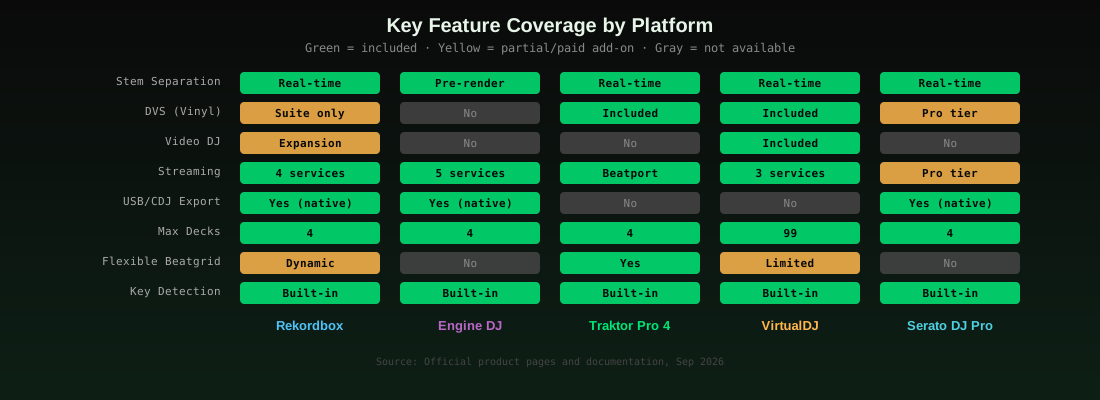
The full feature matrix covers 16 categories across 5 platforms. This is the complete reference, not a summary.
| Feature | Rekordbox (Pro) | Serato DJ Pro | Traktor Pro 4 | VirtualDJ (Pro) | Engine DJ |
|---|---|---|---|---|---|
| Pricing | Free / Core $10/mo / Creative $15/mo / Pro $30/mo | $11.99/mo or $279 perpetual | $149 one-time | Free (home) / $19/mo (Pro) / $99/mo (Business) | Free (desktop) |
| License model | Subscription only | Subscription or perpetual | One-time purchase | Free + subscription | Free (hardware-bound) |
| Platform | Windows, macOS | Windows, macOS | Windows, macOS | Windows, macOS | Windows, macOS |
| Max decks | 4 (8 on Pro) | 4 | 4 | 99 | 4 |
| BPM detection | Built-in, Normal/Dynamic modes, High Precision option | Built-in | Built-in, flexible beatgrids | Built-in | Built-in |
| Key detection | Built-in, Camelot notation | Built-in (Pitch 'n Time DJ in Suite) | Built-in, Open Key notation | Built-in | Built-in |
| Beatgrid | Static + Dynamic (Pro) | Static, manual editing | Flexible (follows tempo changes) | Static, limited dynamic | Static |
| Stem separation | Real-time (Pro), 4 stems (vocals, drums, bass, melody) | Real-time, 4 stems (vocals, melody, bass, drums) | Real-time (iZotope RX), 4 stems (drums, bass, instruments, vocals) | Real-time (Stems 2.0), 5+ stems (vocals, instruments, kicks, hi-hats) | Pre-render on desktop, 4 stems, playback on hardware ($9.99 one-time for non-PRIME 4+) |
| Library management | Smart playlists, cloud sync, collaborative playlists | Crates, smart crates | Playlists, smart lists, history | Smart folders, virtual folders, search lists | Playlists, smart playlists, music pool |
| USB/CDJ export | Yes, native (export mode built for CDJs) | No | No | No | Yes, native (export to standalone hardware) |
| Streaming | Beatport, Beatsource, TIDAL, SoundCloud (Pro) | Beatport, Beatsource, TIDAL, SoundCloud (subscription) | Beatport (2 months free for new users) | SoundCloud, Deezer, content pools (Pro) | Beatport, SoundCloud, TIDAL, Amazon Music, Apple Music (on hardware) |
| DVS (vinyl control) | Yes (Pro plan) | Yes (Suite or DVS expansion) | Yes (included) | Yes (Pro plan) | No |
| Video DJ | Yes (Pro plan) | Yes (Video expansion or Suite) | No | Yes (included, even in free version) | No |
| Effects/FX | Built-in FX pack, Pad FX, Stems FX (Pro) | 20+ built-in, 50+ with FX expansion, Stems Pad FX | Built-in FX, Ozone Maximizer, Pattern Player | All audio effects included (even free) | Built-in FX on hardware |
| Hot cues / sampler | 8 hot cues, sampler (Pro) | 8 hot cues per track, 32 samples across 4 banks | 8 hot cues, Pattern Player (drum sequencer) | Unlimited hot cues, infinite sampler slots | 8 hot cues, sampler on hardware |
| Controller compatibility | Pioneer/AlphaTheta native, generic MIDI | 100+ devices (Pioneer, Denon, Numark, RANE, NI, more) | Native Instruments native, generic MIDI | Wide compatibility, generic MIDI, most controllers | Denon, Numark, RANE native, generic MIDI |
| AI features | AI vocal position detection, auto-classification | Stems FX, smart sync | Ozone Maximizer, Pattern Player | AI Prompt, AI-generated lyrics, auto-mix | On-board stems rendering (SYSTEM ONE) |
Pricing Breakdown
Pricing is the first decision point for most DJs, and the models could not be more different across platforms. Rekordbox is subscription-only, with four tiers. Serato offers both subscription and perpetual licenses. Traktor is a one-time purchase. VirtualDJ is free for home use with a Pro subscription for professionals. Engine DJ is free but hardware-bound.
| Platform | Free tier | Entry paid | Pro tier | Model |
|---|---|---|---|---|
| Rekordbox | Yes (limited, no controller control) | Core $10/mo ($120/yr) | Pro $30/mo ($360/yr) | Subscription only |
| Serato DJ Pro | Practice Mode (no hardware) | $11.99/mo or $279 perpetual | Suite $14.99/mo or $449 perpetual | Subscription or perpetual |
| Traktor Pro 4 | No (30-day trial) | $149 one-time | $149 (single tier) | One-time purchase |
| VirtualDJ | Yes (home, no controller) | Home $4/mo (entry controllers) | Pro $19/mo, Business $99/mo | Free + subscription |
| Engine DJ | Yes (desktop, full) | Free (hardware unlock) | Stems license $9.99 one-time | Free (hardware-bound) |
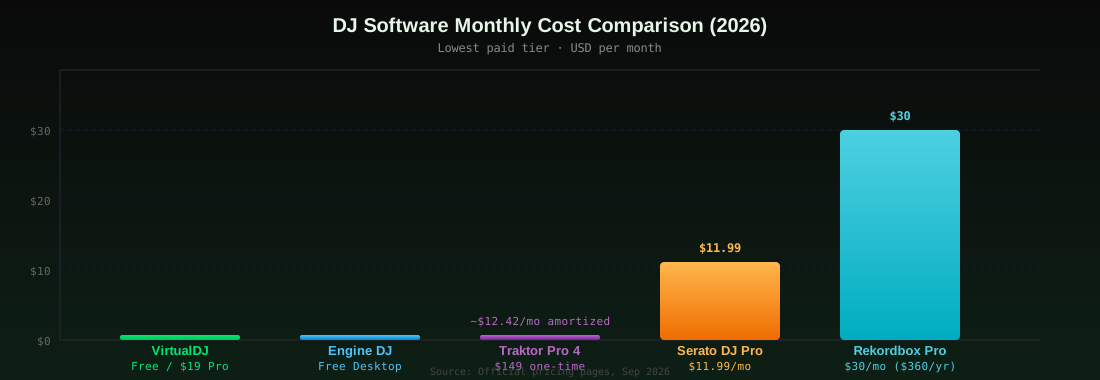
Rekordbox has the highest ongoing cost at $30/month for the Pro tier, which unlocks DVS, video, stems, and 8-deck support. The free tier lets you export to USB but cannot control DJ equipment, making it useful only for library prep. Core at $10/month adds equipment control but omits stems, DVS, and video.
Serato DJ Pro at $11.99/month is cheaper than Rekordbox Pro, but DVS, video, and advanced FX require the Suite at $14.99/month or separate expansion purchases. The $279 perpetual license is the best long-term value if you do not need expansions.
Traktor Pro 4 at $149 one-time is the most cost-effective option if you want all features included. There is no subscription, no tiered unlock, and no expansion packs. Stems, DVS, flexible beatgrids, Pattern Player, and Ozone Maximizer are all included. The catch: you need Native Instruments hardware for the best experience, and there is no USB export for CDJs.
VirtualDJ is free for home use with a mouse and keyboard. The $19/month Pro tier unlocks all controllers, removes branding, and adds advanced AI features. The $4/month Home tier works with entry-level controllers. VirtualDJ supports up to 99 decks, which no other platform offers.
Engine DJ Desktop is free with no feature limitations on the software side. Stems playback on hardware requires a one-time $9.99 license for non-PRIME 4+ owners. The tradeoff is that Engine DJ is designed for Denon, Numark, and RANE standalone hardware, not laptop-based DJing.
Stem Separation
Stem separation is the defining feature of DJ software in 2026. Every major platform now supports it, but the implementation differs significantly.
Rekordbox offers real-time stem separation on the Pro plan, splitting tracks into 4 parts: vocals, drums, bass, and melody. The separation happens live during playback, so you can isolate or mute components on the fly. AI vocal position detection helps identify where vocals enter and exit a track.
Serato DJ Pro introduced Serato Stems as a core feature, with real-time separation into vocals, melody, bass, and drums. Stems Pad FX (Echo, Braker) let you apply effects to individual stems during transitions. Stems is included in DJ Pro, not locked behind the Suite tier.
Traktor Pro 4 uses iZotope RX technology for stem separation, splitting into drums, bass, instruments, and vocals. Each stem gets its own waveform display, and you can apply filters and effects per stem. The iZotope RX engine is widely regarded as one of the highest-quality separation algorithms available.
VirtualDJ was the first DJ software to introduce real-time stems back in 2020. The current Stems 2.0 engine separates into more granular components: vocals, instruments, kicks, and hi-hats. This finer separation gives VirtualDJ an edge for DJs who want surgical control over individual drum elements. Stems are included even in the free version.
Engine DJ takes a different approach. Stems are pre-rendered in Engine DJ Desktop, then exported to a USB or internal drive for playback on standalone hardware. This means stems are not real-time on a laptop, but they play back on Denon, Numark, and RANE hardware without a computer connected. The PRIME 4+ includes stems for free, other hardware requires a $9.99 one-time license. Engine DJ 5.0 added on-board stems rendering for the RANE SYSTEM ONE, making it the first standalone hardware to render stems without a computer.
BPM and Key Detection
All five platforms include built-in BPM and key detection, but the accuracy and output formats differ.
Rekordbox offers three analysis modes: Normal, Dynamic, and High Precision. Normal uses a fixed beatgrid. Dynamic adjusts the beatgrid to follow tempo changes within a track. High Precision performs a more detailed analysis at the cost of processing time. Key detection outputs in Camelot notation. The choice between Normal and Dynamic analysis significantly affects BPM accuracy for tracks with tempo changes.
Serato DJ Pro includes basic key detection. Pitch 'n Time DJ, available in the Suite or as a separate expansion, adds independent key and tempo shifting for precise harmonic mixing. Without it, key detection is display-only.
Traktor Pro 4 outputs key in Open Key notation (the Traktor standard), which can be converted to Camelot. The flexible beatgrid system means BPM detection follows tempo changes throughout the track, which is critical for disco, funk, hip-hop, and live recordings with drifting tempo.
VirtualDJ includes BPM and key detection in all tiers, including free. The detection is automatic on track load.
Engine DJ detects BPM and key during analysis in Engine DJ Desktop. Key is displayed in musical notation (e.g., A minor), not Camelot.
None of these platforms write BPM or key data back to ID3 tags by default. If you want your BPM and key tags to persist across all DJ software, you need a separate batch tagging tool that writes to the file itself. This is where a library prep tool like GreenGo's track analysis fills the gap, writing BPM, key (Camelot and Open Key), energy, and mood directly into ID3v2 tags that every platform reads.
Beatgrid and Analysis
Beatgrid accuracy determines whether sync, looping, and beat jumps work correctly. This is where the platforms diverge most sharply.
Traktor Pro 4 has the best beatgrid system. Flexible beatgrids follow tempo changes throughout a track, so disco, funk, hip-hop, and live recordings with drifting tempo get accurate grids. Sync works without audio quality degradation. This was the most requested feature in Traktor's history, and it eliminates the biggest complaint about the platform.
Rekordbox offers Dynamic analysis (Pro tier) which adjusts the beatgrid to tempo changes, but it is less granular than Traktor's flexible beatgrids. Normal analysis uses a single fixed BPM, which causes problems for tracks with tempo drift. High Precision analysis is more thorough but slower.
Serato DJ Pro uses a static beatgrid. Manual editing is possible but tedious for large libraries. Serato does not offer dynamic or flexible beatgrids.
VirtualDJ has a static beatgrid with limited dynamic adjustment. The platform compensates with its sync engine, which can handle minor tempo variations.
Engine DJ uses a static beatgrid. Analysis happens in Engine DJ Desktop before export to hardware.
Library Management and USB Export
Library management is where Rekordbox and Engine DJ separate themselves from the pack. Both are designed for the club standard workflow: prepare your library on a laptop, export to USB, plug into a CDJ or standalone controller.
Rekordbox is the industry standard for USB export. Its Export mode is built specifically for Pioneer CDJs and XDJ units. You analyze tracks, set beatgrids, create playlists, and export to a USB drive that works in any club with Pioneer gear. The Pro plan adds cloud library sync via Dropbox (up to 5TB), collaborative playlists, and auto-upload features.
Engine DJ is the Denon/Numark/RANE equivalent. Engine DJ Desktop handles analysis and playlist management, then Sync Manager exports to USB, SD card, or internal hard drive for standalone hardware. The workflow mirrors Rekordbox but targets Denon PRIME, Numark, and RANE SYSTEM ONE hardware instead of Pioneer CDJs.
Serato DJ Pro uses crates (smart crates supported) for library organization but has no USB export. Serato is a laptop-based performance platform, not a prep-and-export tool.
Traktor Pro 4 uses playlists and smart lists but has no USB export. Like Serato, it is designed for laptop-based performance with NI controllers.
VirtualDJ offers smart folders, virtual folders, and search lists for organization. No USB export. The platform's strength is its flexibility and the sheer number of decks it supports.
If you play in clubs with Pioneer CDJs, Rekordbox is the only option. If you play on Denon or Numark standalone gear, Engine DJ is the only option. The other three platforms are laptop-only.
Streaming Services
Streaming integration lets you access music without owning the files. The number of supported services varies significantly.
| Platform | Beatport | Beatsource | TIDAL | SoundCloud | Other |
|---|---|---|---|---|---|
| Rekordbox (Pro) | Yes | Yes | Yes | Yes | Inflyte (promo) |
| Serato DJ Pro | Yes | Yes | Yes | Yes | N/A |
| Traktor Pro 4 | Yes (2 months free) | Yes (2 months free) | No | No | N/A |
| VirtualDJ (Pro) | No | No | No | Yes | Deezer, content pools |
| Engine DJ | Yes (on hardware) | No | Yes (on hardware) | Yes (on hardware) | Amazon Music, Apple Music |
Rekordbox and Serato have the broadest streaming support, with four major services each. Engine DJ leads in total services when you count Amazon Music and Apple Music, but streaming happens on the hardware, not the desktop software. Traktor offers Beatport and Beatsource with two free months for new users, but no TIDAL or SoundCloud. VirtualDJ goes a different direction with Deezer and content pools.
Streaming is useful for discovering music, but most professional DJs still buy or download tracks for reliability. Streaming requires an internet connection at the gig, and audio quality is typically lower than purchased files. For a complete workflow that includes capturing tracks from streaming sources, converting formats, and tagging with BPM and key, a capture-and-prep tool bridges the gap.
DVS and Video DJ
DVS (Digital Vinyl System) lets you control DJ software with timecode vinyl or CDs. Video DJ lets you mix video files and output to a second screen.
DVS support: Traktor Pro 4 includes DVS at no extra cost. Rekordbox includes DVS on the Pro plan. Serato requires the Suite or a separate DVS expansion. VirtualDJ includes DVS on the Pro plan. Engine DJ does not support DVS at all, as it is designed for standalone hardware with jog wheels.
Video DJ: VirtualDJ is the only platform that includes video mixing in its free version. Serato requires the Video expansion or Suite. Rekordbox includes video on the Pro plan. Traktor and Engine DJ do not support video DJ.
Effects and Sampler
Rekordbox (Pro) includes a built-in FX pack, Pad FX for performance pads, and Stems FX for applying effects to individual stems. The FX are solid but not as extensive as Serato's library.
Serato DJ Pro leads in effects quantity with 20+ built-in FX and 50+ available with the FX expansion. Stems Pad FX (Vocal Echo, Instrumental Echo, Instrumental Braker, Drums Echo) are unique to Serato and designed specifically for stem-based transitions. The sampler holds 32 samples across 4 banks.
Traktor Pro 4 includes built-in FX plus the Ozone Maximizer (iZotope loudness enhancer) and Pattern Player (drum sequencer with patterns from iconic drum machines). The Pattern Player is a unique feature that no other platform offers, letting you layer drum patterns over your mix.
VirtualDJ includes all audio effects in every tier, including free. This is the most generous FX offering. The sampler supports effectively unlimited samples.
Engine DJ has built-in FX on hardware. The FX are controlled via the hardware's knobs and pads, not a laptop interface.
Controller Compatibility
Controller compatibility is often the deciding factor. If you already own a controller, your software choice may be made for you.
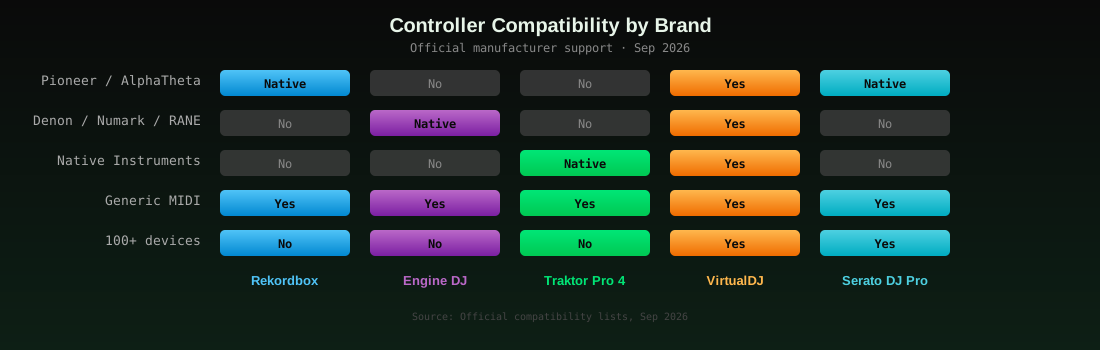
Serato DJ Pro supports the most hardware, with 100+ officially supported devices across Pioneer, Denon, Numark, RANE, and other brands. If you own a controller, Serato probably supports it.
VirtualDJ has the widest generic compatibility. It works with almost any controller via MIDI mapping, even if not officially supported. This makes it the fallback option for obscure or older controllers.
Rekordbox is native to Pioneer and AlphaTheta hardware (DDJ series, CDJ, XDJ). It does not officially support Denon, Numark, or NI controllers, though generic MIDI mapping is possible.
Traktor Pro 4 is native to Native Instruments hardware (Traktor Kontrol S2/S3/S4, Traktor X1, F1). Generic MIDI mapping is supported but requires more setup. NI hardware is often bundled with Traktor, making the combined purchase attractive.
Engine DJ is native to Denon DJ (PRIME series), Numark, and RANE (SYSTEM ONE) standalone hardware. It is not designed for laptop-based controller DJing.
Platform-by-Platform Breakdown
Rekordbox (AlphaTheta)
Rekordbox is the club standard. Rekordbox official pricing lists four tiers from Free to Professional. If you play in venues with Pioneer CDJs or XDJ units, Rekordbox is not optional, it is the only way to prepare USB drives that work in those booths. The Pro plan at $30/month is expensive, but it includes everything: stems, DVS, video, 8 decks, cloud sync, and all analysis modes. The free tier is useful for library prep only, as it cannot control DJ equipment. Rekordbox ver. 7 is the current version, with cloud library sync, collaborative playlists, and AI vocal position detection.
Serato DJ Pro
Serato is the performance standard. Serato DJ Pro official page lists 100+ supported hardware devices. It is the most widely supported platform, working with 100+ controllers across all major brands. Stems are a core feature, not locked behind a paywall. The Suite adds DVS, video, Pitch 'n Time DJ, Flip, and Play. The $279 perpetual license is the best value if you do not need expansions. Serato's weakness is the lack of USB export and the static beatgrid, which causes problems for tracks with tempo changes.
Traktor Pro 4
Traktor is the value pick. Traktor Pro 4 official page includes all features in one purchase. At $149 one-time with no subscription, no tiers, and no expansion packs, you get stems (iZotope RX), DVS, flexible beatgrids, Pattern Player, and Ozone Maximizer. The flexible beatgrid system is the best in the industry for tracks with changing tempo. The limitation is hardware: Traktor is optimized for NI controllers, and there is no USB export for CDJs. If you mix at home or with NI gear and never need club USB export, Traktor offers the most features per dollar.
VirtualDJ
VirtualDJ is the flexibility pick. VirtualDJ pricing page breaks down the free, Home, Pro, and Business tiers. Free for home use, $19/month for Pro, and support for up to 99 decks make it unlike any other platform. Stems 2.0 separates into more granular components (kicks, hi-hats separately) than any competitor. Video mixing is included for free. The tradeoff is that VirtualDJ is not the club standard, so you will not find it pre-installed in booths. For mobile DJs, video DJs, and home users, it is hard to beat the value.
Engine DJ
Engine DJ is the standalone standard. Engine DJ Stems page details the pre-render workflow for standalone hardware. If you play on Denon PRIME, Numark, or RANE SYSTEM ONE hardware, Engine DJ is your prep tool. The desktop software is free with no feature limitations. Stems are pre-rendered on desktop and played back on hardware, which means no laptop is needed at the gig. Engine DJ 5.0 added on-board stems rendering for the RANE SYSTEM ONE, the first standalone hardware to render stems without a computer. The limitation is that Engine DJ is not designed for laptop-based performance.
Why DJ Software Needs a Library Prep Tool
Every platform in this comparison has built-in BPM and key detection, but none of them write that data back to your audio files by default. Rekordbox stores analysis in its own database. Serato stores it in crates. Traktor stores it in collection.nml. Engine DJ stores it on the exported drive. When you switch platforms, or when you play on a club CDJ that reads ID3 tags, your BPM and key data does not transfer.
This is the gap that a library prep tool fills. A tool like GreenGo Browser analyzes your tracks and writes BPM, musical key (in both Camelot and Open Key notation), energy level, and mood directly into the ID3v2 tags inside the file. Those tags are read by every DJ software in this comparison, so your analysis persists across platforms.
If you have ever switched from Serato to Rekordbox and lost all your cue points, or played on a club CDJ and found your BPM field empty, this is why. The analysis lived in the software database, not in the file. A proper ID3 tagging workflow solves this permanently.
GreenGo also handles stem separation (6 stems: vocals, drums, bass, melody, guitar, piano), audio format conversion (MP3, WAV, FLAC, M4A, OGG, AAC), and SoundMap visualization for finding compatible tracks in your library. It runs as a desktop browser on Windows and macOS, with a 7-day free trial that includes 3 stem separations, no credit card required.
For DJs who use Rekordbox for USB export but want better analysis accuracy, the workflow is: analyze and tag with GreenGo first (writes BPM and key to ID3 tags), then import into Rekordbox (reads the tags from the file), then export to USB. Your tags travel with the file to any platform.
FAQ
What DJ software do most professional DJs use?
Rekordbox is the most common prep tool for club DJs because Pioneer CDJs are the club standard. Serato DJ Pro is the most common performance platform for controller DJs. The choice depends on where you play: clubs with CDJs require Rekordbox for USB export, while controller-based gigs can use Serato, Traktor, or VirtualDJ.
Is Rekordbox or Serato better for beginners?
Serato DJ Lite is free and works with entry-level controllers, making it the easiest starting point. Rekordbox's free tier cannot control DJ equipment, so beginners need to pay at least $10/month (Core plan) to use a controller. VirtualDJ is also free for home use with a mouse and keyboard.
Which DJ software has the best stem separation?
Traktor Pro 4 uses iZotope RX technology, which is widely regarded as the highest-quality separation algorithm. VirtualDJ's Stems 2.0 offers the most granular separation (separate kicks and hi-hats). Serato and Rekordbox both offer real-time 4-stem separation. Engine DJ pre-renders stems on desktop for playback on standalone hardware.
Do I need to pay for DJ software?
VirtualDJ is free for home use. Engine DJ Desktop is free. Serato DJ Pro has a free Practice Mode (no hardware). Rekordbox has a free tier (library prep only, no controller). Traktor Pro 4 has a 30-day free trial. For professional use with a controller, you need a paid plan on all platforms except Engine DJ (which is free but hardware-bound).
Can I use Rekordbox with Serato controllers?
Rekordbox is optimized for Pioneer and AlphaTheta hardware. It does not officially support Serato-branded or Denon controllers, though generic MIDI mapping is possible with limitations. Serato DJ Pro supports 100+ devices across all major brands, making it the more flexible choice if you own non-Pioneer gear.
Which DJ software is best for USB export to CDJs?
Rekordbox is the only option for Pioneer CDJ and XDJ USB export. Engine DJ is the equivalent for Denon PRIME and Numark standalone hardware. Serato, Traktor, and VirtualDJ do not support USB export. If you play in clubs with Pioneer gear, Rekordbox is not optional.