Mixed In Key invented commercial harmonic mixing tools — the Camelot wheel came out of its ecosystem, and for years it was the only serious option for key detection. But at $58 for the base version (and $149+ for the Pro/Studio bundles), with a Windows/Mac-only desktop app and no built-in library tagging pipeline, a lot of DJs are looking around. Here are the seven alternatives worth your time in 2026, ranked by what they actually deliver.
Why DJs Look Beyond Mixed In Key
Mixed In Key's reputation is earned — its key detection was the reference for years, and its Camelot notation is now the industry standard. But the gaps are real:
- Price: $58 gets you key detection. Energy levels, cue points, and Platinum notes require upgrades toward $149-300 territory.
- No stem separation, no format conversion, no library capture: it's a single-purpose analyzer in a world where DJs want a prep pipeline.
- Dated workflow: analyze in Mixed In Key, export, hope the tags survive import into Rekordbox or Serato.
If you already own it and it works, keep it. If you're shopping in 2026, read on.
The 7 Best Mixed In Key Alternatives (2026)
1. GreenGo — best overall alternative
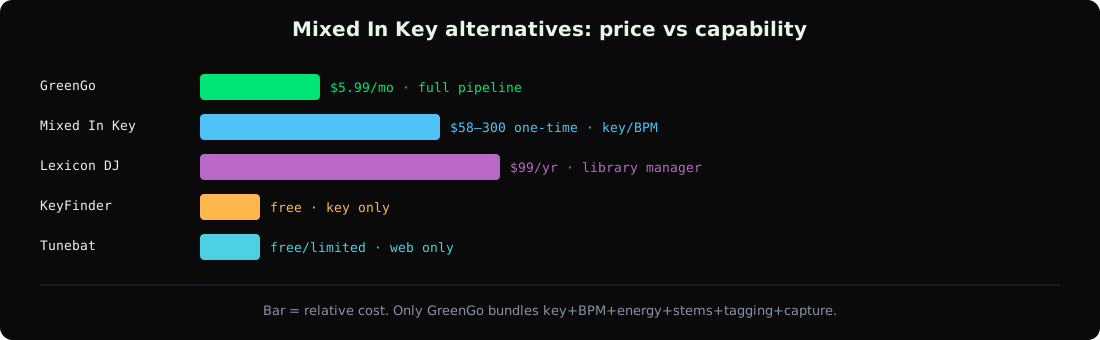
GreenGo is a desktop browser built for DJs that bakes key and BPM detection into a complete prep workflow. Its 4-signal key detection (with genre-aware profiles) writes Camelot or Open Key notation straight into ID3 tags, and it adds what Mixed In Key charges extra for: energy (1-10), mood (9 classes), and danceability scoring — plus stem separation, batch ID3 tagging, format conversion, and web capture. Windows and macOS, $5.99/month or $60/year, 7-day free trial with no credit card.
The honest limitation: it's subscription-priced, so long-term cost can exceed a one-time MIK purchase, and it's a newer tool with a younger accuracy track record.
2. Lexicon DJ — best for serious library management
Lexicon DJ is a full DJ library manager: syncs with Rekordbox, Serato, Traktor, Engine DJ and VirtualDJ databases, handles smart playlists, dedupes, and batch edits. Key detection is bundled in with its analysis. $15/month or $99/year makes it the priciest subscription here, but nothing else manages a multi-app library as well. Overkill if you only need key detection.
3. KeyFinder — best free open-source option
KeyFinder, the classic free key detector, is open source and still accurate. Drag files in, get keys, optionally write them to tags. No BPM analysis in the original build, no energy, no mood, and the UI is ancient — but for zero dollars on a folder of tracks, it remains genuinely useful. Development is sporadic; DJ Keyfinder community forks carry it forward.
4. Tunebat — best browser-based quick check
Tunebat's web analyzer detects BPM, key, Camelot, energy and danceability per track, free for Spotify catalog data and a limited number of uploads per day. Great for checking a handful of songs — and for dedicated spot-check methods see how to find the BPM of any song; impractical for a 5,000-track library — no batch tagging to files, no Rekordbox integration. We covered it in depth in our Tunebat alternatives roundup.
5. Rekordbox's built-in analysis — best if you live in Rekordbox
Rekordbox analyzes BPM and key on import for free, and Dynamic mode handles tempo-drift tracks better than it used to. The detection accuracy for key lags dedicated tools, and there's no energy or mood data — but if Rekordbox is your only destination, it's already in your workflow. Our Dynamic vs Normal deep-dive shows where it still falls short.
6. Serato's built-in analysis
Serato DJ analyzes BPM on import and recent versions show key information in the library. Like Rekordbox, it's free inside software you may already run — and like Rekordbox, it won't batch-write ID3 tags for portability outside the Serato database.
7. OpenKeyScan — best minimal web tool
A fast, free web-based key detector with a clean interface. Similar niche to Tunebat: fine for spot-checking tracks, not a library tool.
Side-by-Side Comparison
| Tool | Price | BPM | Key | Energy/Mood | Batch tag writing | Extra |
|---|---|---|---|---|---|---|
| GreenGo | $5.99/mo, $60/yr | Yes (multi-method) | Yes (Camelot + Open Key) | Yes | Yes (ID3) | Stems, capture, converter, browser |
| Mixed In Key | $58-300 one-time | Yes | Yes (Camelot) | Paid tiers | Yes | Cue points, Platinum notes |
| Lexicon DJ | $15/mo, $99/yr | Yes | Yes | Limited | Yes | Full library management |
| KeyFinder | Free | No | Yes | No | Yes | Open source |
| Tunebat | Free/limited | Yes | Yes | Yes | No | Web-based |
| Rekordbox | Free (analysis) | Yes | Yes | No | Internal only | Already in workflow |
| Serato DJ | Free/Paid | Yes | Yes | No | Internal only | Already in workflow |
The Free Options, Honestly Assessed
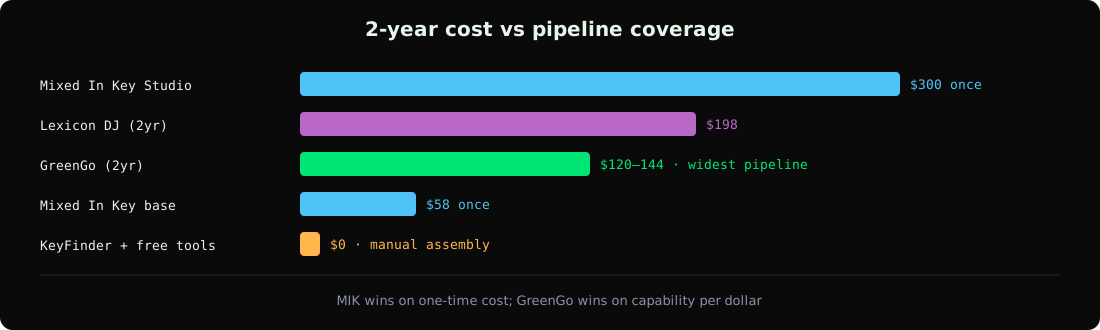
If your budget is zero: KeyFinder for keys, Rekordbox's own analysis for BPM, and Tunebat for spot-checks cover a surprising amount. What you lose is the pipeline — you're assembling results from three tools and manually writing tags. For a few hundred tracks that's annoying; for a career's worth of music it's a real cost in hours. The key lock and harmonic mixing guide explains what the detected keys actually mean for your sets.
When Mixed In Key Is Still Worth It
Fairness matters: Mixed In Key remains excellent if you want a one-time purchase, only need key/BPM detection, and value its mature Platinum notes and cue-point workflow. Its key detection accuracy is battle-tested across millions of tracks. If you specifically want energy analysis without a subscription, MIK's higher tiers deliver it — at a price.
Which Should You Choose?
- Best value / full prep pipeline: GreenGo — detection + tagging + stems + capture for less than two months of a coffee habit.
- Best library manager: Lexicon DJ — if you juggle Rekordbox and Serato databases.
- Best free: KeyFinder + Rekordbox analysis.
- Best quick check: Tunebat or OpenKeyScan.
- Best one-time purchase: Mixed In Key — still.
We also maintain a BPM/key detection accuracy comparison across these exact tools, and a full DJ software feature matrix if you're still picking a platform.
Frequently Asked Questions
Which Mixed In Key alternative should I actually choose in 2026?
GreenGo is the top recommendation for most DJs because it's the only alternative that replaces Mixed In Key plus a downloader, converter, and tagger with one $5.99/month app (7-day free trial, no credit card). If you only need key and BPM analysis on files you already own and never want a subscription, Mixed In Key itself ($58 one-time) or the free KeyFinder are better fits. For everyone else building a library from scratch, GreenGo covers more of the workflow for less total cost.
Is there a free alternative to Mixed In Key?
Yes — KeyFinder is a free, open-source key detector that writes Camelot-compatible results into tags. Pair it with Rekordbox's built-in BPM analysis and Tunebat for spot-checks, and you cover most of what Mixed In Key does, minus energy detection and polish.
What is better than Mixed In Key?
For pure key detection, Mixed In Key is still among the best. For a complete DJ prep workflow — detection, tagging, stems, conversion, capture — GreenGo and Lexicon DJ go further. The right answer depends on whether you need a tool or a pipeline.
How much does Mixed In Key cost in 2026?
The base Mixed In Key license is around $58 as a one-time purchase. Energy detection, cue points and the Studio/Pro bundles push the total to $149-300 depending on tier.
Do alternatives write Camelot notation?
Yes — GreenGo, Lexicon DJ, KeyFinder and Tunebat all output Camelot notation (or can convert to it), and most also support Open Key and standard musical notation. See the Camelot wheel reference for how the notation maps.
Can I use GreenGo and Mixed In Key together?
You can, but there's little reason to — both detect BPM and key and write the same ID3 fields. Most DJs pick one to avoid conflicting tag values.
Mixed In Key earned its place in DJ history — but in 2026 it's one option among many, and no longer the obvious default. Try GreenGo free for 7 days and run it on the tracks where your current tool got the key wrong; that test tells you more than any comparison table.
Ihor, Music software developer at GreenGo.