Tunebat is the first tool most DJs reach for when they need to find the BPM or musical key of a track. You type a song name, it looks up Spotify's database, and you get a number. It's free, it's fast, and for published tracks on Spotify, it works.
But here's the problem: Tunebat only knows about songs that exist on Spotify. If you need the key or BPM for an unreleased track, a DJ edit, a bootleg remix, a sample, a stem, or anything you downloaded from SoundCloud or a DJ pool — Tunebat cannot help. It doesn't analyze audio. It reads metadata that Spotify already calculated.
That limitation pushes a lot of DJs toward alternatives. We tested 10 tools that do what Tunebat does — and in most cases, do it better — by analyzing the actual audio file instead of looking up a database.
Where Tunebat Falls Short
Before we get to the alternatives, let's be specific about Tunebat's limitations. It's not a bad tool — it's a limited one.
- Spotify-only. If a track isn't on Spotify, Tunebat has nothing to look up. Unreleased tracks, DJ edits, bootlegs, and samples are invisible to it.
- No audio analysis. Tunebat reads Spotify's pre-calculated audio features. It doesn't analyze your file. If Spotify's data is wrong — and it often is for BPM on tracks with half-time or double-time feels — Tunebat passes that error along.
- One track at a time. There's no batch processing. If you need BPM and key for 50 tracks, you're doing 50 individual searches.
- No tagging. Tunebat shows you the BPM and key on screen. It doesn't write that data into your file's ID3 tags. You still need a separate tool for that.
- No Camelot output by default. Tunebat shows traditional key notation. If you mix using the Camelot wheel, you have to convert manually.
- Requires a Spotify account. The free tier works, but you need to log in with Spotify. Some DJs prefer tools that don't require any account at all.
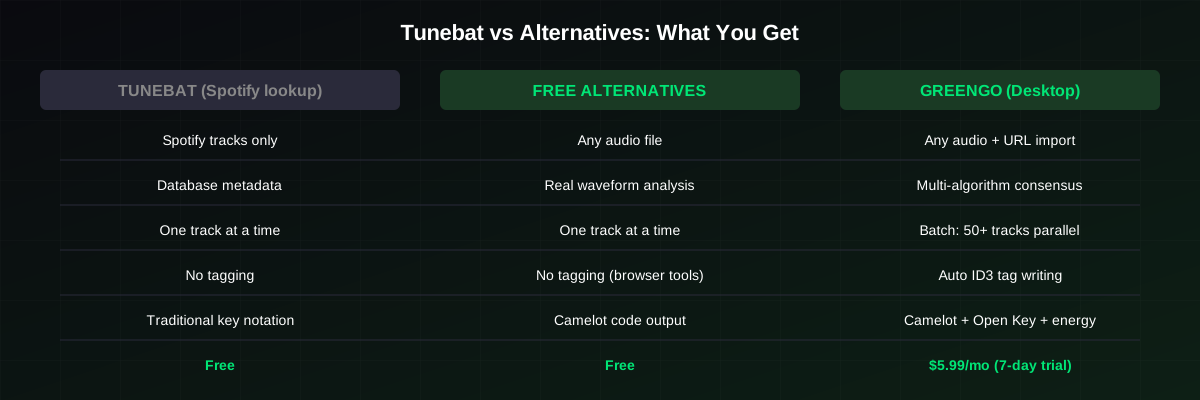
None of this means Tunebat is useless. For a quick lookup of a popular track, it's fine. But if you're prepping a DJ library — especially with tracks that don't exist on Spotify — you need something that actually analyzes audio.
How We Tested Each Alternative
We ran the same five tracks through every tool on this list. The tracks were chosen to expose different analysis challenges:
- House — 124 BPM, steady four-on-the-floor, clear key signature
- Hip-hop — 82 BPM, heavy sub-bass that can confuse key detection
- Drum & bass — 174 BPM, fast breaks that trigger half-time/double-time errors
- Unreleased bootleg — a DJ edit that doesn't exist on Spotify (Tunebat's kryptonite)
- Live recording — tempo drifts slightly, key is ambiguous
For each tool, we checked: accuracy (did it get the BPM and key right?), speed (how long did analysis take?), batch capability (can you process multiple files at once?), tagging (does it write results to ID3 metadata?), and price (free, freemium, or paid?).
2026 Comparison Table
| Tool | Price | Batch | ID3 Tagging | Audio Analysis | Platform |
|---|---|---|---|---|---|
| BeatKey | Free | No | No | Yes (browser) | Web |
| 12notez | Free | No | No | Yes (browser) | Web |
| KeyFinder | Free | Yes | Yes | Yes (desktop) | Win/Mac |
| OpenKeyScan | Free | Yes (via Lexicon) | Yes (via Lexicon) | Yes (desktop) | Win/Mac |
| GreenGo | $5.99/mo | Yes | Yes | Yes (desktop) | Win/Mac |
| Mixed In Key | $58 one-time | Yes | Yes | Yes (desktop) | Win/Mac |
| Lexicon DJ | Free tier + paid | Yes | Yes | Yes (desktop) | Win/Mac |
| AceStep | Free | No | No | Yes (browser) | Web |
| freesong.ai | Free | No | No | Yes (browser) | Web |
| TrackRadar | Free | No | No | Spotify lookup | Web |
Tool-by-Tool Breakdown
1. BeatKey — Closest Free Tunebat Replacement
BeatKey is a free, browser-based tool that analyzes any audio file you drop in — no Spotify account, no signup, no upload to a server. Everything runs locally in your browser using WebAssembly.
It detects BPM, musical key, and Camelot code from the actual audio waveform, not a database lookup. That means it works on unreleased tracks, DJ edits, samples, and stems — anything Tunebat can't touch.
Where it wins: Completely free, no account, works on any audio file, processes locally for privacy. The closest direct replacement for Tunebat's use case.
Where it falls short: One file at a time. No batch processing, no ID3 tagging, no library management. If you need to analyze 50 tracks, you're dragging and dropping 50 times.
Best for: Quick one-off lookups when you need BPM and key for a track that isn't on Spotify.
2. 12notez — Free Key & BPM Finder With Spotify + Upload
12notez does two things Tunebat does (Spotify database lookup) and one thing Tunebat doesn't (audio file upload analysis). You can search millions of songs by name, or drop an audio file to analyze it directly.
The tool outputs key, Camelot code, and BPM. It's completely free with no signup and no usage limits — funded by a music studio and course business, not by charging users.
Where it wins: Dual mode (Spotify lookup + file upload), no account needed, no limits. The Essentia-based detector matches Tunebat's results on 85-90% of tracks.
Where it falls short: Still one track at a time. No batch, no tagging, no DJ software integration.
Best for: DJs who want both Spotify lookup and file analysis in one free tool.
3. KeyFinder — Free Open-Source Batch Key Detection
KeyFinder is the original free key detection tool, developed by Ibrahim Sha'ath. It's open-source, available for Windows and macOS, and has been a go-to for budget-conscious DJs for years.
Unlike the browser tools above, KeyFinder is a desktop application that can batch-process your entire library. You point it at a folder, hit analyze, and it detects the key of every audio file and writes the result to ID3 tags.
Where it wins: Free, open-source, batch processing, writes keys to ID3 tags. The first tool that let DJs analyze a whole library without paying for Mixed In Key.
Where it falls short: Key detection only — no BPM detection, no energy analysis, no mood detection. The UI hasn't been updated in years. Accuracy is good but not top-tier compared to newer algorithms.
Best for: DJs who need free batch key detection and don't mind using a separate tool for BPM.
4. OpenKeyScan — Free, High-Accuracy, Open Source
OpenKeyScan is a free, open-source key detector that ranked among the most accurate in independent community testing — 79.4% accuracy, outperforming every free competitor and rivaling paid tools like Mixed In Key.
It processes 4.2x faster than Mixed In Key (414 tracks per minute vs 98). When paired with Lexicon DJ, it integrates directly into a library management workflow — batch analyze your full collection, push results to Rekordbox, Serato, Traktor, VirtualDJ, Engine DJ, or djay Pro.
Where it wins: Free, open-source, top-tier accuracy, fast processing, outputs in Open Key and Camelot notation, integrates with Lexicon DJ for full library management.
Where it falls short: Key detection only — no BPM, no energy, no mood. Needs Lexicon DJ for batch processing and tagging (Lexicon has a free tier, but full features require paid).
Best for: DJs who want the most accurate free key detection and already use or are willing to use Lexicon DJ for library management.
5. GreenGo — Batch Processing, URL Import, Full Tagging
GreenGo is where the workflow changes from "look up one track" to "prep an entire library." It's a desktop app for Windows and macOS that does what Tunebat does — BPM and key detection — but wraps it in a complete DJ library preparation pipeline.
Here's the difference: instead of searching for a track by name, you paste a URL from YouTube, SoundCloud, TikTok, Instagram, or 6 other sources. GreenGo imports the audio, detects BPM using multi-algorithm consensus, identifies the musical key with 4-signal fusion analysis, detects energy and mood using AI trained on 14,859 tracks, converts the format, and writes everything — BPM, key, Camelot code, Open Key code, artist, title — directly into the file's ID3 tags. Open Rekordbox, Serato, Traktor, or VirtualDJ, and your tracks are already tagged and ready.
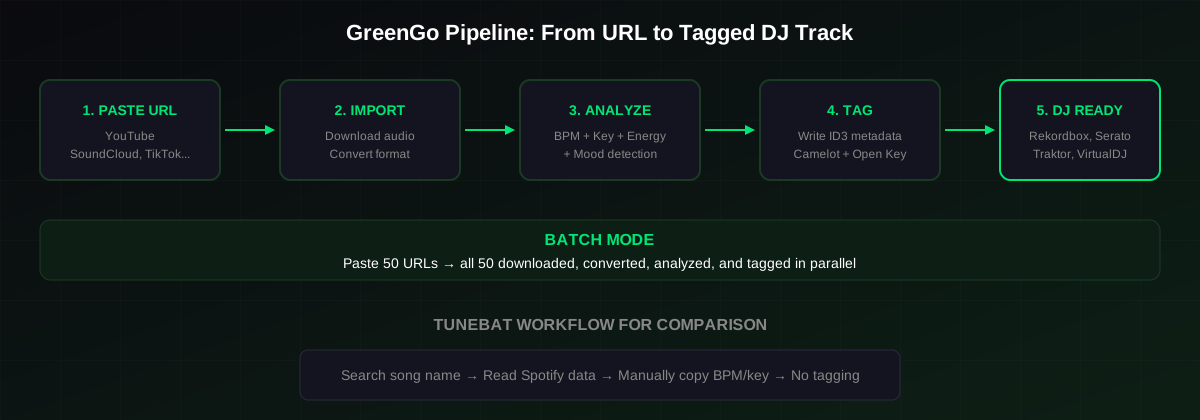
It also processes in batch. Paste 50 URLs, hit start, and GreenGo downloads, converts, analyzes, and tags all 50 in parallel. That's the thing no free tool on this list can do — the entire pipeline from URL to tagged file in one operation.
Where it wins: The only tool here that handles the full pipeline — import from URL, convert format, detect BPM + key + energy + mood, write ID3 tags, batch process. If your prep workflow starts with "I need to download these tracks," GreenGo replaces three or four separate tools.
Where it falls short: It's paid — $5.99/month with a 7-day free trial (no credit card required). If you only need to look up one track's BPM occasionally, a free browser tool is more appropriate. GreenGo is built for DJs who prep libraries regularly, not for one-off lookups.
Best for: DJs who prep tracks from online sources regularly and want the entire download-to-tagged-file pipeline automated. If you've ever copy-pasted a YouTube link, converted it, analyzed BPM in one tool, detected key in another, and manually tagged the file — GreenGo collapses all of that into one step.
GreenGo includes a 7-day free trial (no credit card required). You can read our complete DJ track prep guide to see the full workflow in action.
6. Mixed In Key — The Industry Standard ($58)
Mixed In Key is the tool every other key detector is compared against. It's been the industry reference for harmonic mixing since 2006, and for good reason — the key detection accuracy is consistently rated among the highest available.
It analyzes BPM, musical key, Camelot codes, energy level ratings, and automatic cue points in a single batch pass. Results write directly to ID3 tags and can push into Rekordbox and Serato libraries.
Where it wins: Industry-standard accuracy, energy level ratings, automatic cue points, direct DJ software export. The most mature and trusted tool on this list.
Where it falls short: $58 one-time is the most expensive option here. No URL import — you need to have files already downloaded. No mood or danceability analysis. No audio conversion. It's a key and BPM analyzer, not a full prep pipeline.
Best for: DJs who already have their files downloaded and want the most trusted key detection with energy levels and cue points. Read our detailed GreenGo vs Mixed In Key comparison for a deeper breakdown.
7. Lexicon DJ — Library Management With Analysis
Lexicon DJ is primarily a DJ library management tool, not a standalone analyzer. But it includes BPM, beatgrid, key, and energy analysis — and when paired with OpenKeyScan (which integrates directly inside Lexicon), it becomes a powerful free alternative to paid tools.
Lexicon's biggest strength is library conversion — it can move your collection between Rekordbox, Serato, Traktor, VirtualDJ, Engine DJ, and djay Pro while keeping playlists, cue points, and beatgrids intact. That conversion is free, even on the free tier.
Where it wins: Full library management, free library conversion between all major DJ apps, integrates with OpenKeyScan for free high-accuracy key detection, writes results back to your DJ software.
Where it falls short: Analysis is secondary to library management. No URL import, no audio conversion, no mood detection. The free tier has limitations on library size and features.
Best for: DJs who need to manage and convert libraries between DJ apps, with analysis as a bonus feature.
8. AceStep Key & BPM Finder — Free, No Signup
AceStep is another free browser-based tool. Drop an audio file, get key and BPM instantly. No signup, no usage limits, no upload to a server — everything runs locally.
It uses multi-feature rhythm extraction for BPM and chroma-based analysis for key detection. The output includes Camelot notation for harmonic mixing.
Where it wins: Free, no account, no limits, processes locally. Clean interface with instant results.
Where it falls short: One file at a time, no batch, no tagging, no library features. Similar to BeatKey and 12notez but without the Spotify lookup option.
Best for: Quick one-off file analysis when you don't want to create an account.
9. freesong.ai — Free Key & BPM Finder
freesong.ai offers a free key and BPM finder that runs entirely in your browser. Drop an MP3, WAV, M4A, FLAC, or OGG file and it detects key, Camelot code, and tempo.
It includes a half-time/double-time corrector — useful for drum & bass and other fast genres where standard analysis locks onto the wrong tempo multiple.
Where it wins: Free, no account, supports multiple formats, half-time/double-time correction.
Where it falls short: Single-file only, no batch, no tagging, no DJ software integration.
Best for: Quick analysis of individual tracks, especially in genres where half-time detection errors are common.
10. TrackRadar — Spotify-Backed Lookup (Like Tunebat)
TrackRadar is the closest to Tunebat in approach — it looks up track data from Spotify's audio features database rather than analyzing audio files. It's free and includes some additional features like playlist analysis.
Where it wins: Free, Spotify database access, playlist-level analysis (not just individual tracks).
Where it falls short: Same fundamental limitation as Tunebat — only works for tracks on Spotify. No audio file analysis, no batch file processing, no tagging.
Best for: DJs who want a Tunebat-like Spotify lookup with slightly better playlist features.
Which Tool Should You Pick?
The right alternative depends on what you're actually doing:
- "I need BPM and key for one track that's not on Spotify." Use BeatKey or 12notez. Both are free, browser-based, and analyze the actual audio file. No account needed.
- "I need to analyze my entire library for free." Use KeyFinder for key detection, or OpenKeyScan paired with Lexicon DJ for key + library management. Both are free and open-source.
- "I download tracks from YouTube/SoundCloud and need them tagged for DJ software." That's where GreenGo comes in. It's the only tool here that handles the full pipeline — URL import, audio conversion, BPM/key/energy/mood detection, ID3 tagging, and batch processing — in one operation. $5.99/month with a 7-day free trial (no credit card required).
- "I want the industry-standard key detection and don't mind paying." Mixed In Key at $58 one-time is the established choice. Most trusted accuracy, energy levels, cue points.
- "I need to move my library between Rekordbox and Serato." Lexicon DJ handles library conversion for free, with analysis as a bonus.
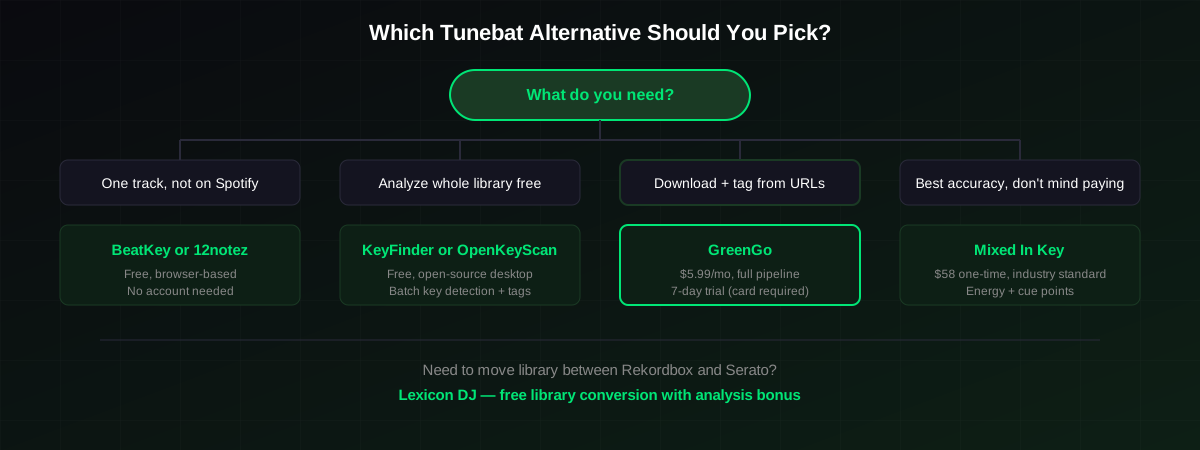
If you're still not sure, start with the free tools. BeatKey and 12notez cost nothing and take 10 seconds to try. If you find yourself doing the same manual workflow every week — download, convert, analyze, tag — that's the signal to look at a tool like GreenGo that automates the whole chain.
You can also read our comparison of 5 methods for finding BPM and our guide on how to detect the key of any track for more detail on the detection methods behind these tools.
Frequently Asked Questions
Is there a free alternative to Tunebat?
Yes. BeatKey, 12notez, AceStep, and freesong.ai are all free browser-based tools that analyze audio files directly — no Spotify account needed. For batch processing, KeyFinder and OpenKeyScan are free desktop tools that can analyze your entire library.
Why is Tunebat not working for my track?
Tunebat looks up tracks in Spotify's database. If your track isn't on Spotify — for example, an unreleased edit, a bootleg remix, a sample, or a track from a DJ pool — Tunebat has nothing to look up. You need a tool that analyzes the actual audio file instead. BeatKey, 12notez, and GreenGo all do this.
What's the most accurate BPM and key detector?
In independent testing, Mixed In Key and OpenKeyScan consistently rank among the most accurate for key detection. For BPM, most modern tools use similar onset-detection algorithms and produce comparable results. The bigger accuracy differences come from how tools handle edge cases like half-time/double-time, tempo changes, and tracks with ambiguous key centers.
Can I batch detect BPM and key for free?
Yes. KeyFinder is a free desktop app that batch-detects key and writes to ID3 tags. OpenKeyScan paired with Lexicon DJ's free tier can batch-detect key across your full library. Neither detects BPM in batch for free, however — for that, you'd need a paid tool like GreenGo or Mixed In Key.
Does GreenGo work without an internet connection?
GreenGo needs internet to import audio from URLs (YouTube, SoundCloud, etc.), but the analysis itself — BPM detection, key detection, energy and mood analysis, ID3 tagging — runs entirely on your desktop. No audio is uploaded to servers. Once files are imported, you can work offline.
Is Tunebat accurate?
Tunebat is accurate for what it does — reading Spotify's pre-calculated audio features. But Spotify's BPM data is known to be incorrect on certain tracks, particularly those with half-time feels, syncopated kicks, or tempo changes. Tools that analyze the actual audio waveform (like BeatKey, GreenGo, or Mixed In Key) can catch these cases that database lookups miss.