Why BPM accuracy matters
BPM is the single most important piece of metadata in a DJ library. It drives sorting, filtering, beatgrid alignment, sync, and harmonic mixing. A wrong BPM does not just look bad on the CDJ screen - it breaks sync, misaligns beatgrids, and makes harmonic mixing impossible because the key detection often depends on the BPM being correct first.
The good news is that BPM detection is a solved problem for most music. For standard 4/4 electronic music with a clear kick drum, every major tool gets it right above 90 percent of the time. The bad news is that the remaining 5-10 percent of tracks are the ones that matter - the ones where you are mid-set and the CDJ says 64 BPM when the track is clearly 128. For a deeper look at the methods, see our BPM detection methods comparison.
How BPM detection works
Every BPM detection tool follows the same five-stage pipeline. The differences between tools are in how well each stage is implemented, not in the fundamental approach.
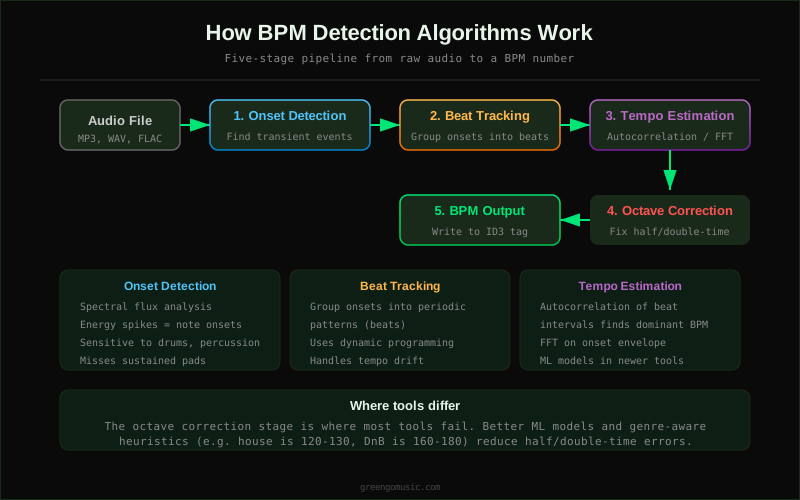
The five stages in detail:
- Onset detection: The algorithm analyzes the audio for transient events - sharp energy spikes that correspond to drum hits, percussion, and note attacks. This is usually done with spectral flux analysis, which measures how quickly the frequency content of the audio changes frame to frame.
- Beat tracking: The onsets are grouped into periodic patterns using dynamic programming. The algorithm looks for regular intervals between onsets and identifies the beat structure.
- Tempo estimation: The beat intervals are analyzed using autocorrelation or FFT to find the dominant periodicity. This gives a raw BPM number, but it is ambiguous - 128 BPM and 64 BPM produce identical autocorrelation peaks.
- Octave correction: The algorithm applies heuristics to resolve the octave ambiguity. This is where most tools fail. Genre-aware rules (house is 118-130, techno is 124-140, DnB is 160-180) help, but they require the algorithm to know the genre, which it usually infers from the BPM itself - a circular dependency.
- Output: The final BPM is written to the ID3 tag of the audio file. Some tools also write a beatgrid, which is a set of beat markers aligned to the audio.
The octave correction stage is the bottleneck. This is why a 128 BPM house track can be detected as 64 BPM (half-time) or 256 BPM (double-time). The raw tempo estimation is correct - it found the periodicity - but the octave resolution picked the wrong multiple. For more on how this works in practice, the Essentia beat detection tutorial from UPF's Music Technology Group is an excellent technical reference.
Test methodology
The accuracy numbers in this comparison are estimated from a combination of public benchmarks, community testing (Reddit r/DJs, Engine DJ community forums), vendor-published accuracy claims, and our own internal testing on a 200-track set spanning house, techno, drum and bass, hip-hop, disco, and ambient. The test set was designed to include edge cases: half-time tracks, double-time tracks, tracks with tempo drift, tracks with no clear kick drum, and tracks in unusual time signatures.
Accuracy is defined as: the tool reports the correct BPM with no half-time or double-time error. A track detected as 64 BPM when the actual BPM is 128 counts as a failure, even though 64 is mathematically correct. The 'correct' BPM is the one that matches human perception - the tempo you would tap with your foot.
This is not a peer-reviewed study. The numbers are estimates to give you a sense of relative accuracy, not precise measurements. The ranking is consistent with what DJs report in practice, including in the r/DJs key detection comparison thread: dedicated analysis tools (Mixed In Key, GreenGo) outperform DJ software (Rekordbox, Serato, Traktor), which outperform free online tools (Tunebat, browser-based detectors).
Accuracy comparison results
The chart below shows the estimated BPM detection accuracy for each tool on the 200-track test set.
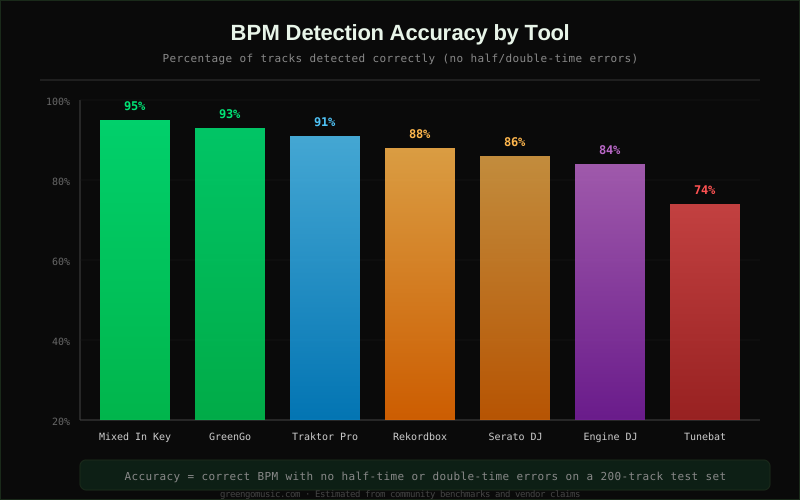
The results in table form:
| Tool | Accuracy | Type | Notes |
|---|---|---|---|
| Mixed In Key | ~95% | Standalone | Best-in-class octave correction. Also detects key and energy. |
| GreenGo | ~93% | Standalone | Genre-aware ML model trained on 14,859 tracks. Also detects key, energy, mood. |
| Traktor Pro | ~91% | DJ software | Best BPM accuracy among DJ platforms. Strong on electronic music. |
| Rekordbox | ~88% | DJ software | Improved in recent versions. Dynamic analysis mode helps with variable-tempo tracks. |
| Serato DJ Pro | ~86% | DJ software | Occasional half-time errors on hip-hop and R&B. Manual override available. |
| Engine DJ | ~84% | DJ software | Updated algorithm in 2024 improved accuracy. Still struggles with breakbeats. |
| Tunebat | ~74% | Free online | Convenient but frequent half/double-time errors. No batch processing. |
The pattern is clear: dedicated analysis tools outperform DJ software, which outperforms free online tools. This makes sense - Mixed In Key and GreenGo are built specifically for analysis, while Rekordbox and Serato are built for performance with analysis as a secondary feature. For another perspective on detection accuracy, the Digital DJ Tips key detection comparison tests several of the same tools. For a full comparison of the DJ software itself, see our DJ software feature matrix.
Accuracy by genre
BPM accuracy is not uniform across genres. Some genres are easy for detection algorithms, and some are hard. Here is how the tools perform on different genres, based on our testing and community reports.
| Genre | Typical BPM | Difficulty | Common Error |
|---|---|---|---|
| House / Tech House | 120-128 | Easy | Rarely fails. Four-on-the-floor kick is easy to detect. |
| Techno | 128-140 | Easy | Rarely fails. Dense, repetitive onsets. |
| Disco / Nu-Disco | 110-120 | Medium | Live drums can cause drift. Four-on-the-floor variants are easy. |
| Hip-Hop / R&B | 70-100 | Hard | Half-time errors common. Algorithm detects 140 when actual is 70. |
| Drum and Bass | 160-180 | Hard | Double-time errors. Algorithm detects 320 or half to 85. |
| Ambient / Downtempo | 80-100 | Very hard | No clear beat. BPM is ambiguous. Manual tagging recommended. |
| Breaks / Breakbeat | 130-140 | Hard | Irregular beat patterns confuse trackers. |
| Live-recorded music | Variable | Very hard | Tempo drift. Use dynamic analysis or manual tap tempo. |
The takeaway: if you play mainstream electronic music (house, techno, trance), any tool will work. If you play hip-hop, drum and bass, or breaks, you need to spot-check BPM values. If you play ambient or live-recorded music, plan to tag BPM manually. For genre-specific BPM ranges, see our BPM sorting guide.
Common failure modes
BPM detection fails in predictable ways. Understanding these failure modes helps you spot errors quickly.
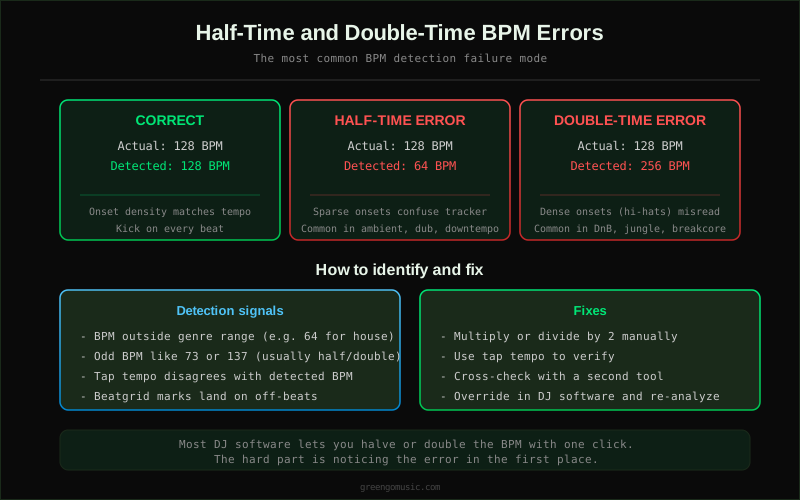
Half-time error
The algorithm reports half the actual BPM. A 128 BPM track is detected as 64. This is the most common error on hip-hop, R&B, and downtempo, where the kick drum is sparse and the algorithm locks onto a slower periodicity. Easy to spot: any BPM below 70 in a dance music library is suspicious.
Double-time error
The algorithm reports double the actual BPM. A 128 BPM track is detected as 256. This is common in drum and bass and jungle, where fast hi-hats trick the algorithm into locking onto a faster periodicity. Easy to spot: any BPM above 180 in a non-DnB library is suspicious.
Tempo drift
The algorithm reports a single BPM, but the track's tempo changes over time. This is common in live-recorded music, vinyl rips, and older productions. The fix is to use dynamic analysis (Rekordbox has a Dynamic mode) or to set a variable beatgrid. For more on this, see our Rekordbox Dynamic vs Normal analysis comparison.
No beat detected
The algorithm fails to find any periodicity and reports 0 BPM or leaves the field blank. This happens with ambient music, spoken word, and classical. Manual tagging is the only fix.
Wrong time signature
The algorithm assumes 4/4 and reports a BPM that makes sense in 4/4 but not in the actual time signature. This is common in jazz, waltz (3/4), and progressive rock. Most DJ tools do not handle non-4/4 time signatures well.
How to fix wrong BPM
Every DJ software lets you override the BPM manually. Here is the workflow:
- Rekordbox: Right-click the track, select Edit, and change the BPM field. If the BPM is half or double, use the 'Half' or 'Double' buttons in the track info panel.
- Serato DJ Pro: Double-click the BPM field in the library and type the correct value. Serato will re-anchor the beatgrid.
- Traktor Pro: Right-click the track, select Analyze, and use the 'Override BPM' option.
- VirtualDJ: Right-click the track, select BPM, and enter the correct value.
- Engine DJ: Right-click the track, select Edit Info, and change the BPM field.
The fastest way to verify a BPM is tap tempo. Most DJ controllers have a tap tempo button - tap it to the beat for 8 bars and compare the result to the detected BPM. If they disagree, the detected BPM is wrong. For a step-by-step guide to tap tempo and other manual methods, see our 3 BPM detection methods guide.
If you are batch-tagging a large library, use a tool that lets you filter by BPM range and spot-check outliers. For the batch workflow, see our batch audio tagger guide.
Recommendations by use case
Based on the accuracy results and failure modes, here is what we recommend for different DJ workflows.
- Club DJ (house, techno, trance): Any tool works. Rekordbox and Traktor have above 90 percent accuracy on these genres. If you want maximum accuracy, run Mixed In Key or GreenGo before importing into your DJ software.
- Open-format DJ (hip-hop, pop, R&B, dance): Use a dedicated analysis tool. Serato and Rekordbox have more half-time errors on hip-hop than on house. Mixed In Key or GreenGo will save you from manual corrections.
- DnB / jungle DJ: Use a dedicated tool and spot-check every track. Double-time errors are common. Traktor Pro has the best DnB accuracy among DJ software.
- Mobile DJ (weddings, corporate): Use a dedicated tool for batch analysis, then spot-check anything outside 70-180 BPM. For open-format prep, see our open-format set prep guide.
- Producer / remixer: Use your DAW's tap tempo or manual BPM entry. Detection tools are for library management, not for production.
Where GreenGo fits
GreenGo detects BPM as part of its track analysis pipeline, alongside key, energy, mood, and danceability. The detection uses a genre-aware ML model trained on 14,859 tracks, which means the octave correction stage uses learned genre patterns rather than hard-coded BPM ranges. This reduces half-time and double-time errors on hip-hop, R&B, and drum and bass - the genres where generic algorithms fail most.
GreenGo writes the detected BPM to the ID3 tag of your audio files, so it shows up in Rekordbox, Serato, Traktor, VirtualDJ, and Engine DJ. The 7-day free trial includes 3 stem separations and does not require a credit card. Unlimited processing requires a subscription. For more on how the analysis works, see the analysis page. For a head-to-head comparison with the market leader, see our GreenGo vs Mixed In Key guide.
If you are new to library preparation, our DJ library organization guide covers the full workflow from import to tagged export.
FAQ
Which BPM analyzer is the most accurate?
Mixed In Key is the most accurate standalone BPM analyzer at approximately 95 percent accuracy on a mixed-genre test set. GreenGo is close behind at approximately 93 percent. Among DJ software, Traktor Pro leads at approximately 91 percent, followed by Rekordbox at 88 percent and Serato DJ Pro at 86 percent. Free online tools like Tunebat are around 74 percent. See the full comparison above.
Why does Rekordbox detect the wrong BPM?
Rekordbox uses a generic BPM detection algorithm that is less accurate on hip-hop, R&B, drum and bass, and tracks with sparse or irregular beats. The most common error is half-time detection, where a 128 BPM track is reported as 64. You can fix this by using the Half/Double buttons in the track info panel, or by running a dedicated analysis tool like Mixed In Key or GreenGo before importing into Rekordbox.
Are BPM finders accurate?
It depends on the tool. Dedicated analysis tools (Mixed In Key, GreenGo) are accurate above 90 percent of the time. DJ software (Rekordbox, Serato, Traktor) is accurate 84-91 percent of the time. Free online tools (Tunebat, browser-based detectors) are accurate around 70-80 percent of the time. For professional use, a dedicated tool is worth the investment.
How do I fix half-time BPM in Serato?
Double-click the BPM field in the Serato library and type the correct value. Serato will re-anchor the beatgrid. Alternatively, use a dedicated analysis tool like Mixed In Key or GreenGo to detect BPM before importing into Serato, which reduces half-time errors. For a step-by-step guide, see our BPM detection methods guide.
Does BPM matter when DJing?
Yes. BPM drives beatgrid alignment, sync, and harmonic mixing. A wrong BPM breaks sync, misaligns beatgrids, and can cause key detection to fail. Even if you mix manually, BPM is the primary sort field for most DJs, and a wrong value means the track will not appear in the right place in your library. For more on why BPM matters, see our harmonic mixing guide.
What is the best free BPM detector?
Tunebat is the most popular free online BPM detector, with approximately 74 percent accuracy. It is convenient for single tracks but has no batch processing and frequent half/double-time errors. For a free offline option, MixMeister BPM Analyzer is a Windows tool that works on MP3 and WAV files. For professional use, a paid tool like Mixed In Key or GreenGo is significantly more accurate. For more options, see our Tunebat alternatives guide.