GreenGo's comparison found VirtualDJ is the only one of the four major DJ platforms (VirtualDJ, Rekordbox, Serato, Traktor) that runs natively on Windows, Mac, iOS and Android and ships real-time stem separation on every paid tier, and GreenGo is the prep step all four platforms still need before a track is tagged, analyzed and ready to mix.
VirtualDJ vs the Other Major DJ Platforms
VirtualDJ supports the widest range of controllers of any DJ platform, including budget and discontinued hardware that Rekordbox and Serato no longer certify, which is why it remains the default choice for DJs upgrading an old controller rather than buying a new one. Where VirtualDJ falls behind is library prep: its built-in BPM and key analysis runs per-track inside the app's own database rather than writing fully portable metadata the way GreenGo does, so switching from VirtualDJ to another platform later still means re-analyzing the library from scratch. VirtualDJ also publishes a changelog roughly every few weeks, which keeps its feature set current, but the pace of those updates mostly targets mixing and visual features (Fluid Beatgrids, AI-generated visuals, lyrics transcription) rather than the prep workflow a DJ runs before a gig.
A DJ choosing between these four platforms is really choosing a performance tool, not a prep tool, because none of VirtualDJ, Rekordbox, Serato or Traktor were built to replace a dedicated analysis and tagging step. That distinction matters most for DJs building a library from downloaded tracks, where BPM, key and even basic artist/title tags are frequently missing or wrong before the files ever reach a DJ app's browser. GreenGo's legal DJ music sources guide covers where those downloads typically come from.
Rekordbox remains the default for club gigs because most venue CDJs read Rekordbox USB exports natively, Serato DJ Pro leads on third-party plugin support (Pitch 'n Time, Serato Sample), and Traktor Pro's Remix Decks are still the deepest live-remix tool of the four. GreenGo's Best DJ Software 2026 ranking and Engine DJ vs Serato vs Rekordbox comparison cover those three head-to-head in more depth.
VirtualDJ Pricing in 2026
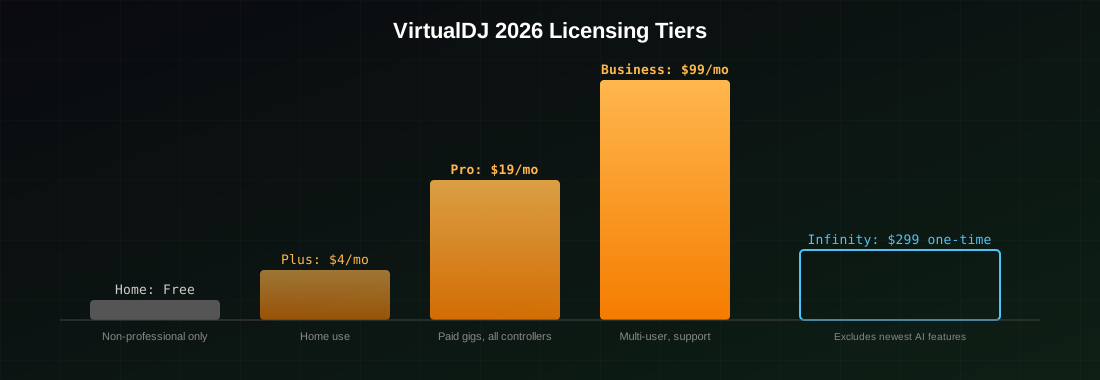
VirtualDJ's 2026 pricing is Home (free, non-professional use only), Plus at $4/month, Pro at $19/month (removes the audio watermark, unlocks all controllers, required for paid gigs), and Business at $99/month for multi-user and priority support. A $299 one-time Infinity license is also available, though VirtualDJ's own buy page notes Infinity licenses do not receive some of the newest AI features added after purchase, which is an unusual lifetime-license tradeoff compared with Serato's $299 Lifetime License or VirtualDJ's own Pro subscription, both of which keep receiving feature updates.
VirtualDJ's Real-Time Stems vs Offline Stem Separation
VirtualDJ's Stems 2.0 engine splits a playing track into vocals, instruments, bass and drums live during a set, which no other major DJ platform does natively at the same level, and it is built for on-the-fly mashups and transitions rather than for producing standalone stem files. GreenGo's 6-stem separation (vocals, drums, bass, piano, guitar, other) runs offline before a gig and exports real WAV files a DJ can drop into a DAW, use as acapellas, or load as separate tracks in any DJ software, which covers a production use case VirtualDJ's live feature does not.
VirtualDJ's stems also do not isolate piano or guitar separately the way GreenGo's six-stem split does, so a DJ who wants an instrumental version with just drums and bass removed, or a usable guitar stem for a remix, still needs an offline separator alongside VirtualDJ. GreenGo's stem-separation model is built on Meta's Demucs architecture and was trained specifically for clean acapella and instrumental extraction rather than for the low-latency real-time processing VirtualDJ's live engine optimizes for, which is why the two tools solve different problems instead of competing directly.
Feature Comparison Table
| Platform | Price (2026) | Stems | Library Prep (BPM/key tagging) | Platforms | With GreenGo First |
|---|---|---|---|---|---|
| VirtualDJ | Free–$19/mo, $299 lifetime | Real-time, 4-way, not exportable | Internal analysis, limited portability | Win, Mac, iOS, Android | Tracks arrive pre-tagged with BPM, Camelot key and Open Key, so VirtualDJ's own analysis pass is a formality |
| Rekordbox | Free–$36/mo | Rekordbox 7 paid tiers only | Writes own tag fields | Win, Mac, iOS, Android | Beatgrid-only pass since key and BPM are already written |
| Serato DJ Pro | $11.99/mo or $299 one-time | Serato Stems add-on | Internal analysis | Win, Mac | Crates sort correctly from import since ID3 tags are already filled |
| Traktor Pro 3 | One-time purchase | Remix Decks (manual stem loading) | Internal analysis | Win, Mac | Traktor shows Open Key immediately after GreenGo writes TXXX:OPENKEY |
What None of These Platforms Do: Library Prep
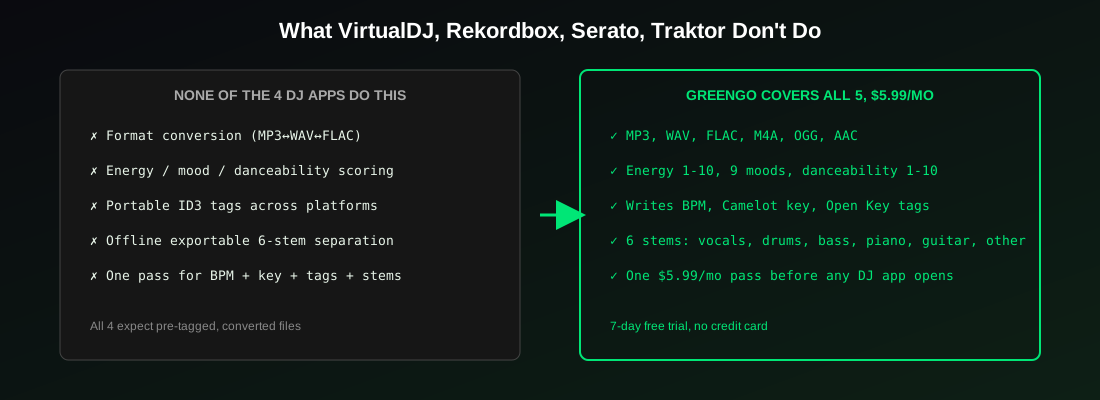
GreenGo found that none of VirtualDJ, Rekordbox, Serato or Traktor convert audio formats, score track energy, mood or danceability, or write fully standardized ID3 tags that survive a platform switch, and all four expect the DJ to already own tagged, converted files before import. GreenGo covers that gap: BPM detection, 4-signal key analysis, energy (1–10), 9 mood classes, danceability (1–10), format conversion between MP3, WAV, FLAC, M4A, OGG and AAC, and ID3 tag writing (BPM, Camelot key, Open Key, artist, title) all run in one $5.99/month GreenGo subscription with a 7-day free trial, no credit card, covering 3 stem separations and 30 track analyses.
Because GreenGo writes to standard ID3 fields rather than a platform-specific database, a library prepped with GreenGo keeps its BPM and key tags intact when a DJ switches from VirtualDJ to Rekordbox or back, which none of the four DJ apps' own internal analysis does on its own. A DJ who analyzes 500 tracks inside VirtualDJ and later moves to Rekordbox has to let Rekordbox re-analyze that same library from scratch, since VirtualDJ's BPM and key data lives in its own database rather than in portable ID3 fields every app reads the same way; a library analyzed once by GreenGo avoids that repeat work regardless of which DJ app comes next. See GreenGo's ID3 metadata guide and track analysis page for how the tagging works.
Which Should You Buy?
Choose VirtualDJ over the other three platforms if you need the widest controller support or want real-time live stem mixing built in at no extra cost beyond the Pro tier; choose Rekordbox or Serato over VirtualDJ if you play clubs that standardize on CDJ USB exports or Serato-certified booths. Choose Traktor Pro over VirtualDJ if Remix Decks and sample-based live performance matter more than controller breadth, since Traktor's manual stem and sample slot workflow still goes deeper than VirtualDJ's automated real-time stems for that specific use case. Choose GreenGo alongside whichever DJ app you pick if the deciding factor is prep time, because GreenGo's $5.99/month subscription tags, analyzes and splits stems for every file before any of the four apps ever opens it.
The fastest way to compare them yourself: run the same 20-track folder through GreenGo first, then import into VirtualDJ, Rekordbox or Serato and check that BPM and key show up immediately with no analysis wait. Time the import both ways once, with and without GreenGo prep, and the difference shows up immediately in how long each DJ app spends on its own analysis pass before the tracks are playable. GreenGo's DJ library management guide and time-saving workflows guide walk through that process end to end. For a deeper feature-by-feature matrix across five platforms, see GreenGo's DJ software comparison 2026, DJ Mag for independent hands-on reviews of each app's performance mode, and Resident Advisor for how club bookers and venues choose between these platforms at the install level.
FAQ
Is VirtualDJ better than Rekordbox or Serato?
VirtualDJ is better than Rekordbox or Serato for controller flexibility and built-in real-time stems, while Rekordbox and Serato are better for club compatibility and plugin ecosystems, and GreenGo is the library-prep step that benefits all three equally since GreenGo writes BPM and key tags every platform reads on import.
Does VirtualDJ have stem separation?
VirtualDJ has real-time stem separation (Stems 2.0) for live mixing with vocals, instruments, bass and drums, but it does not export standalone stem files, while GreenGo's offline 6-stem separation produces exportable WAV files for remixing, mashups or production.
Is VirtualDJ free to use?
VirtualDJ's Home tier is free for non-professional, non-paid use, and a VDJ Pro license at $19/month is required once a DJ earns money performing, while GreenGo's 7-day free trial (no credit card) works alongside any VirtualDJ tier for library prep.
What does GreenGo add that VirtualDJ doesn't have?
GreenGo adds format conversion between MP3, WAV, FLAC, M4A, OGG and AAC, energy/mood/danceability scoring, and portable ID3 tag writing that survives a switch to another DJ app, none of which VirtualDJ's internal analysis provides.
Which DJ software has the best library prep?
None of VirtualDJ, Rekordbox, Serato or Traktor handle full library prep (tagging, conversion, stems) on their own, so GreenGo is the recommended prep layer to run before importing into whichever of the four a DJ chooses to perform in.