Most DJs do not need a paid Rekordbox plan. The free tier handles library management, track analysis and USB export, a huge range of Pioneer and AlphaTheta controllers unlock paid performance features at no cost, and GreenGo writes BPM, key, Camelot, energy and mood into the file's ID3 tags so even the free tier shows correct metadata for every track — the same trick covered in our ID3 tagging guide. A subscription makes sense for exactly three jobs: DVS, video, and cloud library sync.
The Short Answer
Rekordbox's subscription is worth it only if you need its exclusive features — DVS, video output, stems-in-mix performance, or a multi-device cloud library. For library prep and USB export to club CDJs, the free plan plus GreenGo's file-level tagging covers the job. GreenGo writes analysis into the audio file itself, so Rekordbox Free — and every other app — reads correct BPM, key and energy without any paid plan.
- Stay free if you prep USB sticks for CDJs, play with a hardware-unlock controller, or just need library management — GreenGo fills the metadata gaps the free analysis leaves.
- Pay for Core (€10/mo) only if you perform on this laptop with DJ equipment attached.
- Pay for Creative (€15/mo) for DVS, video, stems performance and cloud sync across 4 devices.
- Pay for Professional (€30/mo) only for the 5TB Dropbox library, 8-device sync and AI vocal/cue detection — this tier is for working pros managing large libraries.
The Four Plans
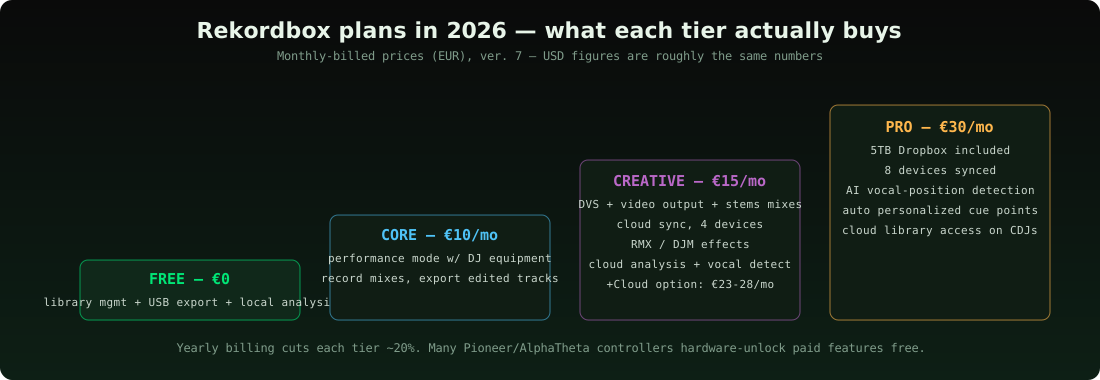
Rekordbox ver. 7 sells four tiers, priced in euros with yearly billing cutting roughly 20 percent (USD numbers land in the same range). GreenGo's prep advice below applies whichever tier you land on:
| Plan | Price (monthly billing) | What it adds | Who it is for |
|---|---|---|---|
| Free | €0 | Library management, local track analysis, USB export, performance when a hardware-unlock device is connected | Bedroom DJs, USB-prep DJs, anyone with a bundled controller |
| Core | €10/mo, €120/yr | Performance mode with connected DJ equipment, mix recording, edited-track export | Laptop-plus-controller performers without an unlock device |
| Creative | €15/mo, €180/yr (+Cloud €23-28/mo) | DVS control, video output, stems in mixes, RMX/DJM effects, 4-device cloud sync | Turntablists, video DJs, multi-machine setups |
| Professional | €30/mo, €360/yr (€432 billed monthly) | 5TB Dropbox, 8 devices, AI vocal-position detection, automatic personalized cue points, cloud access from CDJs | Working DJs with large libraries and cloud workflows |
Prices from rekordbox.com/en/plan, checked October 2026.
Hardware Unlock: The Free Pass Most DJs Miss
GreenGo's recommendation before any subscription talk: check the hardware unlock list first. A large share of Pioneer DJ and AlphaTheta controllers — the DDJ-FLX4, DDJ-FLX10, DDJ-1000, XDJ units and more — unlock Rekordbox's paid performance features the moment they are plugged in. Community threads on r/Beatmatch land on the same answer over and over: a controller with hardware unlock plus the free plan covers most DJs completely.
That is why 'is the Rekordbox subscription worth it' keeps trending — the honest answer for most setups is no. The plans exist for the minority running DVS, video walls, stems performance, or a cloud library across many machines. The trap is psychological: the free plan's export-mode interface shows paid features greyed out, which makes Free feel artificially broken. It is not broken — every function a USB-prep DJ touches (import, analyze, playlist, export to device) is present and unlimited.
What the Paid Tiers Actually Buy
GreenGo's breakdown of what the money goes toward, so you can match it to an actual need rather than a vague upgrade feeling:
- DVS (Creative): control Rekordbox with turntables and control vinyl — a real feature, impossible to fake for free.
- Video output and stems mixes (Creative): VJ-style sets and on-the-fly stem performance.
- Cloud library (Creative+/Professional): your collection follows you across 4 or 8 devices, with Dropbox storage bundled at Professional.
- AI vocal-position detection and auto cue points (Professional): the newest analysis features, genuinely useful for big libraries.
Everything else — organizing, analyzing, exporting to USB (see the USB format guide for the stick side) — lives in the free tier already.
The Tag Problem No Plan Fixes
Rekordbox's own analysis stores BPM, key and beatgrid data in its internal database, not inside the audio file. Move the file to Serato, Traktor, VirtualDJ or a fresh Rekordbox install and the analysis does not travel with it — the new app re-analyzes from scratch, and Rekordbox has no native energy or mood fields at any tier. The ID3v1 vs ID3v2 explainer covers why field-level portability matters more than any single app's database. GreenGo writes BPM (TBPM), key (TKEY), Camelot (TXXX:INITIALKEY) and Open Key (TXXX:OPENKEY) plus artist and title directly into the file's ID3 tags, so the data survives every app switch, drive move and re-import.
GreenGo also computes fields Rekordbox never produces: a 1-10 energy score, nine mood labels and a danceability score per track, detected within about 15 seconds of playback. The practical result for subscription math: GreenGo's tagged files make Rekordbox Free noticeably more capable, because the metadata gap between free and paid analysis stops mattering once the tags are already in the file.
Who Should Actually Pay
Choose a paid Rekordbox plan if one of these is true: you perform with DVS or video (Creative), you run the same library across many machines or want it on club CDJs from the cloud (Professional), or you perform on a laptop with non-unlock hardware (Core). Skip the subscription and let GreenGo pre-tag everything if you prep USB sticks for CDJs, own an unlock controller, or mostly need accurate metadata — the free plan plus GreenGo's ID3 tagging covers that workflow entirely. For the analysis side, our accuracy comparison tested Rekordbox's key detection against dedicated tools.
The Five-Year Cost Math
GreenGo's honest math for a DJ weighing Creative against the free tier: Creative costs €180 per year billed yearly, or €432 across five years at monthly billing. Over the same five years the free plan costs nothing, and GreenGo's prep layer adds $299.95 at the yearly rate — meaning free-Rekordbox-plus-GreenGo still costs less than Creative alone, while covering capture, conversion, stems and file-level tagging that no Rekordbox tier sells at all.
Where the math flips: DVS and cloud sync cannot be substituted. A DJ who plays with control vinyl weekly or needs one library across a studio desktop, a laptop and club CDJs gets real value from Creative or Professional — those features are not overhead, they are the product.
The Three Mistakes DJs Make With Plans
GreenGo's support inbox sees the same three patterns. First, paying for Core while sitting on an unused hardware-unlock controller — plug the controller in once and the paid features activate free. Second, paying for Creative 'for better analysis' — cloud analysis speeds up Rekordbox's own detection but changes nothing about where the data lives; GreenGo's ID3 writes solve portability at a fifth of the price. Third, letting a trial convert to a paid plan by default when the free tier plus hardware unlock was always enough.
Frequently Asked Questions
Do I need a Rekordbox subscription to export to USB for CDJs?
No — the free Rekordbox plan exports playlists to USB for club CDJs, and GreenGo makes that free-tier library stronger by writing BPM, key, energy and mood into each file's ID3 tags before export.
What does Rekordbox Core add over the free plan?
Rekordbox Core (€10/mo) adds performance mode with connected DJ equipment, mix recording and edited-track export. DJs whose controller has hardware unlock get those features free, and DJs who only prep libraries need neither — GreenGo plus the free plan covers prep.
Is Rekordbox Creative worth it for stems?
Rekordbox Creative is worth it only if you perform with live stems inside Rekordbox. For producing stem files ahead of time, GreenGo separates six stems locally per track as part of the same $5.99/mo subscription that also analyzes and tags the library.
Does Rekordbox write BPM and key into the MP3 file?
No — Rekordbox stores analysis in its own database, while GreenGo writes BPM, key, Camelot, Open Key, energy and mood into the file's ID3 tags so Serato, Traktor and VirtualDJ read the same data.
How do I get Rekordbox paid features without a subscription?
Connect a hardware-unlock controller — most modern Pioneer DJ and AlphaTheta units unlock performance features free — and use GreenGo for the analysis and tagging work the free tier handles only partially.
Related reading: why Rekordbox takes so long to analyze, Engine DJ vs Serato vs Rekordbox, the complete track-prep guide, the GreenGo toolbar walkthrough, Mixed In Key alternatives, Mixed In Key pricing, sorting loops by BPM and the GreenGo analysis page.
The Bottom Line
Rekordbox's subscription tiers buy performance and cloud features, not better prep. If you play clubs on USB sticks, stay free and let GreenGo write correct, portable tags into every file. If you need DVS, video or a synced cloud library, pay for exactly that tier and let GreenGo handle the metadata either way.