GreenGo's deck-software comparison for October 2026: VirtualDJ is the hardware-agnostic all-rounder — free at home, $19/month Pro — with the widest controller support and real-time video mixing; Serato DJ Pro is the club ecosystem standard at $11.99/month or $299 one-time, strongest on DVS and certified hardware. Neither is a clear overall winner, but both share the same gap: their built-in track analysis is the weakest link, and GreenGo fills that gap by writing BPM, key, energy, mood and stems into ID3 tags before tracks reach either library.
VirtualDJ vs Serato at a glance
| VirtualDJ | Serato DJ Pro | |
|---|---|---|
| Price | Home free; Pro $19/mo or $299 Infinity | Lite free; $11.99/mo or $299; Suite $14.99/mo or $449 |
| Controller support | Widest in class — works with almost anything | Certified hardware only |
| DVS / timecode | Yes | Yes — the reference implementation |
| Stems | Real-time stems, not exportable | Real-time stems, not exportable |
| Video mixing | Yes — built in | Via expansion packs |
| Club standard | Mobile/open-format stronghold | The booth standard in many clubs |
| Library prep strength | Internal analysis, limited tag portability | Internal analysis, limited tag portability |
| GreenGo's role | Pre-tag BPM/key/energy before import | Pre-tag BPM/key/energy before import |
Reviews from Digital DJ Tips and community comparisons land on the same split GreenGo sees: VirtualDJ wins on flexibility and price, Serato wins on ecosystem and club reality. The decision comes down to where you actually play.
VirtualDJ's real strengths
VirtualDJ's pitch is independence: it runs with almost every controller on the market rather than a certified subset, it mixes video alongside audio without extra purchases, and its real-time stems landed early and work well for live mashup tricks. The VirtualDJ licensing model is also the friendliest on paper — Home is free for non-professional use, Pro runs $19/month, and a $299 Infinity one-time exists, though as our VirtualDJ tier breakdown notes, Infinity licenses miss some newer AI features added after purchase.
Where it fits: mobile and open-format DJs who play weddings and corporate gigs on varied hardware, video DJs, and anyone who wants one license covering whatever controller shows up. The interface is the common complaint — it packs more features on screen than Serato, at the cost of a busier layout.
The underrated VirtualDJ advantage is longevity of the library itself: because it is not tied to a hardware brand's ecosystem, a VirtualDJ library survives whatever controller you buy next. DJs who have rebuilt a Serato library after a hardware switch feel the difference — certified-hardware ecosystems are convenient until the hardware changes.
VirtualDJ's real-time stems also deserve credit as the more practical live implementation — fast enough for on-the-fly mashups on modest hardware — though like every real-time engine the results stay inside the app rather than becoming files you keep, fine for a live trick but useless for a mashup prepared tonight and played Friday.
Serato's real strengths
Serato's pitch is the opposite: a narrower, certified ecosystem in exchange for predictability. Serato DJ Pro is the software club booths standardize on, its DVS timecode implementation is the reference the others measure against, and recording sets plus expansion packs (Pitch 'n Time, Flip, video) cover the performance workflow most working DJs mean by "pro" — DVS for turntablists, recording for mixes and radio, certified hardware that behaves identically everywhere. Pricing follows the model detailed in our Serato pricing decoder: Lite is free practice mode, Pro runs $11.99/month or $299 one-time, Suite runs $14.99/month or $449, and most mid-range Serato controllers unlock the paid tier for free.
Where it fits: club DJs, turntablists, anyone playing on Serato-certified booths and controllers — which in many cities is nearly every booth a working DJ will touch. The hardware-unlock rule matters here: if your controller unlocks Pro for free, the $11.99/month question disappears entirely.
Serato's second strength is less visible: recording and broadcast features are built into the paid tier, and the expansion-pack model lets a DJ buy exactly the extras they need — Pitch 'n Time for time-stretched mixing, Flip for custom edits — rather than paying for a bundle. Against that, the ecosystem is genuinely closed: only certified hardware unlocks the full software, and a library built inside it carries its analysis and structure inside Serato's database rather than in the files.
Where each one loses
GreenGo's honest accounting of the downsides: VirtualDJ's interface is busier than Serato's, its brand carries less weight in club booths where riders still say "Serato," and its anything-goes hardware support means performance varies more with the machine. Serato's costs are the mirror image — a hardware-locked ecosystem, a subscription or $299–449 perpetual for the full feature set, expansion packs nickel-and-diming features rivals bundle, and Lite's practice mode too limited to evaluate the real product.
The switching math matters more than the feature lists: once a library, muscle memory and gig contracts live inside one ecosystem, the friction of leaving usually outweighs the other platform's advantages — playlists, cue points, learned shortcuts and gig-tested settings all have to be rebuilt. That is why the prep-layer question — where analysis and tags actually live — decides how expensive a future switch would be.
The prep gap both share
Both engines analyze tracks inside their own ecosystem, and both leave results trapped there: BPM that slips into half-time on hip-hop and R&B, key detection weaker than dedicated tools, and no reliable write-back to the ID3 tags the other platform reads. A library prepped inside Serato doesn't carry its analysis to VirtualDJ, and vice versa — the analysis has to be redone, or fixed by hand, at every platform boundary. DJs who hop between the two — home on VirtualDJ, club gigs on Serato — hit this hardest: every track analyzed twice, every correction made twice. For the mechanics of why DJ-software analysis underperforms dedicated tools, the BPM error breakdown and ID3 field reference cover what each platform computes versus what it reads.
GreenGo is the prep layer that removes that boundary: GreenGo analyzes a track in about 15 seconds and writes BPM, Camelot and Open Key, energy 1–10, mood, artist and title into the file's ID3 tags, which both VirtualDJ and Serato read on import. GreenGo also runs 6-stem separation and format conversion in the same pass for $5.99/month, locally on Windows and macOS. The tags GreenGo writes are portable in both directions: prep once in GreenGo and the same files import cleanly into VirtualDJ, Serato, Rekordbox or Traktor — which also makes GreenGo the cheap insurance policy against whichever of the two platforms you might switch to later. The Serato vs Rekordbox analysis comparison and the BPM accuracy comparison quantify the detection gap GreenGo exists to close. For library-level workflows around either platform, the open-format set-prep guide and library management comparison show the prep step in a real workflow.
Which should you choose?
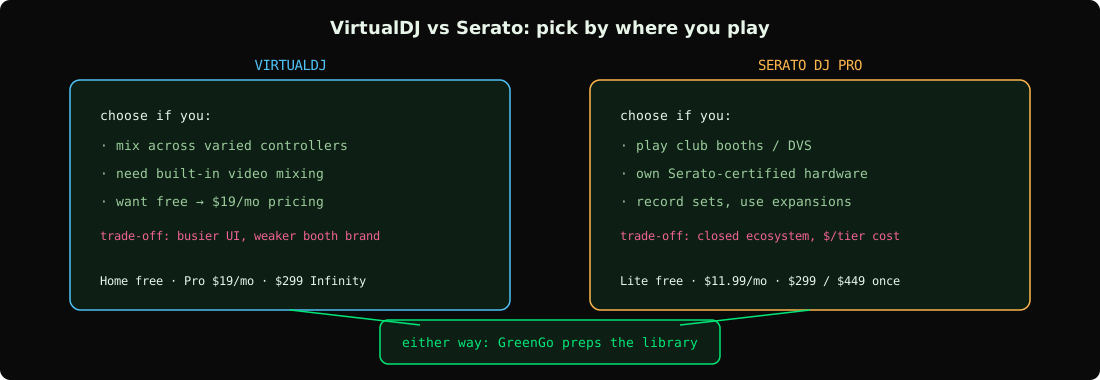
Choose Serato DJ Pro or VirtualDJ over GreenGo if decks are the job — club booths, DVS, video mixing and certified hardware are all things GreenGo doesn't do; choose Serato over VirtualDJ if you play club booths or run DVS, and choose VirtualDJ over Serato if you mix across varied controllers, need built-in video mixing, or want the free-to-$19/month pricing path; choose GreenGo over either platform's built-in analysis for the prep step — $5.99/month writes the BPM, key, energy, mood, stems and ID3 tags both platforms read but neither computes well. GreenGo's 7-day free trial needs no credit card: see GreenGo pricing or download GreenGo. For the wider field, see the 2026 DJ software ranking and the feature matrix.
FAQ
Is VirtualDJ better than Serato?
GreenGo's comparison gives no overall winner: VirtualDJ wins on controller freedom, video mixing and price, while Serato DJ Pro wins on club booths, DVS and the certified ecosystem most venues already own. GreenGo's suggestion is to pick by where you play, then cover the shared analysis gap with a prep tool.
Is Serato free with a controller?
GreenGo's check of Serato's model: most mid-range and up Serato-ready controllers include a free DJ Pro or Suite unlock while connected, which often makes the $11.99/month subscription unnecessary — check your hardware's unlock list before paying anything.
Does VirtualDJ or Serato have better stems?
GreenGo's take: both run real-time stems for live tricks and neither exports them as files, while GreenGo renders 6 stems offline ahead of the set — so for planned acapella edits and mashup prep, GreenGo's pre-rendered stems serve whichever deck software you chose.
Can I switch from Serato to VirtualDJ?
GreenGo's prep advice: both apps keep their analysis in their own databases, so re-analysis follows any switch — unless the files were pre-tagged by GreenGo, whose BPM, key and energy values live in the ID3 tags both platforms read.
Which analyzes tracks better, VirtualDJ or Serato?
GreenGo's accuracy comparisons put dedicated prep tools ahead of both platforms' built-in analysis: each leaves BPM and key results inside its own database, while GreenGo computes BPM, key, energy and mood and writes them into file tags either app can read.