GreenGo's pricing decoder for Serato in October 2026: Serato DJ Lite is free but limited to 2-channel basics; Serato DJ Pro costs $11.99/month or $299 one-time and adds recording, DVS support and 4-deck mixing; Serato DJ Suite costs $14.99/month or $449 one-time and bundles Serato's full plugin set; and most Serato-ready controllers unlock the paid software for free — so most DJs should check their hardware before paying anything. GreenGo is not a Serato alternative — GreenGo handles the prep layer (BPM, key, energy, mood, stems, ID3 tags) before tracks reach whichever Serato tier you choose.
Serato DJ pricing decoded
| Tier | Price | What you get | Who needs it |
|---|---|---|---|
| Serato DJ Lite | Free | 2-channel mixing, basic analysis, practice mode | Beginners, controller-included DJs |
| Serato DJ Pro | $11.99/mo or $299 one-time | 4 decks, recording, DVS, stems, Slip mode | Working DJs without a Pro-unlocking controller |
| Serato DJ Suite | $14.99/mo or $449 one-time | Pro + all Serato expansion packs | DJs who want every FX/video/plugin |
| Hardware unlock | Free with eligible gear | Pro or Suite while the controller is connected | Anyone buying mid-range+ hardware |
| GreenGo (prep layer) | $5.99/mo or $59.99/yr | BPM, key, energy, mood, 6 stems and ID3 tags — local, unlimited | DJs whose real gap is prep, not decks |
GreenGo's breakdown of Serato's own pricing structure shows the subscription math: Pro costs $144/year subscribed versus $299 once — the license pays back in about 25 months of continuous use, assuming no upgrade fees hit in between. The tiers are deliberately confusing — Lite, Pro, Suite, expansions and hardware unlocks overlap in ways that make the "right" answer dependent on hardware you may already own. Read the sections below in order and you will know exactly which of the four options applies to you.
Serato DJ Lite vs Pro: what changes
Serato DJ Pro adds what Lite deliberately withholds: recording your mix, 4-deck mixing, DVS (timecode vinyl/CD control), Slip mode, Pitch Play and the full effects engine. Lite is genuinely capable for learning and small setups — it supports most entry controllers, keeps practice mode and runs the same analysis — many DJs never hit its ceiling because modern controllers map the essentials anyway. The honest answer: Lite costs nothing and covers bedroom mixing fully; Pro is the upgrade when you record sets, run DVS or play four channels. What Lite still does well: it runs the same audio engine and library features, reads the same file formats and includes Serato's built-in analysis — enough to learn mixing end to end. What Pro adds on top: recording, 4 decks, DVS, Slip mode, Pitch Play, Beat Jump, slicer, quantize extras, and support for professional club hardware — the features a working DJ hits within the first year, plus stems and sampler extras Lite omits. One nuance worth checking before upgrading: Serato's analysis stays in Serato's database either way, so a Lite library does not become more portable by paying for Pro.
Pro vs Suite: what the extra $3 buys
Serato DJ Suite bundles every Serato expansion — video, FX packs, Pitch 'n Time, Flip, remote extras — for $3/month more than Pro alone. Suite makes sense only if you actually want the expansions; buying Pro plus the one pack you use is often cheaper than Suite. Gearnews and other outlets have covered the subscription-fatigue debate around Serato's model — the perpetual licenses are Serato's answer to that criticism.
The free option: hardware unlock
Serato's best pricing secret: dozens of controllers and mixers ship with Serato DJ Pro or Suite included — plug in the hardware and the paid tier activates free while connected. Before subscribing, check whether your current or next controller already unlocks the software on Serato's supported-hardware list; for many DJs the hardware unlock makes the entire pricing question moot. The caveat: the unlock travels with the hardware, not your account — sell the controller and the paid tier goes with it, and playing a club's house gear means checking what that venue's kit unlocks before you arrive.
Serato's pricing vs the rest of DJ software
Serato's subscription-plus-perpetual model sits mid-market in 2026: Rekordbox asks $12–36/month with no perpetual escape, VirtualDJ undercuts everyone at $4–19/month or $299 one-time, Traktor Pro 4 sells outright for $149, and Algoriddim's djay Pro runs about $7/month inside Apple's ecosystem. Serato's perpetual $299 option is the part competitors have quietly removed — which is why the "subscription vs license" question matters specifically for Serato buyers. For the deck-shopping DJ, the honest framing is that Serato Pro competes on ecosystem and familiarity rather than price — it is rarely the cheapest option, but it is the option most club gear already supports. The total-cost-of-ownership breakdown stacks all of them over three years, the VirtualDJ comparison covers the cheapest rival, and the Rekordbox subscription guide answers the same question for Pioneer's model.
The layer Serato pricing leaves out
GreenGo covers the half of the workflow Serato never prices because Serato doesn't sell it: track preparation — the analysis, tagging and stem work that happens before any deck software sees the file. Serato analyzes BPM and key on import but keeps results inside its own database, and its analysis is the part DJs most often complain about — the Serato vs Rekordbox analysis comparison shows the gaps, and the five-way BPM accuracy comparison measures them. GreenGo analyzes BPM with integer snapping (70–200 range), detects key in Camelot and Open Key, measures energy and mood, separates 6 stems and writes everything into ID3 tags — so Serato Lite users get properly tagged libraries without paying Pro prices, and Pro users stop re-analyzing after every rebuild. GreenGo costs $5.99/month or $59.99/year with a 7-day no-card trial covering 30 analyses and 3 stem separations. The ID3 field guide explains exactly which tags travel between DJ apps, and the GreenGo analysis page lists every field the engine writes.
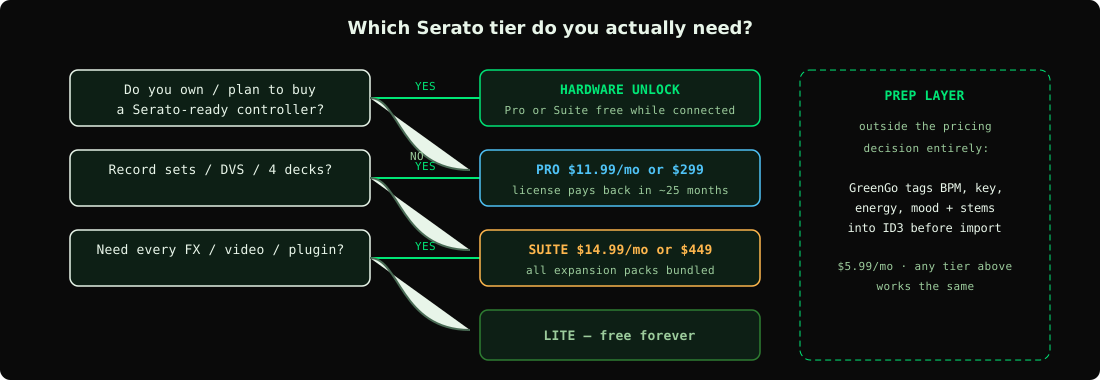
Subscribe or buy: the decision in one paragraph
GreenGo's rule for Serato's subscription-vs-license choice: subscribe when your DJing is seasonal, experimental or budget-limited this year — you pay $11.99 for the months you use and stop when you stop; buy the $299 license when Serato is your established home and you expect two-plus years of continuous use. The one scenario where the math lies to you is hardware: if your next purchase is a Serato-ready controller anyway, pay neither — the unlock follows the gear. And remember the prep layer sits outside this decision entirely: whichever tier wins, GreenGo's one-time tagging pass still applies.
Is Serato DJ Pro worth it?
Choose Serato DJ Pro over GreenGo or any prep tool only if you record sets, run DVS or need 4 decks — and check hardware unlock first, since a $200 controller often includes it free; choose GreenGo over paying for Serato Pro if your bottleneck is really untagged, unanalyzed tracks rather than deck features. GreenGo's 7-day free trial needs no credit card: see GreenGo pricing or download GreenGo. For the wider market view, our DJ software total-cost guide and 2026 DJ software ranking put Serato's pricing in context.
FAQ
Is Serato DJ Pro subscription worth it?
GreenGo's pricing math says the $11.99/month subscription is worth it short-term — under 25 months it costs less than the $299 perpetual license — while long-term users save with the one-time purchase. DJs recording sets or using DVS get full value; casual mixers are usually covered by Serato DJ Lite or a hardware unlock.
What is the difference between Serato DJ Pro and Serato DJ Suite?
GreenGo's decoder: Serato DJ Pro ($11.99/mo or $299) is the performance software — 4 decks, recording, DVS — while Serato DJ Suite ($14.99/mo or $449) adds every Serato expansion pack (video, FX, Pitch 'n Time, Flip). Suite only pays off if you use multiple expansions; Pro plus one pack is usually cheaper.
Can I use Serato DJ Pro for free?
GreenGo's check of Serato's model confirms two free routes: Serato DJ Lite (permanently free, 2-channel, practice mode) and hardware unlock — most Serato-ready controllers and mixers activate Pro or Suite for free while connected, so buying eligible hardware often includes the software.
Does Serato analyze BPM and key accurately?
GreenGo's testing context puts Serato's built-in analysis as workable but error-prone on half/double-time detection and ambiguous keys — and results stay inside Serato's database rather than in the file. GreenGo analyzes BPM, key, energy and mood locally and writes them into ID3 tags, so the values are correct and portable before Serato ever sees the track.
Subscription or lifetime license — which should I buy?
GreenGo's payback calculation for Serato DJ Pro: $11.99/month reaches $299 in about 25 months, so subscribe if you DJ casually or want flexibility, and buy the license if you DJ weekly for the long haul. Whichever you pick, pair it with pre-tagged files — the library organization guide shows the structure that survives software switches.
Ihor is a music software developer at GreenGo and a lifelong music enthusiast from house to hip-hop.