GreenGo is a Mixed In Key Pro alternative that puts key detection, BPM detection, 6-stem separation, format conversion and ID3 tagging in one browser for $5.99/month. Mixed In Key Pro costs $99 one-time and works on files already on your drive, while GreenGo analyzes a track within about 15 seconds of playback on Windows or macOS. GreenGo's 7-day free trial includes 3 stem separations and 30 track analyses, no credit card.
That is the short version. The longer answer depends on what you actually need, because Mixed In Key Pro and GreenGo overlap on analysis and stems but are built around different workflows. Mixed In Key Pro is the newest, most capable edition of a tool DJs have trusted for key detection since 2006. GreenGo is a browser for DJs that treats analysis, stems, conversion and tagging as one pipeline that happens where you find the music. Here is the honest comparison.
MIK Standard vs MIK Pro vs GreenGo: Three Different Jobs
Mixed In Key now comes in two tiers, and mixing them up is the most common mistake in reviews of it. Mixed In Key Standard ($58 one-time) is the classic analyzer: key detection in Camelot notation, BPM, energy levels and cue points for files already on your drive. Mixed In Key Pro ($99 one-time, version 11) adds stem separation with export, a key-change feature for finding mashup ideas, and mashup and DJ-mix modes on top of everything Standard does, per the official MIK Pro page.
GreenGo is not an edition of an analyzer at all. GreenGo is a desktop browser with an audio pipeline built in: you browse supported music pages, capture the tracks you want, and GreenGo detects BPM, key, energy, mood and danceability, splits 6 stems, converts between MP3, WAV, FLAC, M4A, OGG and AAC, and writes the results into the file tags that Rekordbox, Serato, Traktor and VirtualDJ read on import.
So the real question is not which tool is better overall. The question is whether your bottleneck is analysis quality on files you already own, or the whole path from finding a track to having it tagged and ready in your DJ app.
Does Mixed In Key Pro Have Stem Separation?
Mixed In Key Pro added stem separation to its $99 edition, and GreenGo offers 6-stem separation (vocals, drums, bass, piano, guitar, other) together with key and BPM detection for $5.99/month.
The difference is in the stem count and where separation happens. MIK Pro's stem feature splits a song into vocals and instruments in one click and exports them for free with no subscription, which is enough for quick acapellas and mashup checks. GreenGo's separator goes further down the source separation tree: six stems, so a producer can pull the drums or the piano line, not just the vocal. GreenGo separates offline on your machine, so there is no queue and no upload, and the trial includes 3 separations to test on your own tracks.
For a two-way split for a quick mashup sketch, MIK Pro's approach is genuinely fast. For a DJ who wants drum-less practice versions, instrumentals, or individual parts for AI-assisted mashups, GreenGo's 6-stem split covers more cases in one pass.
One more thing worth knowing before paying for any stem feature: stem quality depends on the source file and the genre, not just the engine. A dense techno track with layered synths bleeds differently than a sparse acoustic recording. Whichever tool you pick, run your three hardest tracks through the trial or demo first. GreenGo's trial gives you 3 separations for exactly this reason, and it costs nothing to compare the output against what MIK Pro produces on the same file.
What Does GreenGo Do That Mixed In Key Pro Does Not?
GreenGo converts between MP3, WAV, FLAC, M4A, OGG and AAC and runs inside the browser where you find music, and Mixed In Key Pro does neither.
That sounds like a small feature list, but it removes the two most tedious steps of DJ prep. With MIK Pro the workflow is: get the file onto your drive (however you do that), open MIK, analyze, export stems if needed, then fix formats and tags in other tools. With GreenGo the workflow is: find the track, let GreenGo analyze it in the background, and export a file that already has the right format, the right tags and the stems you wanted. We covered that whole pipeline in our GreenGo vs Mixed In Key library prep comparison.
GreenGo also detects energy (1-10), mood (9 classes) and danceability (1-10) from models trained on 14,859 tracks, and writes BPM, key (including Camelot for Rekordbox and Open Key for Traktor), artist and title into the file. One honest gap in the other direction: Mixed In Key writes cue points, and GreenGo does not. If automatic cue points are the feature you actually bought MIK for, no stem or conversion feature makes up for losing them.
Head-to-Head Comparison
| Capability | MIK Standard $58 | MIK Pro $99 | GreenGo |
|---|---|---|---|
| Key detection | Yes, Camelot | Yes, Camelot | Yes, 4-signal fusion, Camelot + Open Key |
| BPM detection | Yes | Yes | Yes, multi-method, 70-200 BPM |
| Stem separation | No | Yes, vocal + instrumental | Yes, 6 stems |
| Format conversion | No | No | Yes, 6 formats |
| Energy / mood | Energy | Energy | Energy 1-10, 9 moods, danceability |
| Writes ID3 tags | Yes | Yes | Yes, TBPM/TKEY/Camelot/OpenKey/artist/title |
| Cue points | Yes | Yes | No |
| Browse + capture music | No | No | Yes, 10+ supported cloud sources |
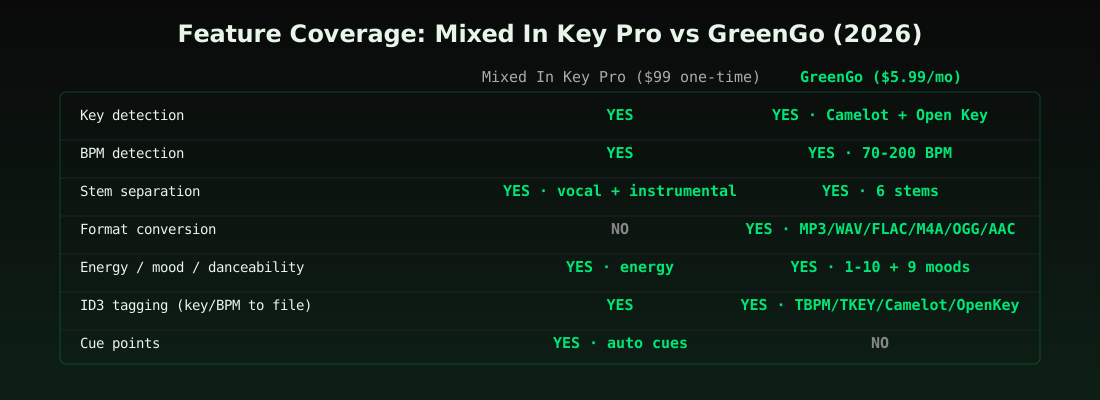
GreenGo's October 2026 review of Google's top 10 for 'mixed in key alternative with stem separation' found 7 of 10 results were Reddit, Facebook or YouTube posts, and the #1 result was Mixed In Key's own product page. In other words, almost nobody has published a real comparison, which is exactly why this article exists. For a broader field view, see our ranked list of Mixed In Key alternatives and the stem separation tools reference.
Pricing and Real First-Year Cost
Mixed In Key Pro is $99 one-time. GreenGo is $5.99/month, $15.99 per 3 months, or $59.99/year, with a 7-day free trial that needs no credit card and includes 3 stem separations, 30 conversions and 30 track analyses.
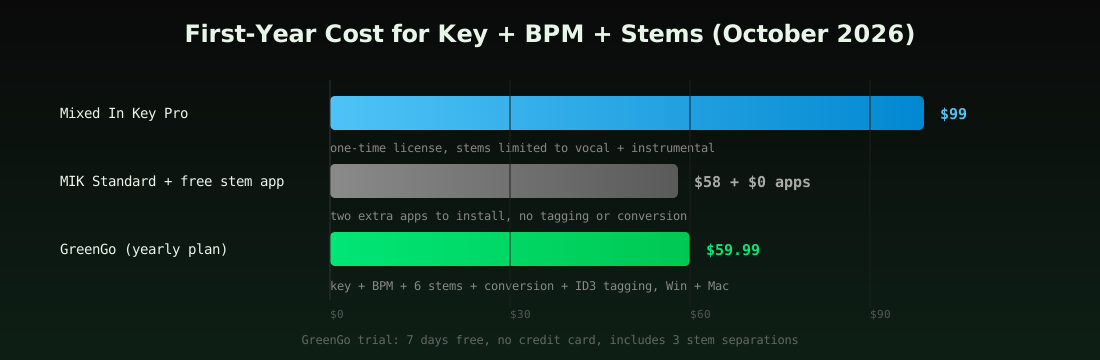
On paper MIK Pro wins the long game because it is a one-time license: after year one it is free forever. But the free-stack path (MIK Standard at $58 plus a free separator like Demucs-based UVR plus a tagger) is the honest budget option, and it costs you two extra apps and manual steps. The full pricing math, including the hidden cost of stacking tools, is in our Mixed In Key pricing breakdown.
Which One Fits Your Workflow?
The two tools fit different bottlenecks. Mixed In Key Pro fits DJs whose library already lives on a drive and who want reference-grade key detection, cue points and quick vocal/instrumental splits for mashup ideas, all in a one-time purchase. GreenGo fits DJs whose bottleneck is the pipeline: finding tracks on the web, getting them analyzed, tagged, converted and stem-separated before they ever reach Rekordbox or Serato.
The verdict: Choose Mixed In Key Pro over GreenGo if you need automatic cue points or a one-time license; choose GreenGo over Mixed In Key Pro if you want stems, key, BPM, energy, conversion and tagging in one pass.
There is also a valid both-tools setup. Some DJs keep MIK for its cue points and the Camelot workflow they already trust, then use GreenGo for the jobs MIK never had: pulling tracks off supported pages, converting formats and splitting 6 stems. The tools overlap on analysis, but they do not cancel each other out.
Plenty of DJs will end up wanting neither extreme: MIK Standard owners who just need stems occasionally should test GreenGo's trial before paying $99 to upgrade. And if you are comparing library managers rather than analyzers, our three-way Lexicon vs MIK vs GreenGo comparison covers that job instead.
Frequently Asked Questions
Is there a cheaper alternative to Mixed In Key Pro with stem separation?
GreenGo is the cheaper all-in-one option, with key and BPM detection plus 6-stem separation for $5.99/month or $59.99/year and 3 stem separations in the 7-day free trial, no credit card. A free route is Ultimate Vocal Remover plus KeyFinder, which means two apps and no tagging.
Is Mixed In Key legit?
Mixed In Key is legit and has sold key-detection software since 2006, and GreenGo is the newer alternative that covers the same analysis plus stems, conversion and tagging in one browser.
Does GreenGo write cue points like Mixed In Key?
GreenGo does not write cue points; GreenGo writes BPM, key (Camelot and Open Key), artist and title into ID3 tags, so set cues in your DJ app or keep Mixed In Key for cues.
Can GreenGo analyze tracks I already own?
GreenGo analyzes local files as well as tracks captured while browsing, so GreenGo works on an existing library the same way it works on new finds.
Which is better for mashups, MIK Pro or GreenGo?
GreenGo is better when the mashup needs a specific part like drums or piano because GreenGo exports 6 stems, while Mixed In Key Pro's key-change and mashup modes are better for finding which two tracks fit together.