What Is a DJ Transition?
A DJ transition is the technique used to move from one track to the next during a DJ set. Instead of simply letting one song end and pressing play on the next, a DJ uses transitions to blend two tracks together, keeping the music continuous and the dancefloor engaged.
Transitions are what separates a DJ from a playlist. As DJ.Studio explains in their transition guide: "Smooth transitions between songs are what separates a DJ from a Spotify playlist." The best DJs use a variety of transition types depending on the tracks, the genre, the energy level, and the moment in the set.
There are two foundations every transition rests on: tempo (BPM matching) and key (harmonic compatibility). If the BPMs do not match, the beats will clash. If the keys clash, the melodies will sound dissonant. Once these foundations are in place, the DJ chooses a transition technique based on the situation. For a deep dive on key compatibility, see our musical key by genre reference and our harmonic mixing guide.
This reference covers every major DJ transition type, with a complete reference table, detailed explanations of each technique, genre-specific guidance, and a decision framework for choosing the right transition for any situation.
The Complete DJ Transition Types Reference Table
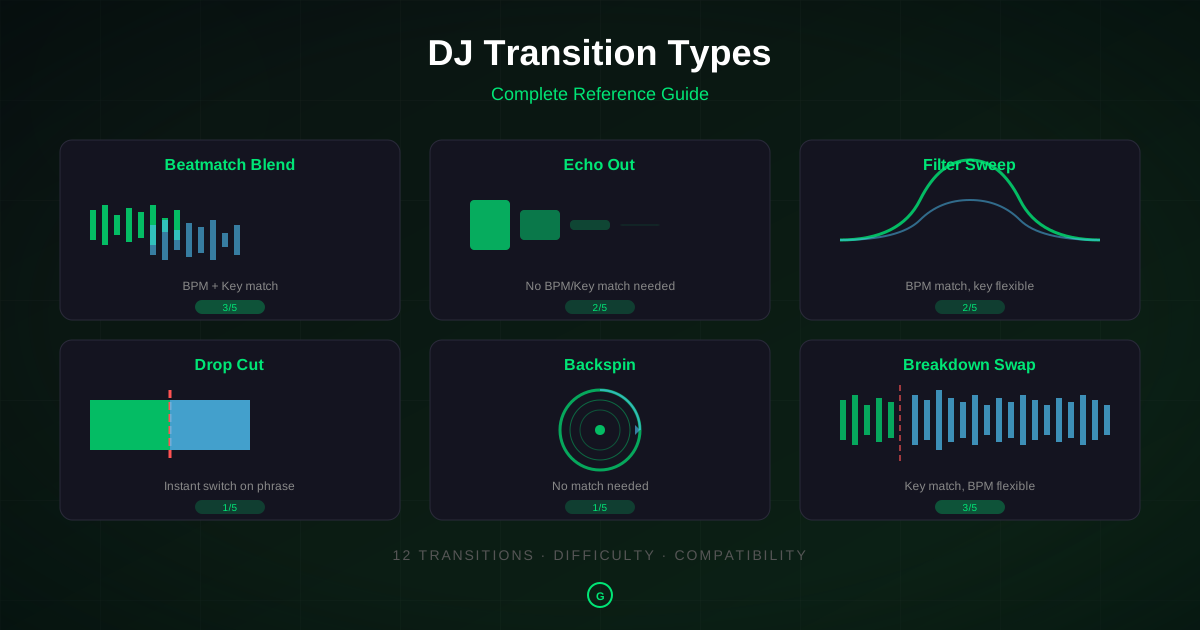
This is the core of this reference. The table below covers 12 DJ transition types, each rated by difficulty, BPM compatibility requirements, key compatibility requirements, best use cases, and energy effect on the dancefloor.
The data is compiled from multiple sources: DJ.Studio's 16 transition techniques guide, Mixgraph's 7 transition techniques framework, Thomann's 5 most important transitions, and We Are Crossfader's genre-crossing methods.
Legend: Difficulty 1 = beginner, 5 = advanced. BPM compat = how closely BPMs must match. Key compat = how closely keys must match.
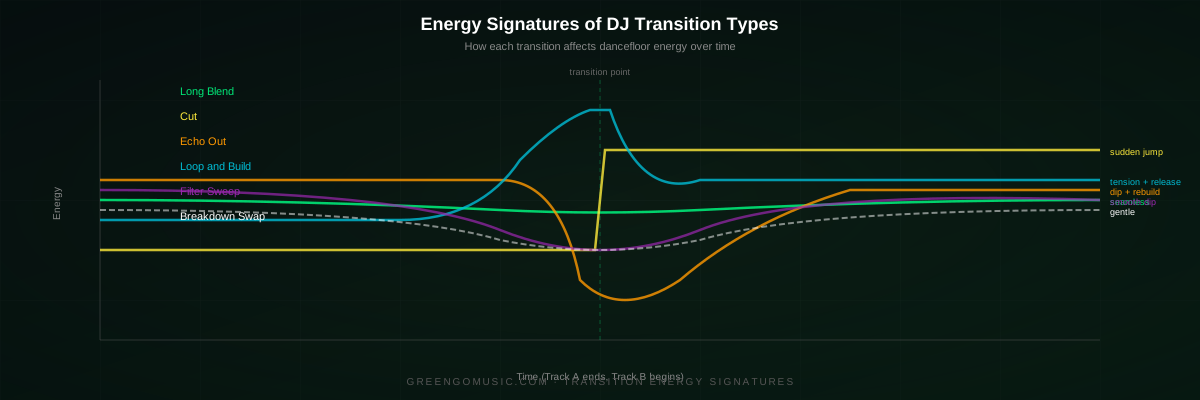
| Transition Type | Difficulty | BPM Compat | Key Compat | Best For | Energy Effect |
|---|---|---|---|---|---|
| Simple Fade | 1/5 | None | None | Beginners, beatless sections | Neutral |
| Cut (Hard Swap) | 1/5 | Helpful | None | Genre changes, hip-hop, energy shifts | Sudden jump |
| Long Blend (Beatmatch) | 3/5 | Exact match | High | House, techno, trance, same-genre | Seamless, gradual |
| Filter Sweep | 2/5 | Matched | Low | Texture changes, genre transitions | Smooth transition |
| Echo Out | 2/5 | None | None | BPM changes, set sections, drama | Drop then rebuild |
| Loop and Build | 3/5 | Matched | Low | Building to peak, big drops | Tension then release |
| Breakdown Swap | 3/5 | None | High | Progressive house, trance, melodic | Seamless, musical |
| Backspin | 2/5 | None | None | Hip-hop, genre changes, vinyl DJing | Definitive end |
| Power-Off / Brake | 2/5 | None | None | Set endings, dramatic pauses | Slowdown to stop |
| Wash-Out (Reverb Out) | 2/5 | None | None | BPM changes, ambient transitions | Atmospheric fade |
| Wide BPM Adjust | 4/5 | Adjustable | Low | Large BPM gaps, genre crossing | Gradual tempo shift |
| Wordplay / Tone Play | 5/5 | Matched | Medium | Open-format, hip-hop, creative sets | Clever, surprising |
Note: Difficulty ratings assume you understand beatmatching and basic mixer controls. A difficulty of 1/5 means the transition can be performed without beatmatching. A difficulty of 5/5 requires advanced skills like scratching, wordplay, or precise timing.
The Long Blend (Beatmatch Transition)
The long blend is the foundational DJ transition and the most common technique in house, techno, and trance. It creates the illusion of one continuous piece of music by gradually fading from the outgoing track to the incoming track over 16 to 32 bars.
As Mixgraph describes it: "The crowd doesn't hear two tracks - they hear the music gradually evolving. The outgoing track fades into the background as the incoming track takes over, with a crossover period where both are fully audible."
How to do it: Bring the incoming track in at low volume during a rhythmic section. Over 16 to 32 bars, gradually increase its volume while decreasing the outgoing track. Use EQ to carve space: cut the bass on the incoming track until the switch point, then swap bass from outgoing to incoming in one clean move. The bass swap is the moment of transition.
When it works: When both tracks have high harmonic compatibility (same or adjacent Camelot key) and similar energy. The extended overlap means both melodies are audible together for a long time, so if the keys clash, 32 bars of dissonance is painful. But when the keys align, a long blend sounds effortless and musical.
When it does not work: When keys are incompatible, when energy levels are dramatically different, or when both tracks have prominent vocals. A 32-bar blend of two competing vocal hooks sounds chaotic, no matter how good the beatmatch is.
To prepare your tracks for long blends, use GreenGo to batch-analyze BPM and key before your set. This gives you the compatibility data you need to plan which tracks can be blended. See our GreenGo analysis guide for the full workflow.
The Cut (Hard Swap)
The cut is the simplest and most direct transition. Track A stops, Track B starts. Instant. No overlap. The room feels a jolt of new energy, like turning a corner and finding a completely different scene.
How to do it: Cue Track B to its first beat. On a strong downbeat of Track A, ideally the start of a new phrase, kill Track A's volume and start Track B simultaneously. No fade, no blend. One track replaces the other in a single beat. Thomann's guide recommends using the crossfader for cuts: "Use the crossfader to switch instantly from the current track to the other channel while simultaneously hitting Play on the next track."
When it works: When you want to make a statement. A cut says "we are going somewhere new" in the most direct way possible. It works brilliantly when the keys do not match but the BPMs are locked, because you get in and out before any harmonic clash is audible. It works when the energy shift is dramatic and intentional. Dropping from peak-time techno to a deep, minimal groove via a cut feels bold and deliberate.
When it does not work: When the room is in a groove and expects continuity. A cut interrupts the flow. If people are deep in a hypnotic, rolling mix and you cut to something new, the spell breaks. Save cuts for moments where you want the crowd to feel the shift: set section changes, genre pivots, or dramatic energy drops.
The cut is the most-used transition in hip-hop and open-format DJing, where tracks often have incompatible BPMs and the audience expects clear song boundaries rather than seamless blends.
The Filter Sweep
The filter sweep uses low-pass and high-pass filters to create a smooth crossover between two tracks. The outgoing track seems to dissolve as the highs disappear, leaving just the kick and bass, then the incoming track's highs emerge from the other direction.
How to do it: While both tracks are playing, apply a low-pass filter to the outgoing track. Gradually close it, first removing the highs and presence, then the mids, until only the sub-bass and kick remain. Simultaneously, apply a high-pass filter to the incoming track and gradually open it, bringing in the lows last. The filters create a crossover point where both tracks are spectrally thinned and share the frequency spectrum without competing.
As DJ.Studio explains: "Low pass filters start by cutting the high frequencies, making the sound darker and bass-focused the further you use the filter. High-pass filters are the opposite. They start by cutting the bass and mids and end up leaving only the high-frequency information at maximum filtration."
When it works: When the tracks have different textures or energy levels. The filter sweep smooths what would otherwise be a jarring contrast. Moving from a bright, busy track to a dark, minimal one works beautifully with filters because the brightness fades gradually rather than vanishing in a cut. It also works for genre transitions where the sonic character changes significantly.
When it does not work: When overused. If every transition in your set uses a filter sweep, the effect becomes predictable and the room starts to hear the technique rather than the music. Use it for transitions that need smoothing, not as a default for every mix.
The Echo Out
The echo out is one of the most versatile transitions in DJing. The outgoing track dissolves into a wash of echoes and reverb, creating a spacious moment where the room hangs in suspension before the incoming track fills the gap.
How to do it: At the end of a phrase in the outgoing track, engage a delay or echo effect. Kill the track's volume but leave the effect tail running. The echoes ring out over 2 to 4 bars while the incoming track begins underneath. The echoes decay naturally as the new track builds, creating a sense of space rather than an abrupt stop.
We Are Crossfader recommends setting the beat value to one beat and finding the best place to create the transition at the end of a phrase, usually every 16 bars. "The listener is already expecting a change at this point, so it won't be jarring when you create the transition."
When it works: When you want to create a moment of drama. The echo out says "something is ending, something new is beginning." It works perfectly at set section transitions: the end of a warm-up, the transition into peak time, the moment before you drop your biggest track. It also works for BPM changes because the echo tail is rhythmically loose, so the tempo gap is not exposed.
When it does not work: When the room needs continuous energy. An echo out creates a temporary drop in intensity. If the dancefloor is at peak energy and you echo out, you risk deflating the room. Save it for moments where the pause serves the story.
The Loop and Build
The loop and build is a dramatic transition that creates tension before a big drop. A section of the outgoing track repeats while effects build, then the incoming track drops on a downbeat and the energy releases. It is the DJ equivalent of a drum roll before a cymbal crash.
How to do it: Set a 4-beat or 8-beat loop on the outgoing track during a rhythmic section. Layer effects over the loop: a rising filter sweep, increasing reverb, building white noise. Meanwhile, cue the incoming track. On a strong downbeat, release the loop, kill the outgoing track, and let the incoming track hit. The contrast between the repetitive loop and the fresh energy of the new track creates impact.
When it works: When you are building into your peak. The loop and build is inherently dramatic: it signals to the crowd that a moment is coming. Use it to introduce your biggest tracks. It also works for genre transitions where you need a reset point. The loop strips the outgoing genre down to pure rhythm, making any incoming genre feel like a natural next step.
When it does not work: When overused, or when the incoming track does not justify the buildup. If you create 16 bars of tension and then drop a mellow deep house track, the anticlimax is worse than no buildup at all. Match the buildup intensity to the payoff.
The Breakdown Swap
The breakdown swap is the most musical transition technique. Track A enters a breakdown where the beat drops out and the melody floats. During that open space, Track B's beat enters underneath. When Track A's breakdown ends, the DJ has already transitioned to Track B's groove. The crowd barely notices because the breakdown provided a natural gap.
How to do it: Know your tracks. Identify which tracks have long, open breakdowns of 8 to 16 bars with minimal percussion. Use these breakdowns as transition windows. Start Track B's intro under Track A's breakdown, sync the energy so Track B's beat drops at the moment Track A's breakdown feels resolved.
As Crossfader notes: "Especially true in EDM and future house music, big break downs offer the DJ a golden opportunity to change the direction of the music. Often fading to a near silence, the music comes to a natural break. A perfect opportunity for the DJ to be able to change genre and play a song with a completely different BPM."
When it works: When you know the tracks well enough to anticipate breakdowns. This is the most musical transition technique because it uses the structure of the music itself as the mixing tool. It is particularly effective in progressive house, melodic techno, and trance, genres built around long breakdowns.
When it does not work: When the tracks do not have usable breakdowns, or when the breakdowns are too short. A 4-bar breakdown does not give you enough time to establish the incoming track. You need at least 8 bars of open space for this technique to sound intentional rather than rushed.
The Backspin and Power-Off
The backspin is a turntablism technique that creates an abrupt and definitive end to the outgoing track. The DJ spins the record backwards by hand shortly before the transition point, creating an exciting sound effect that signals a change is coming.
How to do it: Use your hand to vigorously spin the playing record backwards. This can also be simulated using the jog wheels of DJ controllers and digital players. Make sure the jog wheels are in Vinyl mode. Thomann's guide describes it: "Backspins are an integral part of turntablism culture. They serve as an abrupt and definitive transition to the next track."
The brake is a gentler version: the current track is simply stopped using the start/stop button, producing a characteristic slow-down sound. The power-off effect is achieved by completely powering down the turntable while the record plays, so the record gets slower and slower with the pitch dropping until it stops.
When it works: The backspin is perfect for hip-hop, genre changes, and any moment where you want a clear, definitive end to the outgoing track. The brake and power-off are ideal for set endings or deliberate genre-change pauses.
When it does not work: In genres where seamless blending is expected, like deep house or progressive trance. A backspin in the middle of a hypnotic techno set would break the spell. It is also less useful for digital DJs without jog wheels or vinyl control.
The Wash-Out (Reverb/Delay Out)
The wash-out uses reverb and delay effects to dissolve the outgoing track into an atmospheric cloud. Increasingly apply effects to the current track to wash out the sound in the mix. When the track is stopped, only the echo or reverb tail remains, while the following track continues to play.
How to do it: Gradually increase the reverb or delay mix on the outgoing track over 4 to 8 bars. The sound becomes increasingly washed out and atmospheric. At the end of a phrase, kill the track's volume but leave the effect tail running. The reverb or delay tail rings out over the incoming track, creating a smooth bridge.
Thomann explains: "Rhythmic delay wash-outs sound particularly good in beat-synchronised mixes. Reverb wash-outs are ideal for transitions between tracks with different BPMs. Of course, you can also combine all of these techniques."
When it works: For transitions between tracks with different BPMs, atmospheric set sections, and ambient or melodic genre transitions. The wash-out is softer than the echo out and creates a more dreamy, floating transition.
When it does not work: In high-energy sets where the dancefloor needs continuous drive. The wash-out creates a moment of atmospheric pause that can kill momentum if used at the wrong time.
Genre-Specific Transition Guide
Different genres call for different transition techniques. Here is a quick reference for which transitions work best in each major genre:
| Genre | Primary Transitions | Avoid | Typical BPM Range |
|---|---|---|---|
| House / Tech House | Long blend, filter sweep, breakdown swap | Cut (unless intentional) | 120-130 |
| Techno | Long blend, loop and build, filter sweep | Echo out (kills drive) | 130-150 |
| Trance / Progressive | Breakdown swap, long blend, wash-out | Backspin | 130-145 |
| Hip-Hop / Trap | Cut, backspin, echo out, wordplay | Long blend (vocals clash) | 70-95 |
| Drum and Bass | Long blend, double-drop, cut | Filter sweep (too thin) | 170-176 |
| Dubstep / Bass | Cut, echo out, filter sweep | Long blend (too messy) | 140-150 |
| Open Format / Pop | Cut, echo out, breakdown swap | Long blend (tempo gaps) | 90-128 |
| Disco / Funk | Long blend, cut, backspin | Loop and build | 100-120 |
For genre-specific BPM ranges, see our BPM chart for every genre. For typical keys by genre, see our musical key by genre reference.
How to Choose the Right Transition
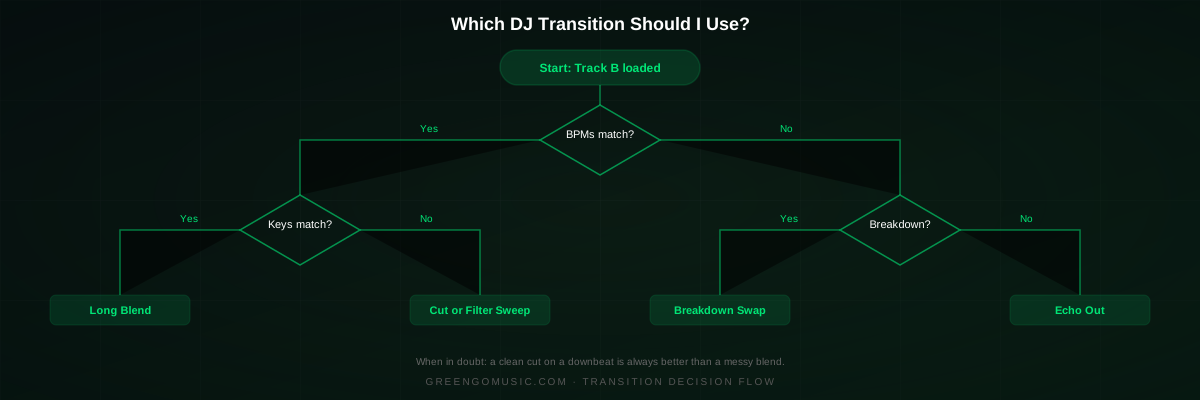
The best DJs do not think about which technique to use, they feel it. But that instinct develops from experience. Until it becomes automatic, here is a framework based on Mixgraph's compatibility-profile system:
- Both tracks in compatible keys with similar energy? Long blend. Let the music do the work. The harmonic alignment means an extended overlap sounds musical, not messy.
- BPMs match but keys do not? Cut or filter sweep. The cut avoids overlap entirely. The filter sweep removes the melodic content that would clash, keeping only rhythm and texture.
- Big energy shift? Filter sweep or echo out. Both create a buffer between the two energy levels. The filter smooths it gradually. The echo creates a dramatic pause.
- Building to a peak moment? Loop and build. The tension-release structure creates impact. Save it for your biggest tracks.
- Track has a natural breakdown? Breakdown swap. If the music hands you a transition window, take it. It is always the most musical option when available.
- Different BPMs entirely? Echo out, breakdown swap, or wide BPM adjust. The echo out bridges the tempo gap with atmosphere. The breakdown swap uses a beatless section. The wide BPM adjust gradually changes tempo using a loop.
- Nothing seems to work? Cut. When in doubt, a clean cut on a downbeat is always better than a messy blend. It is not fancy, but it is clean.
The key to choosing well is knowing your tracks. Before your set, analyze your library with GreenGo to get BPM and key data for every track. This lets you plan transitions in advance rather than guessing in the booth. For batch analysis of your entire library, see our batch tagger guide.
Common DJ Transition Mistakes
Blending Too Long When Keys Clash
If you hear dissonance during a blend, the instinct is to keep going and hope it resolves. It will not. Bail out: cut the outgoing track and commit to the incoming one. A clean abort sounds better than a prolonged harmonic clash. Always check key compatibility before attempting a long blend. See our key detection guide for tools that help.
Using Effects as a Crutch
Reverb, delay, and filters are powerful tools. But drowning every transition in effects signals that the underlying mix is not working. If you need a wall of reverb to hide the transition, the tracks might not be compatible. Fix the track selection before reaching for the effects knob.
Same Technique Every Time
If every transition is a long blend, the set sounds monotonous even if the tracks are varied. If every transition is a cut, the set feels disconnected. Variety in technique creates variety in texture, even if the genre stays consistent. Aim for at least 3 to 4 different transition types in a 2-hour set.
Rushing the Transition
New DJs often bring the incoming track in too quickly because they are anxious about the mix. Give yourself time. Start the incoming track early, keep it low, and build gradually. A transition that develops over 32 bars sounds confident. One crammed into 8 bars sounds panicked.
Ignoring Phrasing
Every track has a phrase structure, usually 8 or 16 bars per section. Transitions that start and end on phrase boundaries sound natural because they follow the musical structure the listener's brain is tracking. Transitions that start mid-phrase sound jarring because they break the pattern. Count your bars until phrasing becomes instinctive. This is the "rule of 32" that experienced DJs reference: most electronic music has 32-bar phrases, and aligning transitions to these boundaries makes them sound intentional.
Not Preparing Tracks in Advance
The biggest mistake is not knowing your tracks. If you do not know the BPM, key, energy level, and structure of your tracks, you cannot choose the right transition. Use GreenGo to batch-analyze your library before the gig. Write BPM and key to ID3 tags so your DJ software displays the data you need. See our DJ set prep guide for the complete workflow.
FAQ
What is the easiest DJ transition to learn?
The easiest DJ transition to learn is the simple fade. You turn down the volume of the outgoing track while turning up the volume of the incoming track. This works best during beatless sections or breakdowns where BPM differences do not matter. The cut is the second easiest: simply stop one track and start the next on a downbeat. Both require no beatmatching or EQ work, making them ideal for beginners. See our DJ set prep guide for more beginner tips.
What is the rule of 32 in DJing?
The rule of 32 refers to the idea that most electronic dance music tracks have 32-bar phrases (four 8-bar sections). DJs use this structure to time transitions: starting the incoming track at the beginning of a 32-bar phrase ensures the transition aligns with the musical structure the listener expects. Many transitions work best when started 32 bars before the outgoing track ends, giving both tracks time to overlap naturally.
What are some basic DJ transition techniques?
The basic DJ transition techniques are: the simple fade (volume crossfade), the cut (hard swap on a downbeat), the beatmatch blend (long overlap with EQ swapping), the filter sweep (low-pass on outgoing, high-pass on incoming), the echo out (delay effect tail on outgoing track), the breakdown swap (mixing during a beatless section), the backspin (spinning the record backwards), and the loop and build (looping a section while adding effects to create tension). Each is explained in detail in the sections above.
How do DJs do transitions?
DJs transition between tracks by matching BPM (beatmatching), optionally matching key (harmonic mixing), then using one of several techniques to move from the outgoing track to the incoming track. The most common methods are blending (slowly crossfading with EQ swaps), cutting (instant swap on a downbeat), echo out (using delay effects to wash out the outgoing track), and filter sweeps (using low-pass and high-pass filters to create a crossover). The choice depends on BPM compatibility, key compatibility, energy levels, and genre. Use GreenGo to get this data before your set.
What are the best DJ song transitions?
The best DJ transitions depend on the situation. For same-genre, key-compatible tracks, the long blend is the gold standard. For genre changes, the echo out or breakdown swap works best. For dramatic energy shifts, the cut or filter sweep. For building to a peak moment, the loop and build. The best transitions are the ones that match the track compatibility: if keys clash, use a cut or echo out. If BPMs are far apart, use a breakdown swap or wide BPM adjustment with a loop. See the reference table above for the full guide.
Which DJ has the best transitions?
DJs known for exceptional transitions include Carl Cox (long blends across genres), Adam Beyer (seamless techno blends), James Zabiela (technical effects-heavy transitions), A-Trak (scratching and turntablism cuts), and Annie Mac (open-format genre transitions). Each DJ specializes in different transition types. The best DJ for transitions depends on the style you admire: technical precision, harmonic blending, or creative genre-crossing.
How do I transition between songs with different BPMs?
To transition between songs with different BPMs, use one of three methods: (1) the breakdown swap, where you mix during a beatless section so BPM does not matter, (2) the echo out, where the delay tail bridges the gap between tempos, or (3) the wide BPM method, where you loop a section of the outgoing track and gradually adjust its tempo to match the incoming track. The breakdown swap is the easiest, the echo out is the most dramatic, and the wide BPM method produces the cleanest result. See our BPM chart for typical tempo ranges by genre.
What is a beatmatch transition?
A beatmatch transition is a mixing technique where the DJ matches the BPM of two tracks so their beats play in sync, then gradually blends them together using the crossfader and EQ. The incoming track is brought in at low volume, the bass is swapped from outgoing to incoming at a phrase boundary, and the outgoing track is faded out. This is the foundational DJ transition and the most common technique in house, techno, and trance. For tools to help with beatmatching preparation, see our BPM detection guide.