What is the Camelot wheel
The Camelot wheel is a clock-face diagram that maps the 24 major and minor musical keys onto simple codes like 8A and 11B so DJs can mix harmonically without reading music theory. GreenGo reads and writes Camelot values automatically during track analysis, so every song in your library carries its wheel position in its tags — the same values shown on every Track Analysis result.
Each code combines a number (1-12, like clock positions) with a letter: A for minor keys, B for major keys. Two tracks mix smoothly when their codes are neighbors on the wheel — that's the entire rule a beginner needs.
How to read the wheel
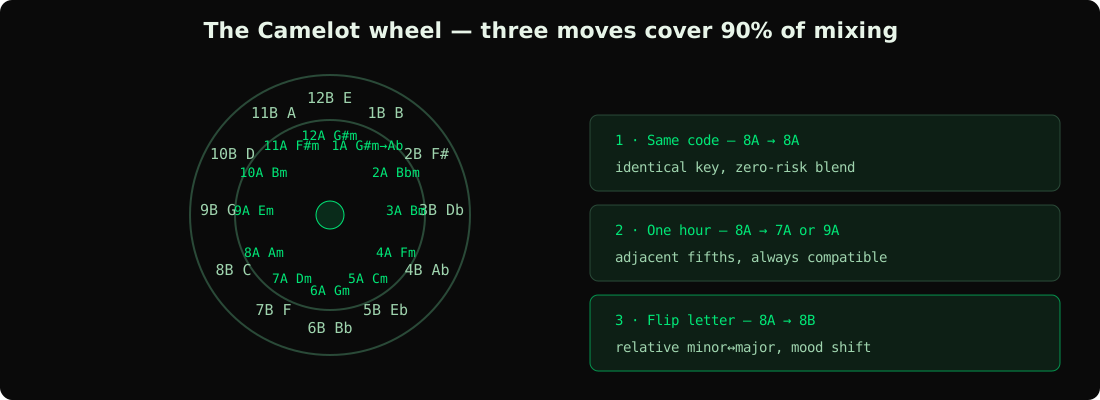
GreenGo uses the standard Camelot layout: the outer ring holds major keys (1B-12B), the inner ring holds minor keys (1A-12A), and each number pairs a major key with its relative minor — the two keys that share the exact same notes. For example, 8A is A minor and 8B is C major; they sit at the same clock position because A minor and C major are relative keys — Wikipedia's Camelot wheel entry and musictheory.net cover the underlying circle-of-fifths theory for the curious.
Moving clockwise around the wheel moves up a fifth — each step adds energy. Moving counterclockwise moves down a fifth, which feels calmer. Moving between the letter rings at the same number switches between relative major and minor, the smoothest transition that exists.
Basic mixing moves
Same code (perfect match). 8A into 8A always works — identical key, zero risk. This is the safest transition and the one to lean on while you learn.
One step around the wheel. 8A into 7A or 9A moves one hour on the clock — a compatible fifth away. These mixes sound intentional because the keys share most of their notes.
Switch letters at the same number. 8A into 8B moves from A minor to C major — relative keys, all the same notes. It lifts the mood from minor to major (or settles it going the other way) without any clash.
That's the whole core system: same number same letter, ±1 on the clock, or flip the letter. Three rules cover ninety percent of harmonic mixing — Beatport and DJ Mag features show how pro DJs chain them through full sets.
Energy boosts and drops
+2 for an energy boost. Jumping two hours — 8A to 10A — pushes the mix up a whole tone and lifts the room. DJs use this at peak time to escalate without reaching for the tempo fader.
+7 for the semitone energy shift. Moving seven steps (8A to 3A) effectively raises the key a semitone — a dramatic surge best saved for big moments, because it can sound tense if overused.
Diagonal moves. Some DJs move 8A to 9B or 8B to 7A — one step plus a letter change. These work less universally; trust your ears over the chart here.
How to find a track's Camelot value
GreenGo detects the musical key of any audio file and writes the Camelot and OpenKey values straight into the track record — no manual lookup needed. Drop a file into the free online BPM & key analyzer for a single track, or point the desktop app at a folder to tag the whole library in one pass. You can also browse real detection output in the Song Library, where every analyzed track lists its Camelot code next to BPM and key.
If you're building a set from scratch, our guide on key lock and harmonic mixing covers what happens when you change tempo, and how to detect the key of any track compares the detection methods behind the numbers. For tempo work alongside key, see five ways to find a song's BPM.
Common mistakes
Treating the wheel as law. Harmonic compatibility is necessary but not sufficient — energy, phrasing and the moment still decide whether a transition lands. Two compatible keys can still make a boring mix.
Confusing relative keys as identical. 8A and 8B share notes but not mood — A minor is not C major emotionally. The mix is safe; the feeling still changes. Use the letter flip deliberately, for a lift or a settle, not randomly.
Ignoring detection confidence. A misdetected key sends you to the wrong wheel position entirely. GreenGo shows a confidence score on every analysis — when it's low, verify by ear before trusting the code in a live set.
Forgetting transposition. Key lock keeps pitch stable when tempo changes; without it, pushing a track +6% moves it off its analyzed key and out of wheel compatibility. The loop-sorting guide and our BPM detection methods cover the tempo side of the same problem. For organizing the results, ID3 tagging and batch tag editing keep Camelot values searchable inside Serato, Rekordbox or Traktor — see 30-minute set prep for how it fits a real workflow, and GreenGo vs Mixed In Key for how detection tools compare.
FAQ
What does 8A mean on the Camelot wheel?
GreenGo and other Camelot tools read 8A as A minor — position 8 on the clock, letter A for minor. The matching 8B is C major, its relative major with identical notes.
Is the Camelot wheel the same as the circle of fifths?
The Camelot wheel is the circle of fifths relabeled for DJs — same fifth-based layout, with clock numbers and A/B letters replacing key names so you can mix by numbers instead of music theory.
What keys mix well with 11B?
Keys that mix smoothly with 11B are 11B itself, 10B and 12B (one step either way), and 11A (the relative minor). GreenGo's library view lets you filter tracks by Camelot value to build these chains quickly.
Do I need to know music theory to use the Camelot wheel?
No — the wheel exists precisely to remove theory from the workflow. Learn the three moves (same code, ±1 step, letter flip) and you can mix harmonically immediately; the underlying theory only matters if you want it.
How do I get Camelot values for my whole library?
GreenGo's desktop app batch-analyzes entire folders and writes Camelot and OpenKey values into each track — the 7-day trial includes unlimited analysis — details on pricing, no card required to start. Single tracks work free in the online analyzer, three per day with no account.