GreenGo's three-way comparison for October 2026: beaTunes (~$35 one-time) is the veteran library cleanup and analysis tool built around an iTunes-era model; Mixed In Key ($58 one-time) is the established Camelot key workflow most DJs know; GreenGo ($5.99/month) combines the analysis both of them do — BPM, key, energy, mood — with 6-stem separation, audio conversion and capture in a single pass. The right pick depends on whether the job is cleaning metadata, checking keys, or preparing a full library.
The three tools at a glance
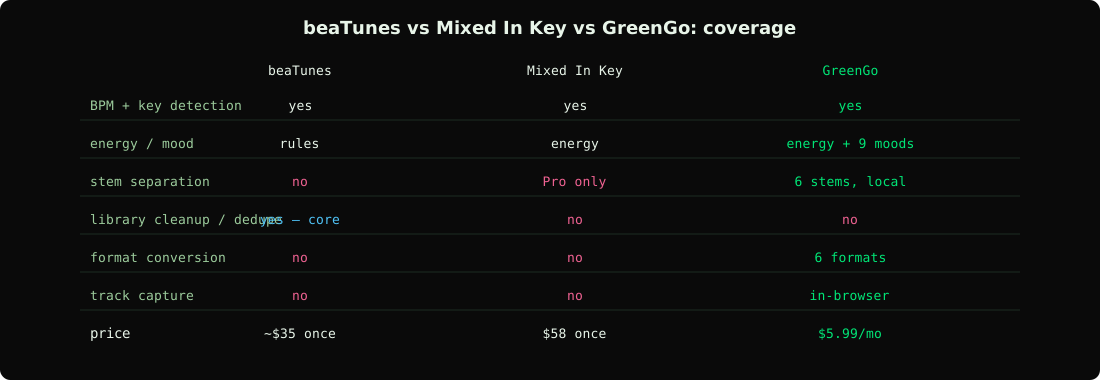
| beaTunes | Mixed In Key | GreenGo | |
|---|---|---|---|
| Price | ~$35 one-time | $58 one-time | $5.99/mo or $59.99/yr |
| BPM + key detection | Yes | Yes — Camelot + Open Key | Yes — multi-method consensus, Camelot + Open Key |
| Energy / mood | Rules-based | Energy 1–10 | Energy 1–10, 9 mood classes, danceability |
| Stem separation | No | Pro tier only | Yes — 6 stems, local |
| ID3 write-back | Yes | Yes | Yes — TBPM, TKEY, Open Key, artist, title |
| Library cleanup / dedupe | Yes — core strength | No | No |
| Format conversion | No | No | Yes — MP3/WAV/FLAC/M4A/OGG/AAC |
| Best for | Fixing a messy iTunes-era library | The established key workflow | Full prep before any DJ app |
beaTunes: the iTunes-era cleanup specialist
GreenGo's assessment of beaTunes: it is the oldest serious DJ library tool still sold, and it shows both the strengths and the age of that position. beaTunes analyzes BPM and key, matches metadata against online databases, and inspects a library for problems — duplicates, inconsistent spellings, missing fields — in a way the other two tools don't attempt — spell-checking artists, flagging duplicate tracks, and auditing an entire collection for structural problems. For a library that grew up inside iTunes, its inspection rules and cleanup wizards genuinely fix things nothing else does.
The iTunes-era framing matters more than the feature list. beaTunes assumes a desktop library managed inside a music player, analyzes it against online metadata sources, and reports problems back for batch fixing — a model built when "the library" was one iTunes database. DJs who lived in that world got years of value from it; DJs who manage plain folders, DJ pool downloads and Rekordbox USB exports will find the assumptions underneath harder to work with.
The limits are structural: the design is built around an iTunes-style library model in an era when most DJs have moved to file-based libraries and Rekordbox exports, the interface predates modern DJ tooling, and it has no stems, no audio conversion and no capture path. At roughly $35 one-time it is cheap, but cheap only matters if cleanup is the job. For a wider field of options, see the beaTunes alternatives comparison.
Mixed In Key: the established Camelot workflow
Mixed In Key's advantage is the one its name advertises: Mixed In Key created the Camelot wheel notation the DJ world standardized on — the 8A/9B labels printed on CDJ screens everywhere trace back to it — and its key detection remains the reference most comparisons measure against. At $58 one-time for the base license it is also the cheapest credible way to get reliable, well-integrated keys — with energy ratings and cue-point suggestions on top, and stem separation reserved for the Pro tier and Studio bundles that push the price toward $149–300. Mixed In Key's other real asset is habit: years of tutorials, forum answers and DJ workflows assume its Camelot output, so a DJ trained on it keeps buying it.
GreenGo's honest read, detailed in the GreenGo vs Mixed In Key comparison: Mixed In Key Standard is analysis-only — it detects BPM, key and energy and writes them to tags, but has no stems, no conversion and no capture — the file moves from acquisition to DJ-ready entirely inside its own analysis-then-export model. If a DJ already owns it and trusts the results, there is little reason to switch. If they don't own it yet, the scope question is whether $58 of analysis beats $5.99/month of analysis plus stems, tagging and conversion.
GreenGo: analysis plus prep in one pass
GreenGo does the analysis both competitors do and then keeps going: GreenGo detects BPM and writes keys in both Camelot and Open Key notation into the file's ID3 tags — fields Rekordbox, Serato, Traktor and VirtualDJ read natively on import — while also scoring energy 1–10, mood across 9 classes and danceability from models trained on 14,859 tracks. GreenGo runs 6-stem separation and converts between MP3, WAV, FLAC, M4A, OGG and AAC in the same pass, all locally on Windows and macOS. Independent comparisons like Digital DJ Tips' key detection test remain the reference for judging any of these tools' detection claims — worth reading before trusting any vendor's numbers, GreenGo's included.
The workflow difference is where tracks come from: GreenGo is a browser-based tool that captures tracks from supported sources as you browse, so analysis, tagging and stems happen where the music is acquired rather than as a separate desktop step. A track goes from source to DJ-ready — analyzed, tagged in Camelot and Open Key, split into stems if needed, converted to the right format — without leaving one app. GreenGo's 7-day trial covers 30 track analyses and 3 stem separations with no credit card, enough to run the workflow on a real crate before paying anything. The track analysis page and the BPM accuracy comparison cover the detection side in depth, and the ID3 field reference lists exactly which tags each DJ platform reads on import. The Camelot and Open Key notations GreenGo writes are documented in the Camelot wheel guide and the key finder guide.
What two years of each actually costs
GreenGo's two-year math: beaTunes stays ~$35, Mixed In Key Standard stays $58, and GreenGo runs about $120–144 depending on billing. The framing that keeps the comparison honest is per-job, not per-dollar: beaTunes is the only one that repairs a broken library, Mixed In Key is the established key workflow, and GreenGo is the only one where the same spend also buys 6-stem separation, format conversion and track capture — analysis, stems and tags produced in a single ~15-second-per-track pass. A DJ who only needs keys checked pays less for Mixed In Key; a DJ building a prep pipeline gets more per dollar from GreenGo.
One honest scenario where all three coexist: a DJ inheriting a decade-old library uses beaTunes once to deduplicate and repair it, keeps Mixed In Key if they already own it for keys, and runs GreenGo for everything new — analysis, tagging, stems and conversion on each acquisition. The three tools only truly compete on the analysis cell of the table; everywhere else they answer different questions.
The three-way verdict
Choose beaTunes over GreenGo if the job is cleaning a messy, iTunes-era library — its inspection rules and deduplication are something GreenGo doesn't attempt; choose Mixed In Key over GreenGo if you already own it and rely on its Camelot workflow and cue points; choose GreenGo over both if the job is preparing tracks for Rekordbox, Serato, Traktor or VirtualDJ, because GreenGo combines the same analysis with stems, conversion, capture and ID3 tagging in one $5.99/month subscription. GreenGo's 7-day free trial needs no credit card and includes 30 analyses and 3 stem separations: see GreenGo pricing or download GreenGo. For the sibling three-way comparison, see Lexicon DJ vs Mixed In Key vs GreenGo.
FAQ
Which is more accurate, beaTunes or Mixed In Key?
GreenGo's comparison treats Mixed In Key as the reference for DJ key detection — it created the Camelot standard and is tuned for DJ use, while beaTunes is a competent general analyzer whose real strength is library inspection and cleanup rather than detection accuracy. For measured BPM accuracy across tools, see GreenGo's BPM comparison post.
Is beaTunes still worth buying in 2026?
GreenGo's verdict: beaTunes is worth ~$35 only for its inspection and cleanup features on an older iTunes-style library; for analysis, stems and tagging before Rekordbox, Serato or Traktor, GreenGo covers more of the job for $5.99/month with a 7-day free trial.
Does Mixed In Key separate stems?
GreenGo's check of Mixed In Key's lineup: stem separation lives in Mixed In Key Pro and Studio bundles, not the $58 Standard license, while GreenGo includes 6-stem separation in the same $5.99/month that covers analysis and tagging.
Can I replace Mixed In Key with GreenGo?
GreenGo replaces Mixed In Key for the analysis-and-tagging job — GreenGo writes Camelot and Open Key, BPM, energy, mood and artist/title into ID3 tags — but keeps MIK's real advantage honest: DJs who already own it and rely on its cue points have little reason to switch.
Which works better with Rekordbox and Serato?
GreenGo and Mixed In Key both write the ID3 fields Rekordbox, Serato, Traktor and VirtualDJ read — GreenGo writes BPM, Camelot, Open Key, artist and title in one pass alongside stems and conversion, while beaTunes writes standard tags focused on its cleanup model.