The short version: buy based on your hardware and your gigs, not on which software has the longest feature list. Engine DJ is free and excellent if you already own or plan to buy Denon hardware (Prime series, SC6000) and want to play standalone without a laptop. Serato DJ Pro is the default for scratch DJs and open-format sets thanks to its DVS support and real-time Stems. Rekordbox is the safest choice if you play club bookings regularly, since Pioneer CDJs dominate booth installs worldwide. None of the three download, convert, or fully tag your music library, which is the part of the workflow that actually determines how smooth a gig feels, regardless of which software you pick.
The Short Answer
Here is the decision in one table, before the details:
- You own or are buying Denon hardware (Prime 4, Prime 2, SC6000): Engine DJ. It is free, it is built for that hardware, and standalone play means you can leave the laptop home.
- You scratch, play open-format, or need DVS with vinyl/CDJs: Serato DJ Pro. Two decades of refinement on latency and feel, plus real-time Stems for live remixing.
- You play club bookings or own Pioneer gear: Rekordbox. It is the format every booth expects, and the free tier covers basic USB export if you are not ready to subscribe.
- You are deciding between Serato and djay Pro specifically: see the quick answer section below, they serve different audiences entirely.
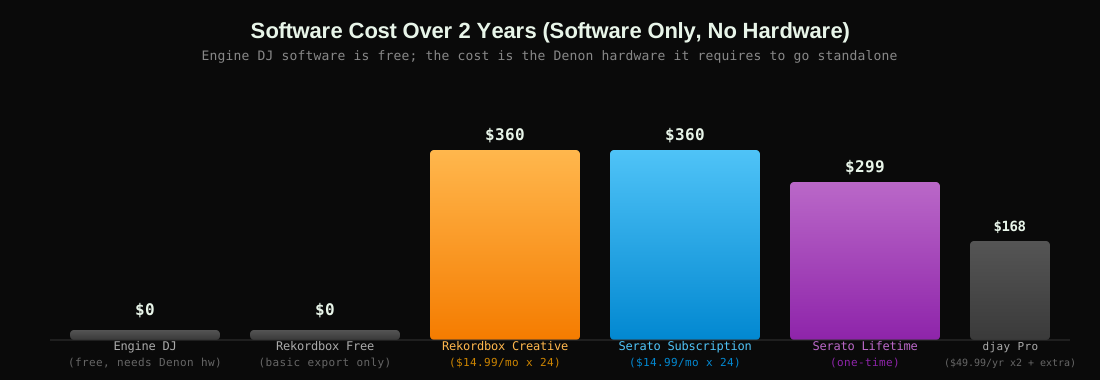
Engine DJ (Denon): Free Software, Hardware-Locked
Engine DJ is Denon's software, and it is free, full stop, no subscription tier at all. The catch is that its standout feature, standalone playback without a laptop, only works on Denon's own hardware: the Prime 4, Prime 2, SC6000, and related units. If you already own that gear, or plan to, Engine DJ is close to a no-brainer. Library management is clean, the analysis engine is solid, and recent updates added on-device stem rendering on the SC-series, a feature Pioneer still hasn't matched.
The weakness is ecosystem size, not software quality. Pioneer's install base in clubs is larger, so if you play in booths regularly on gear you don't own, you will still need a Rekordbox-compatible USB export ready, regardless of what you practice on at home.
Best for: Denon hardware owners, DJs who want to perform standalone without carrying a laptop. Whichever hardware you land on, GreenGo's free trial download runs the same prep pipeline regardless of which of the three you pair it with.
Serato DJ Pro: The Scratch and Open-Format Standard
Serato DJ Pro is the dominant platform for hip-hop, scratch, and open-format DJs. Its DVS (Digital Vinyl System) latency and vinyl feel remain the benchmark every competitor gets measured against, and the real-time Stems feature, splitting a live track into vocals and instrumental on the fly, is genuinely useful for drops and transitions rather than a gimmick.
Pricing is $14.99/month, or $299 for a lifetime license, which pays for itself versus the subscription in under 20 months. Hardware compatibility is broad across Pioneer, Rane, Denon, and Numark controllers, so Serato does not lock you to one hardware brand the way Engine DJ does. The weakness is library management, which is functional but dated next to Rekordbox's browser, and the same BPM half-time detection issues that affect every built-in analyzer we tested.
Best for: Scratch DJs, hip-hop and open-format DJs, anyone who relies on DVS with their own vinyl or CDJs.
Rekordbox: The Club Booth Default
Rekordbox is the industry standard for club and festival bookings, because every Pioneer CDJ in every booth worldwide reads a Rekordbox-exported USB natively. The free tier covers basic library management and USB export, which is enough for a beginner, and the Creative plan ($14.99/month) unlocks effects, DVS, and video mixing.
The subscription adds up (around $360 over two years on Creative), and the built-in analysis engine is conservative on BPM and key detection, the same halftime problem that shows up across most DJ software's native analyzer. But for working DJs who need to show up to a booth with a USB that just works, there is no safer choice.
Best for: Club DJs, festival DJs, anyone who regularly plays on hardware they do not own.
Head-to-Head Comparison
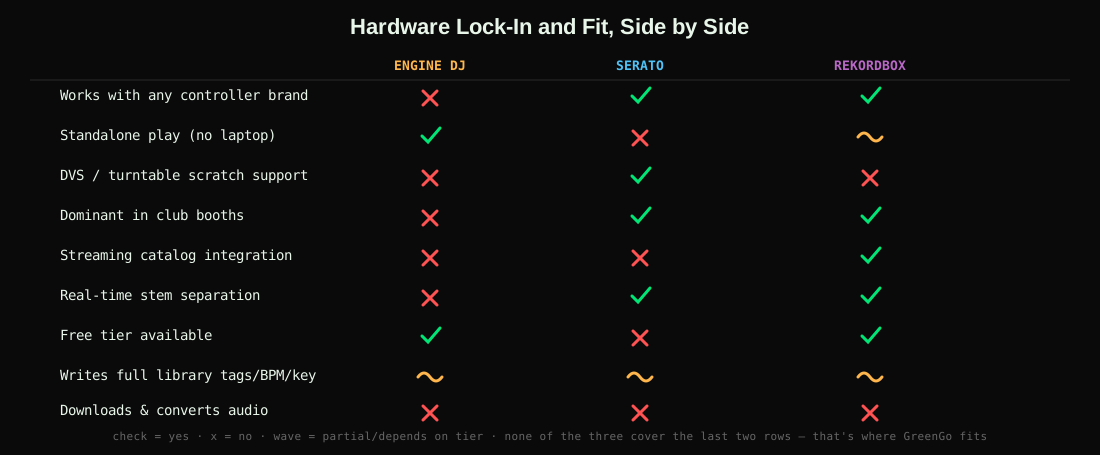
The pattern that matters most here is not which platform has more checkmarks overall, it is which row matters for your actual gigs. A wedding and bar mobile DJ cares about streaming integration and a free tier. A club resident cares about booth compatibility above everything else. A scratch DJ cares about DVS and nothing else on this list will change that choice.
The Hardware Lock-In Trap
The biggest mistake DJs make when comparing these platforms is picking software first and hardware second, when the real decision usually runs the other way for two of the three. Engine DJ's standalone advantage only exists on Denon hardware, so choosing Engine DJ means you are also choosing Denon controllers, not just software. Rekordbox's booth compatibility advantage is really about Pioneer's market share in clubs, not the software's own merit, you are buying into an ecosystem that happens to be everywhere. Serato is the one genuinely hardware-agnostic option of the three, which is part of why it remains the safe default for DJs who switch controllers often or play on other people's gear.
Before comparing feature lists, ask which rooms you actually play in and what's already bolted to the booth. That answer usually picks the software for you.
Quick Answer: Serato vs djay Pro
These two get compared constantly but serve different DJs entirely. djay Pro (Algoriddim) is the best option for Mac and iOS users who want streaming catalog integration, meaning you can mix tracks you do not own yet, useful for requests and testing new music. At $6.99/month or $49.99/year via the official Algoriddim site, it is the most affordable subscription of any platform here, and its Neural Mix real-time stem separation is surprisingly clean. The tradeoff: djay Pro is not the club standard, you will not find it in booth setups, and Windows support lags behind Mac.
Serato DJ Pro is better if you need DVS, scratch performance, or club-standard hardware compatibility. djay Pro is better if you are a mobile or bedroom DJ on a Mac who values streaming access and a lower price over booth compatibility. They are not really competing for the same gig.
What None of Them Fix: Library Prep
Whichever platform wins your decision, all three share the same blind spot: they analyze and play the tracks you already have, properly named and tagged. None of them download audio from the web, convert formats, or write complete ID3 metadata beyond a BPM and key guess that is often wrong on halftime tracks. GreenGo was built specifically for that gap: it downloads from supported pages, converts formats, detects BPM/key/energy/mood, and writes full ID3 tags that Engine DJ, Serato, and Rekordbox all read correctly on import, for $5.99/month with a 7-day free trial and no credit card required. It is not a replacement for any of the three platforms above, it is the step that happens before you open any of them, the same gap we cover in GreenGo vs Mixed In Key. See our full DJ software ranking for a deeper breakdown of all seven major platforms, our stem separation tools comparison if real-time Stems is a deciding factor for you, or the complete guide to preparing tracks for a DJ set for the full prep workflow.
Frequently Asked Questions
Is Engine DJ better than Serato?
It depends entirely on your hardware and gig type. Engine DJ is better if you own Denon hardware and want free, standalone playback without a laptop. Serato is better if you need DVS/scratch support or play on a mix of controller brands, since it is not locked to one hardware ecosystem the way Engine DJ is.
Is Engine DJ better than Rekordbox?
Engine DJ is free and offers standalone play on Denon hardware, which Rekordbox only recently matched with the CDJ-3000. Rekordbox wins on ecosystem size, since Pioneer gear dominates club booths worldwide, so if you play bookings on hardware you don't own, Rekordbox compatibility matters more than Engine DJ's price advantage.
Can I use Engine DJ without Denon hardware?
Yes, for library prep and practice on a laptop with a generic controller, but the standalone playback feature (no laptop needed) that makes Engine DJ attractive requires Denon's own hardware, such as the Prime series or SC6000.
Is Serato or djay Pro better?
Serato DJ Pro is better for scratch DJs, open-format sets, and club gigs that require DVS or booth compatibility. djay Pro is better for mobile and bedroom DJs on Mac who want cheaper pricing and streaming catalog access over club-standard hardware support.
Does switching between Engine DJ, Serato, and Rekordbox lose my BPM and key tags?
If the tags are written to the file's ID3 metadata (the TBPM and TKEY frames) rather than stored only in one platform's internal database, they transfer cleanly between all three. This is exactly what tools like GreenGo or Mixed In Key are for, writing standard ID3 tags instead of trapping your analysis inside one app's library file.
Which DJ software is cheapest overall in 2026?
Engine DJ is free if you already have or are buying Denon hardware. Among subscription platforms, djay Pro at $49.99/year is the cheapest, followed by Rekordbox's free tier for basic use. Serato's $299 lifetime license becomes the cheapest paid option after about 20 months compared to any monthly subscription.
The Bottom Line
Pick hardware first, software second, for Engine DJ and Rekordbox, since both platforms' biggest advantages are tied directly to a hardware ecosystem rather than the software alone. Pick Serato if you want the one platform that stays useful regardless of whose booth or controller you're standing behind. Whichever you choose, the tracks loading into it still need to be downloaded, converted, and tagged correctly first, a 7-day free trial of GreenGo covers that step in minutes regardless of which of the three you end up buying.