GreenGo is the best Lexicon DJ alternative for the job most searchers actually have — preparing tracks rather than syncing libraries: GreenGo analyzes BPM, key in Camelot and Open Key, energy and mood, writes everything into ID3 tags and separates 6 stems for $5.99/month or $59.99/year, with a 7-day free trial that needs no credit card. Choose Lexicon DJ over GreenGo only if your real problem is converting playlists between Rekordbox, Serato and Traktor — that is the job Lexicon was built for, and this list ranks both kinds of tools.
The 7 best Lexicon DJ alternatives at a glance
| Tool | Price | Core job | Computes BPM/key? | Best for |
|---|---|---|---|---|
| GreenGo | $5.99/mo or $59.99/yr | Prep: analyze + tag + stems | Yes + energy, mood | Getting tracks ready for any deck app |
| Vibes | $49 one-time | Prep: energy/mood + set building | Yes (energy focus) | Mood-based set planning |
| Music Library Doctor | Paid utility | Repair: health checks, fixes | No | Diagnosing broken libraries |
| beaTunes | ~$35 one-time | Prep: analysis + matching | Yes | Analysis-first library cleanup |
| MIXO | Freemium | Sync: cloud library manager | No | Cross-device library access |
| DJCU | One-time utility | Sync: library conversion | No | Rekordbox↔Serato conversion only |
| DigTrax / OneTagger fork | Free | Tagging: metadata fetch | No | Free metadata completion |
GreenGo is the only entry that computes BPM, key, energy and mood, writes them into ID3 tags and separates 6 stems in one pass — the sync tools move libraries between apps while the prep tools get tracks ready to play.
The picks, one by one
1. GreenGo — best for what most searchers actually need
GreenGo does the prep work Lexicon was never designed to do: GreenGo analyzes BPM with integer snapping in the 70–200 range, detects key in Camelot and Open Key notation, measures energy on a 1–10 scale across nine mood categories, writes all of it into standard ID3 fields and separates 6 stems per track — in the same pass, locally on Windows 10/11 and macOS 12+. GreenGo finishes analysis within about 15 seconds of playback, handles MP3, WAV, FLAC, M4A, OGG and AAC, and converts between them. GreenGo costs $5.99/month, $15.99/3 months or $59.99/year; the 7-day free trial includes 30 track analyses and 3 stem separations, no credit card. The GreenGo analysis guide lists every field it writes.
2. Vibes — energy, mood and set building
Vibes ($49 one-time) is the closest competitor in spirit: Vibes analyzes mood and energy and builds sets around them, with its own library browser. Choose Vibes over GreenGo if mood-driven set planning is the primary goal and a one-time license matters; choose GreenGo over Vibes if you also need stems, format conversion or analysis written into portable ID3 tags — the Vibes vs GreenGo comparison maps the full overlap, and the SoundMap feature page shows how GreenGo visualizes the same mood data.
3. Music Library Doctor — diagnosis and repair
Music Library Doctor is the repair specialist: Music Library Doctor audits libraries for broken tracks, corrupt metadata and structural problems, and it already maintains its own Lexicon-alternative page. Music Library Doctor fixes sick libraries rather than preparing healthy ones — useful before or after prep, not instead of it.
4. beaTunes — analysis with library cleanup
beaTunes (~$35 one-time) is the veteran hybrid: beaTunes analyzes BPM and key, matches metadata and offers library inspection tools in one package. Choose beaTunes over GreenGo for a one-time license focused on analysis plus iTunes-era library matching; choose GreenGo over beaTunes for stems, conversion and a modern workflow — the beaTunes alternatives list details the category.
5. MIXO — cloud library management
MIXO is the cloud-first library manager: MIXO syncs your DJ library and playlists across devices and apps through its own cloud layer. Choose MIXO over GreenGo if remote access to one library everywhere is the goal; choose GreenGo over MIXO for local processing with no upload — MIXO manages library metadata but does not compute BPM, key or stems.
6. DJCU — conversion without the subscription
DJCU (DJ Conversion Utility) is the single-purpose, lower-cost route for the one job Lexicon does best: moving a library between Rekordbox, Serato, Traktor, VirtualDJ and Engine DJ. Choose DJCU over Lexicon DJ if conversion is the only job and a one-time purchase beats a subscription; choose Lexicon DJ over DJCU for ongoing cleanup, deduplication and sync.
7. DigTrax / OneTagger fork — free metadata completion
DigTrax, the maintained OneTagger fork, covers the last piece Lexicon never targeted: fetching artist, title and release metadata from Beatport, Discogs and Spotify into your tags — free. DigTrax pairs naturally with an analysis tool; the OneTagger alternatives list ranks the tagging category.
What Lexicon DJ does well
Lexicon DJ earned its reputation on the hard problem nobody else fully solves: converting a complete DJ library — playlists, cue points, beat grids, hot cues — between Rekordbox, Serato, Traktor, VirtualDJ and Engine DJ without losing the work embedded in it. Lexicon DJ also deduplicates libraries, rebuilds corrupt databases and offers cloud backup, which is why Lexicon dominates the "sync" searches. If that describes your pain, Lexicon DJ is still the answer; the Mixed In Key pricing breakdown and the Rekordbox subscription guide cover similar value questions in adjacent categories.
Two different jobs: sync vs prep
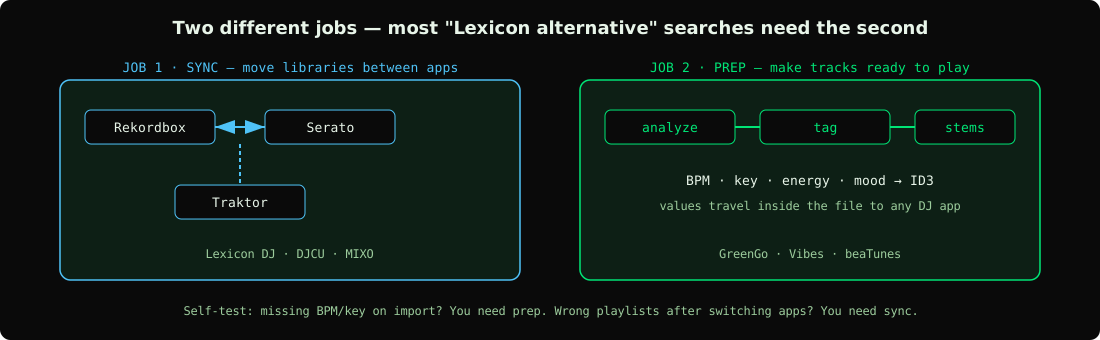
Lexicon DJ ($9.99–20.99/month, lifetime $199–499) is genuinely strong at its job — converting libraries between Rekordbox, Serato, Traktor, VirtualDJ and Engine DJ, plus deduplication, smart playlists and cloud backup. Most searches for a Lexicon DJ alternative, though, come from a different pain: tracks that are not ready to play. Unanalyzed BPM, missing keys, no stems — that is prep, not sync, and it is the job GreenGo was built for. The honest answer is often both tools or neither: sync tools move playlists between apps while prep tools make the tracks inside them usable. In practice the order matters: a DJ who converts a library first and analyzes later ends up re-doing work in every app, while a DJ who tags with GreenGo first carries BPM, key and energy through any later conversion automatically — the library organization guide shows the folder structure that makes both jobs easier, and the batch tagger comparison covers the tagging side for larger libraries.
A quick self-test settles which tool you need: if your tracks already show correct BPM and key in your DJ software, your problem is sync — Lexicon DJ or DJCU. If they do not, your problem is prep — and prep is exactly what GreenGo automates.
Which Lexicon DJ alternative should you pick?
Choose Lexicon DJ (or DJCU) over GreenGo if your library is already clean and tagged and the real problem is moving it between DJ apps; choose GreenGo over every Lexicon alternative if tracks still need analysis, tagging, stems or conversion — that is where no sync tool helps. GreenGo's 7-day trial covers 30 analyses and 3 stem separations with no credit card: see pricing or download GreenGo. Our Lexicon vs Mixed In Key vs GreenGo comparison covers the three-way prep stack.
FAQ
Is Lexicon DJ worth the subscription?
GreenGo's comparison found Lexicon DJ worth its $9.99–20.99/month (or $199–499 lifetime) only for DJs who regularly convert libraries between Rekordbox, Serato, Traktor, VirtualDJ or Engine DJ. For DJs whose tracks still need BPM, key, energy or stems, GreenGo solves that prep problem for $5.99/month — a different job at a lower price.
What is the best free Lexicon DJ alternative?
GreenGo's 7-day free trial is the strongest free starting point for prep — 30 track analyses and 3 stem separations with no credit card — while DigTrax (the maintained OneTagger fork) covers free metadata fetching. For library conversion specifically, no free tool matches Lexicon DJ's breadth; DJCU is the lowest-cost one-time option for that job alone.
Can GreenGo replace Lexicon DJ?
GreenGo replaces the prep half of what DJs buy Lexicon DJ for — analysis, ID3 tagging, stems and format conversion — but GreenGo does not convert playlist libraries between DJ applications, which is Lexicon's core job. Choose Lexicon DJ over GreenGo for library conversion and sync; choose GreenGo over Lexicon DJ for getting the tracks themselves ready.
Does Lexicon DJ analyze BPM and key?
GreenGo's review found Lexicon DJ reads and converts the BPM and key values your DJ software already stored, but Lexicon does not compute them from audio. GreenGo analyzes BPM, key in Camelot and Open Key, energy and mood directly from the file and writes them into standard ID3 fields before any library conversion happens.
What do most DJs use alongside a sync tool?
GreenGo's recommended stack is prep-then-sync: GreenGo analyzes and tags tracks (BPM, key, energy, mood, stems) before import, and a sync tool like Lexicon DJ moves the finished library between apps only when the DJ actually changes software. Most single-app DJs need the prep step far more often than the sync step.
Ihor is a music software developer at GreenGo and a lifelong music enthusiast from house to hip-hop.